

Episode 26 – Monopoly or Competition?

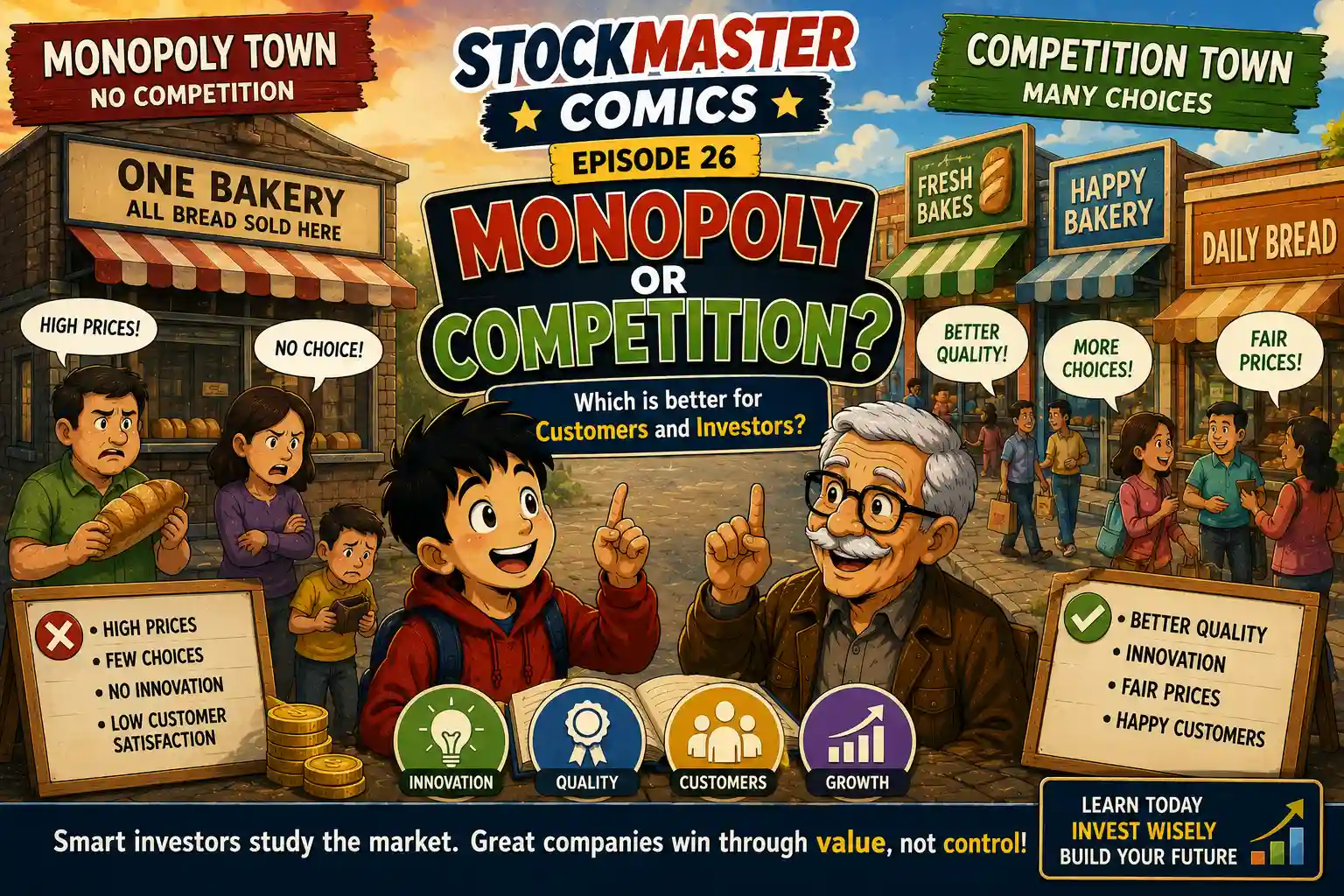
StockMaster Comics Episode 26 Monopoly or Competition featuring Sam and Grandpa Ben comparing Monopoly Town and Competition Town to explain how competition encourages innovation, fair prices, customer value, and long-term business success.

Introduction

After learning what makes a great business, Sam begins noticing that some products have many brands on the store shelf, while others seem to have only one or two choices. Curious, he asks Grandpa Ben, “Is it better when one company controls the whole market, or when many companies compete?”

Grandpa Ben smiles and says, “That’s one of the most important questions every investor should understand.”

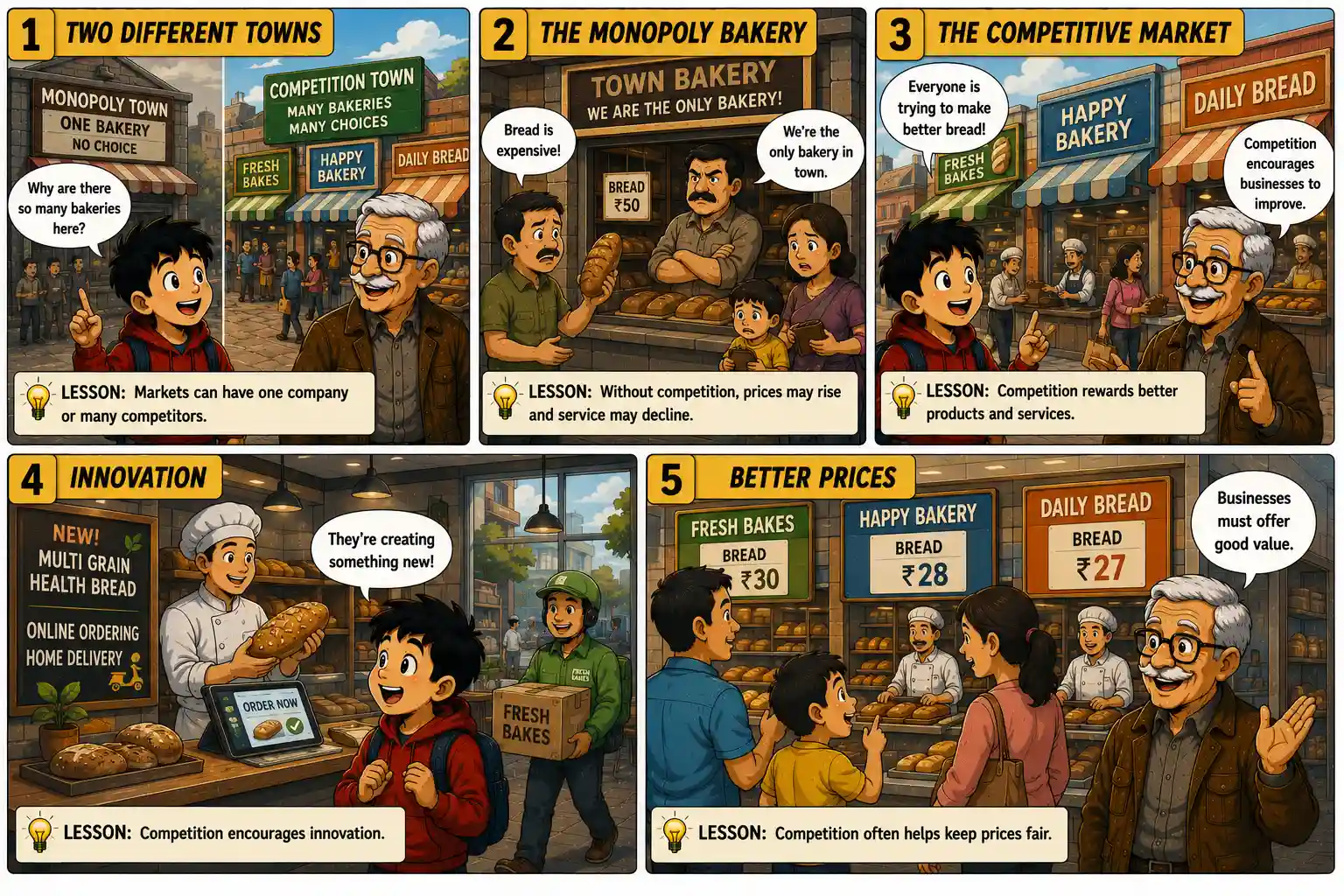
To find the answer, they visit two different towns. In one town, a single bakery sells all the bread. Since there are no competitors, prices are high, quality has stopped improving, and customers have few options.

In the second town, several bakeries compete every day. Each one tries to bake tastier bread, offer better service, introduce new recipes, and keep prices fair. Customers are happier because businesses work harder to earn their trust.

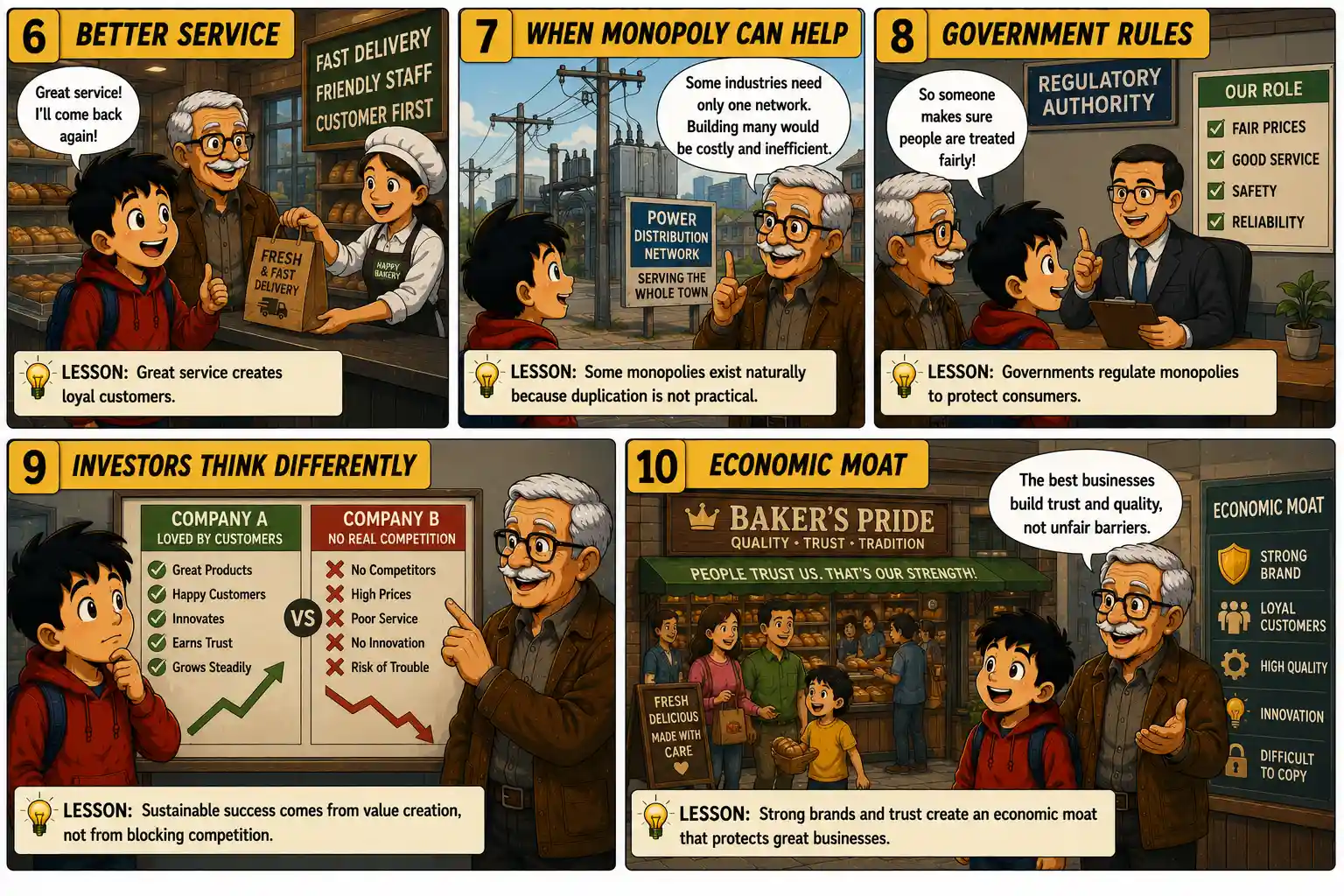
Sam realizes competition pushes companies to become better, while monopoly can sometimes reduce innovation and customer choice. Grandpa Ben also explains that not every monopoly is harmful. Some natural monopolies, such as electricity distribution or railway infrastructure, may exist because building duplicate networks would be impractical. In many countries, governments regulate these industries to protect consumers.

By the end of the day, Sam understands that investors should always ask whether a company wins because it serves customers better—or simply because nobody else can compete.

StockMaster Comics Episode 26 panels 1 to 5 showing two towns, a monopoly bakery, a competitive market, business innovation, and fair pricing to explain how competition benefits customers and companies. StockMaster Comics Episode 26 panels 6 to 10 illustrating customer service, natural monopolies, government regulation, investor analysis, and economic moat concepts using easy-to-understand business examples. StockMaster Comics Episode 26 panels 11 to 15 showing new competitors entering the market, continuous innovation, customer choice, healthy competition versus monopoly, and the importance of investing in businesses that create long-term value.

Lesson Summary

What is a Monopoly and Why Does It Matter?

A monopoly exists when a single company controls most or all of a market, leaving customers with very few or no alternatives. Because there are no strong competitors, the company may have greater power to set prices, decide product quality, and influence customer choices. In some situations, this can result in higher prices, slower innovation, or reduced customer service because the business faces little pressure to improve. However, not all monopolies are harmful. Some industries, such as electricity distribution, water supply, or railway infrastructure, are often called natural monopolies. Building multiple networks for these essential services would be expensive and inefficient. For this reason, governments usually regulate these industries to ensure companies charge fair prices and maintain good service standards. As an investor, understanding whether a monopoly is regulated or unregulated is important because it affects both the company's profitability and the risks it may face in the future.

Why Competition Creates Better Businesses

Competition is one of the strongest drivers of business success. When several companies sell similar products or services, each business must work hard to attract and retain customers. They compete by improving product quality, introducing new ideas, offering better customer service, lowering prices, and building stronger brands. This continuous effort benefits consumers by giving them more choices and better value for their money. Competition also encourages innovation. Companies invest in research, technology, and creative solutions to stay ahead of rivals. Businesses that stop improving often lose customers to competitors who provide better products or experiences. Healthy competition creates a cycle where companies constantly learn, adapt, and improve. For investors, businesses that consistently outperform competitors through innovation, efficiency, and customer satisfaction are often more attractive long-term investments than businesses that rely only on market dominance.

Episode 27 – Why Brands Matter

As Sam walks through a supermarket, he notices something surprising. Two chocolate bars look almost the same, yet one sells much faster than the other—and even costs more! Curious, Sam asks Grandpa Ben, "Why do people choose one brand over another when both products seem similar?" Grandpa Ben smiles and replies, "Because a brand is much more than a name or a logo. It's a promise of quality, trust, and customer experience." Together, they discover how successful companies spend years building strong brands through consistent quality, honest business practices, memorable advertising, and happy customers. Sam also learns that powerful brands often attract loyal customers, charge premium prices, and continue growing even when competitors enter the market. By the end of their journey, Sam realizes that great brands aren't built overnight—they're earned through trust, consistency, and delivering value every single day.

Key Takeaways

  • Competition encourages innovation.
  • Better products usually attract more customers.
  • Customer choice improves markets.
  • Some monopolies are regulated for public benefit.
  • Great businesses earn loyalty through value, not dominance.
  • Long-term investors should study competitive advantages.

Vocabulary

Monopoly – A market dominated by one company.

Competition – Businesses competing to serve customers.

Innovation – Creating better products or services.

Market Share – A company’s portion of total sales in a market.

Economic Moat – A durable competitive advantage that helps protect a business.

Regulation – Government rules that oversee industries.

Smart Investor Tip

Don’t invest in a company simply because it’s the biggest. Invest in businesses that continue to innovate, delight customers, and strengthen their competitive advantage over time.

🏆 Achievement Badge Unlocked: Competition Detective 🕵️📈

Next Episode Preview

Episode 27 – Why Brands Matter

As Sam walks through a supermarket, he notices something surprising. Two chocolate bars look almost the same, yet one sells much faster than the other—and even costs more!

Curious, Sam asks Grandpa Ben, “Why do people choose one brand over another when both products seem similar?”

Grandpa Ben smiles and replies, “Because a brand is much more than a name or a logo. It’s a promise of quality, trust, and customer experience.”

Together, they discover how successful companies spend years building strong brands through consistent quality, honest business practices, memorable advertising, and happy customers. Sam also learns that powerful brands often attract loyal customers, charge premium prices, and continue growing even when competitors enter the market.

By the end of their journey, Sam realizes that great brands aren’t built overnight—they’re earned through trust, consistency, and delivering value every single day.

Coming Next: Episode 27 – Why Brands Matter
Discover how famous brands build trust, create loyal customers, and become valuable businesses that investors love.

Scroll to Top