


Episode 29 – Revenue vs Profit

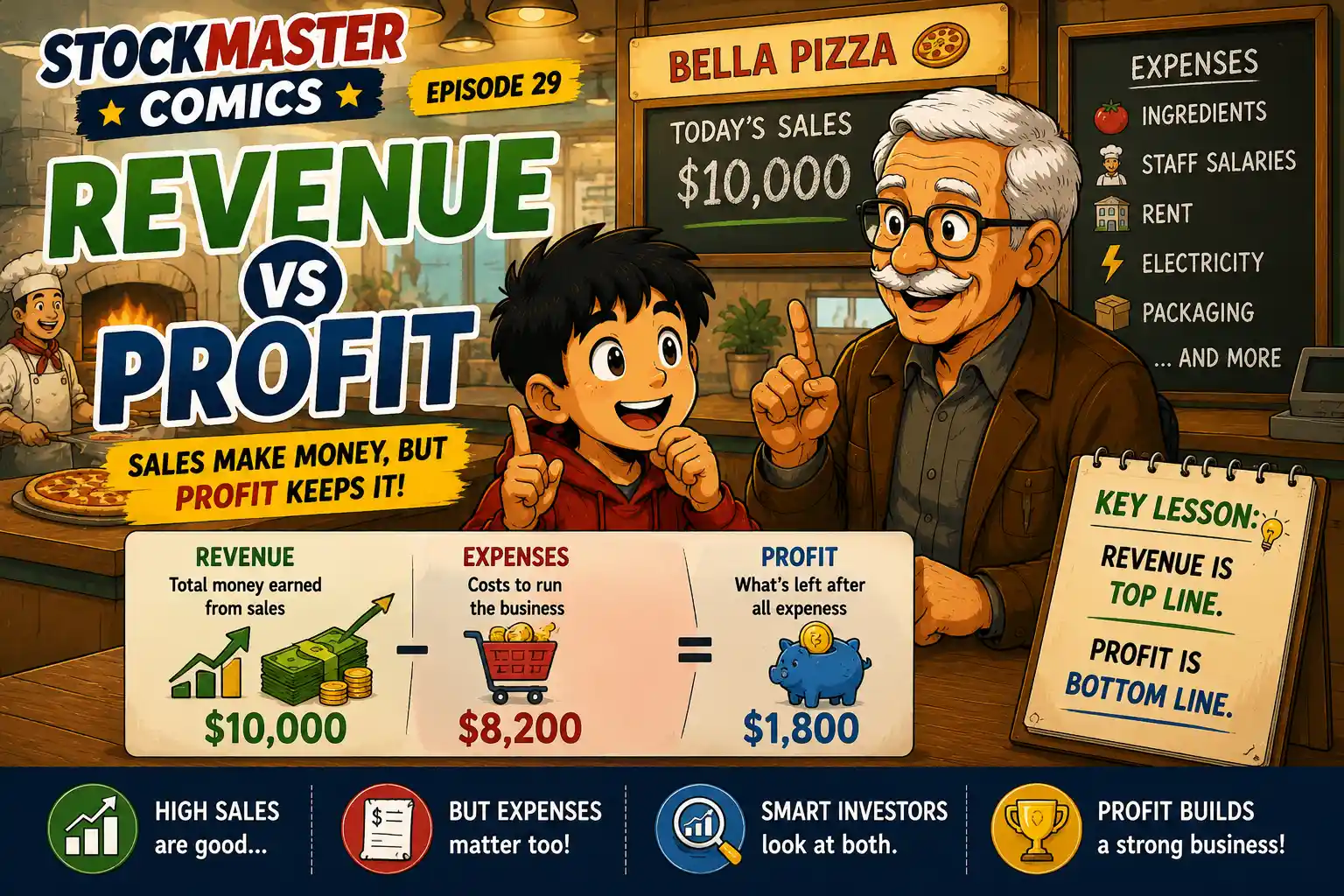
StockMaster Comics Episode 29 – Revenue vs Profit featuring Sam and Grandpa Ben explaining how business revenue, expenses, and profit determine a company's financial success using a pizza shop example.

Introduction

Sam is excited after hearing that his favorite neighborhood pizza shop earned $10,000 in one day. “Wow!” he says. “The owner must be rich!”

Grandpa Ben smiles and replies, “Not so fast, Sam. Earning money and keeping money are two very different things.”

In this episode, Sam learns one of the most important lessons in business and investing—the difference between revenue and profit. Many beginners believe that a company with high sales is automatically successful. However, successful investors know that the real story lies in how much money a company actually keeps after paying all its expenses.

Through a fun visit to a busy pizza restaurant, Sam discovers that ingredients, employee salaries, electricity, rent, taxes, and many other costs all affect a company’s final profit. Even businesses with millions of dollars in revenue can struggle if their expenses are too high.

By the end of this episode, you’ll understand why investors look beyond sales numbers, how businesses earn profits, and why profit is often considered one of the most important measures of a company’s financial health.

Let’s join Sam and Grandpa Ben as they uncover the secret behind every successful business.

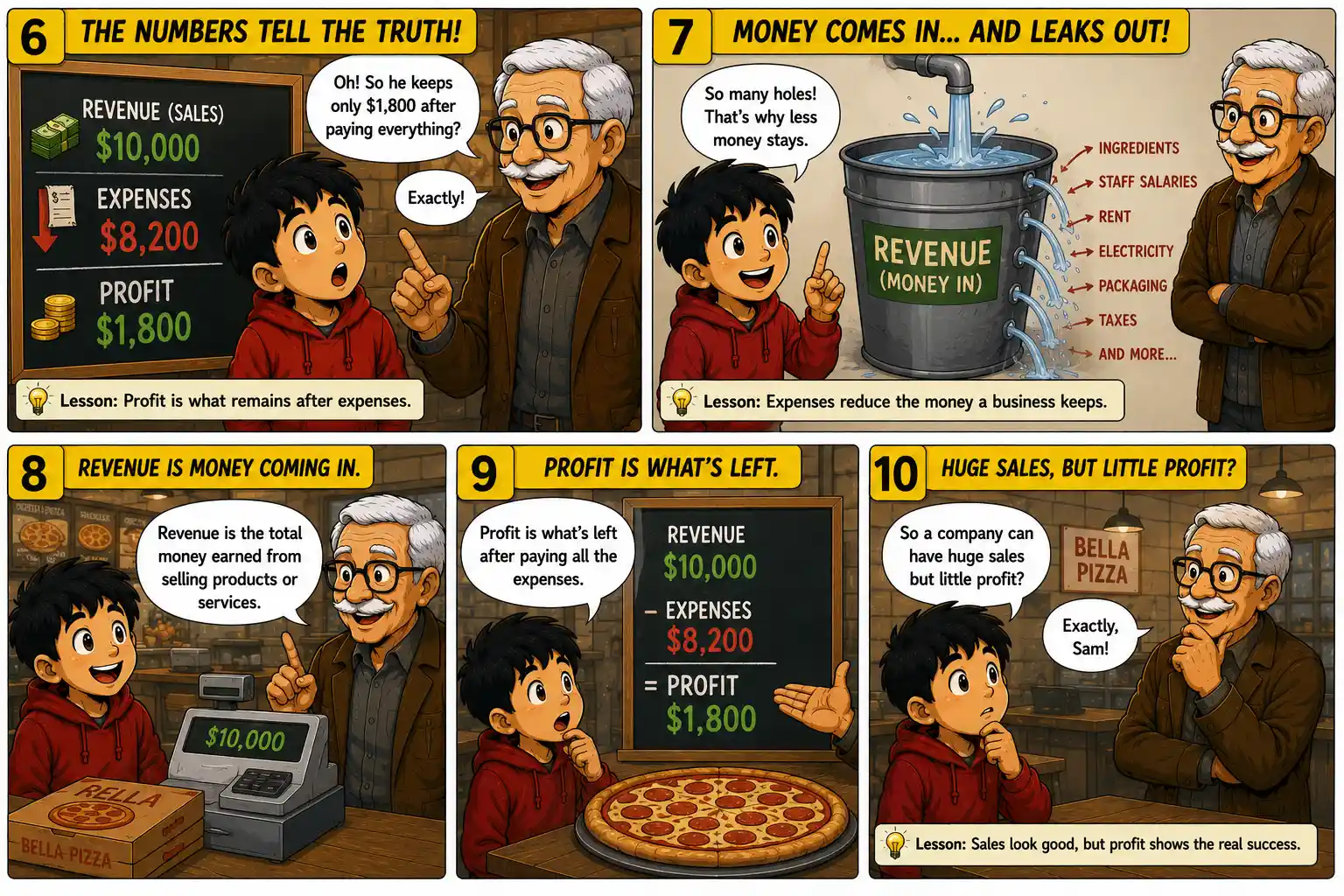
StockMaster Comics Episode 29 panels 1 to 5 showing Sam visiting Bella Pizza and learning that revenue is total sales while profit is the money left after paying business expenses. StockMaster Comics Episode 29 panels 6 to 10 explaining revenue, expenses, and profit with simple business examples to help beginner investors understand company financial statements. StockMaster Comics Episode 29 panels 11 to 15 comparing two businesses with different revenue and profit, teaching why investors analyze profitability instead of sales alone.

Lesson Summary

What Is Revenue?

Revenue is the total amount of money a business earns from selling its products or services before deducting any expenses. It is often called sales or the top line because it appears near the top of a company's income statement. Imagine a bakery sells 500 cakes for $10 each. The bakery's revenue is $5,000. However, this amount does not represent the money the owner gets to keep. The business still needs to pay for ingredients, staff wages, rent, electricity, packaging, taxes, and other operating costs. Growing revenue usually means a company is attracting more customers or selling more products, but revenue alone does not tell us whether the business is making money.

What Is Profit?

Profit is the money remaining after a business pays all of its expenses. It is often called the bottom line because it appears near the bottom of an income statement. Using the bakery example, if the bakery earns $5,000 in revenue but spends $4,200 on expenses, its profit is $800. A company with steady profits usually has more flexibility to invest in new products, hire employees, expand operations, or reward shareholders. Investors often pay close attention to profit because it helps them understand how efficiently a company is operating.

Why Investors Look at Both

Successful investors rarely judge a company using only one number. Revenue shows how much business the company is doing, while profit shows how much value it keeps after covering its costs. Some fast-growing companies increase revenue rapidly but spend heavily on expansion, which can reduce or eliminate profits in the short term. Other businesses may have moderate revenue but strong profit margins because they manage expenses efficiently. Looking at both revenue and profit gives investors a more complete picture of a company's financial performance. Neither figure should be viewed in isolation, and understanding both is an important step toward becoming a smarter investor.

Key Takeaways

  • Revenue is the total money earned from sales.
  • Profit is the money remaining after expenses.
  • High revenue does not always mean high profit.
  • Expenses play a major role in business success.
  • Investors often evaluate both revenue and profit when analyzing companies.

Vocabulary

Revenue – Total income from selling goods or services before expenses.

Profit – Money remaining after all business expenses have been paid.

Expense – Costs incurred to operate a business, such as rent, salaries, and materials.

Income Statement – A financial report showing a company’s revenue, expenses, and profit over a period.

Profit Margin – The percentage of revenue that remains as profit after expenses.

Smart Investor Tip

📊 Don’t be impressed by big sales alone. A great business doesn’t just generate revenue—it manages its expenses effectively and earns sustainable profits. Always consider both revenue growth and profitability when evaluating a company.

Next Episode Preview

Episode 30 – Debt Isn't Always Bad

After learning about revenue and profit, Sam notices that a successful business has taken a large bank loan. Surprised, he asks, “Grandpa, if debt is bad, why would a profitable company borrow money?” Grandpa Ben smiles and explains that not all debt is harmful. Used wisely, debt can help businesses expand, build new factories, develop innovative products, or open new stores. But when borrowed carelessly, it can become a heavy burden. Join Sam as he discovers the difference between good debt and bad debt, why companies borrow money, and how smart investors evaluate debt before investing.

Coming next: Episode 30 – Debt Isn’t Always Bad

Scroll to Top