Episode 46 – Fake News Disaster

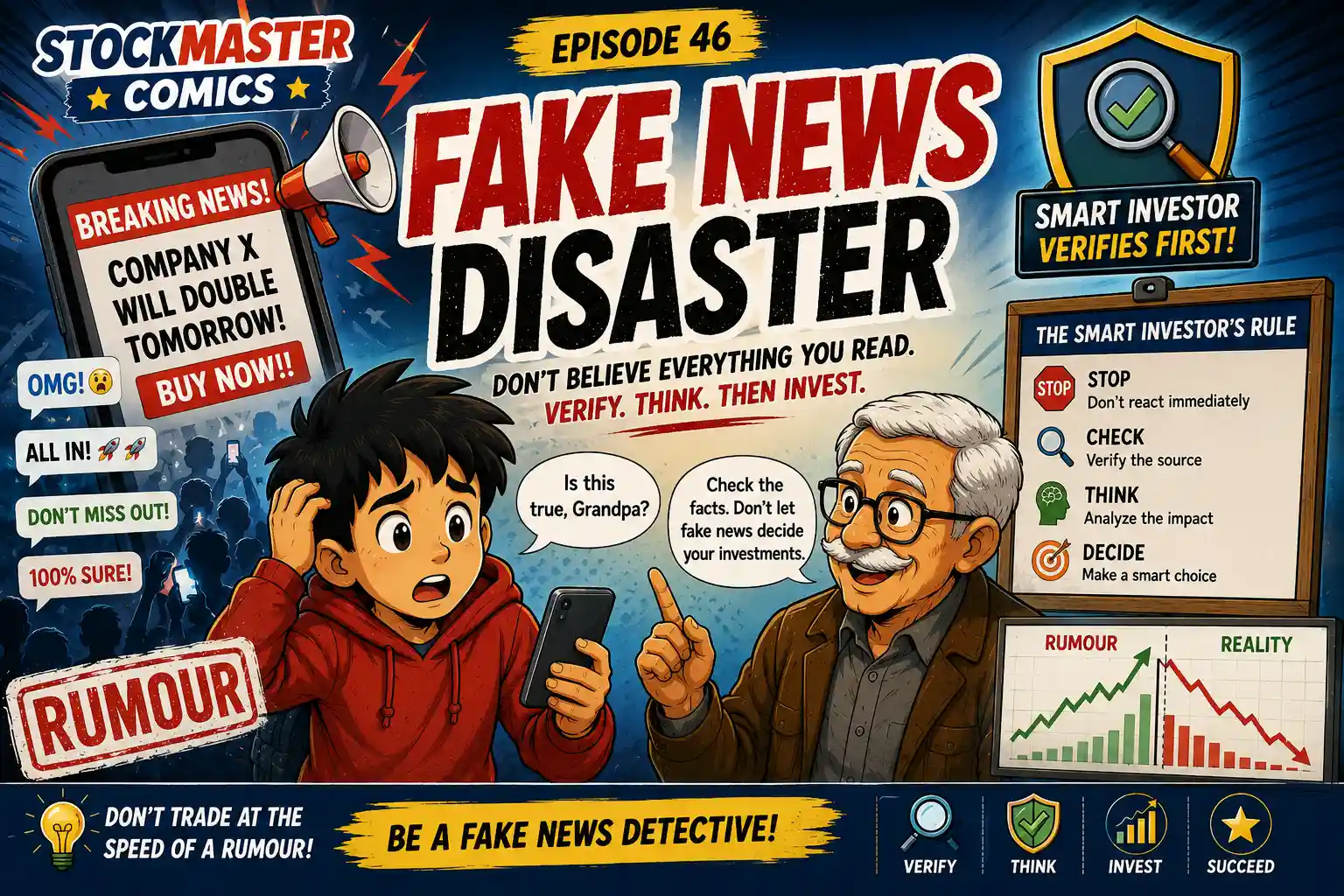
StockMaster Comics Episode 46 Fake News Disaster showing Sam and Grandpa Ben learning to verify financial news before investing.

Introduction

Imagine waking up one morning and seeing a shocking headline:

“Company X Is About to Become the Biggest Company in the World!”

The stock price is already rising. Everyone on social media seems excited. Messages are flying through group chats. People are telling their friends to buy immediately.

But what if the story isn’t true?

In Episode 46 – Fake News Disaster, Sam discovers how quickly false or misleading information can spread through social media, messaging apps, websites, and online communities. A single fake headline can create excitement, fear, or panic—and investors who react without checking the facts can make expensive mistakes.

Grandpa Ben teaches Sam an important lesson: a headline is not the same thing as evidence.

The stock market moves on information and expectations. When investors believe something important has happened, they may buy or sell shares very quickly. But information can sometimes be incomplete, exaggerated, misunderstood, or completely false.

This episode isn’t about ignoring every piece of news. News can be extremely valuable to investors. Instead, it teaches readers how to pause, investigate, verify, and think before making a financial decision.

Whether you’re 15 or 75, the lesson is simple:

Don’t let a shocking headline make your investment decision for you.

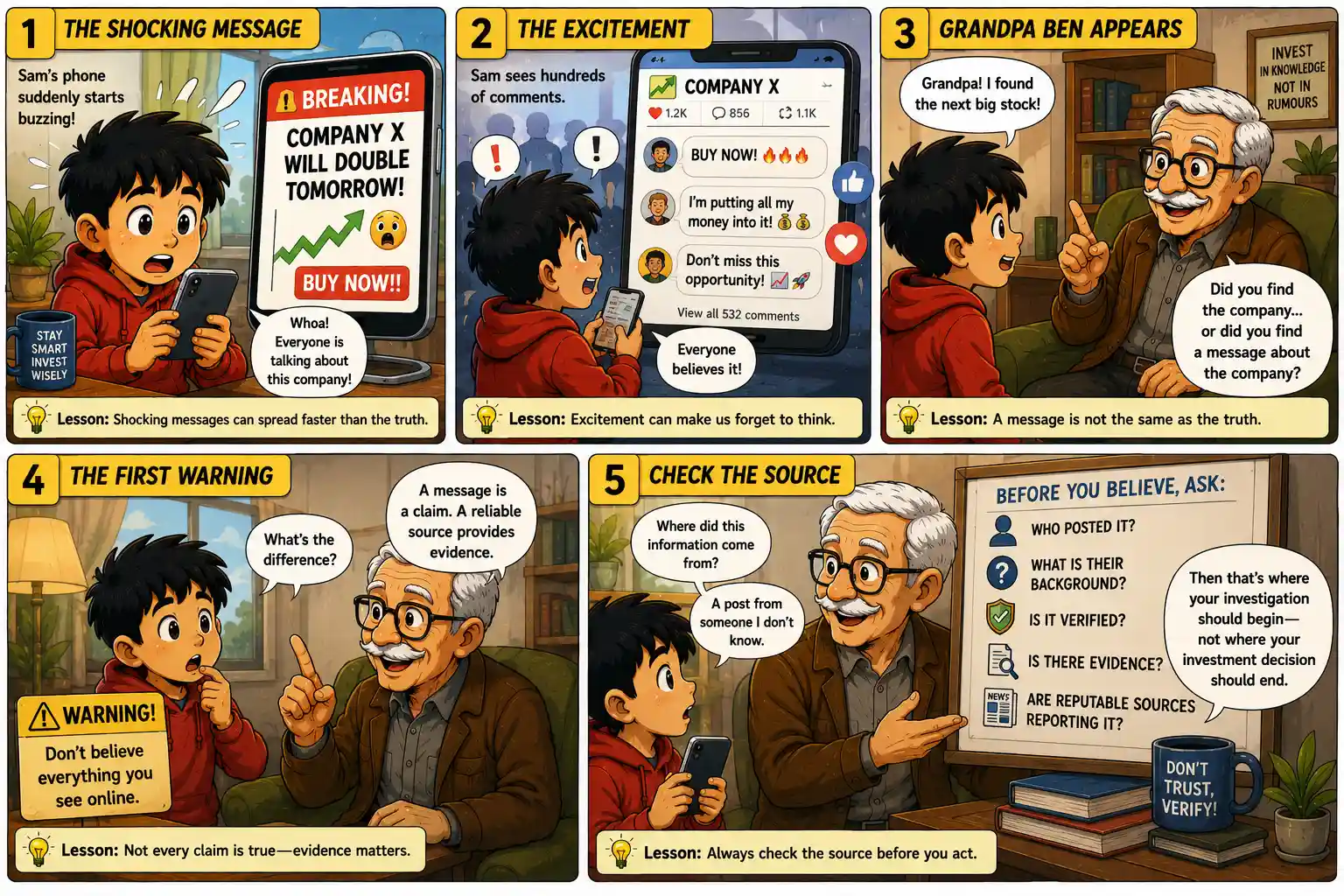
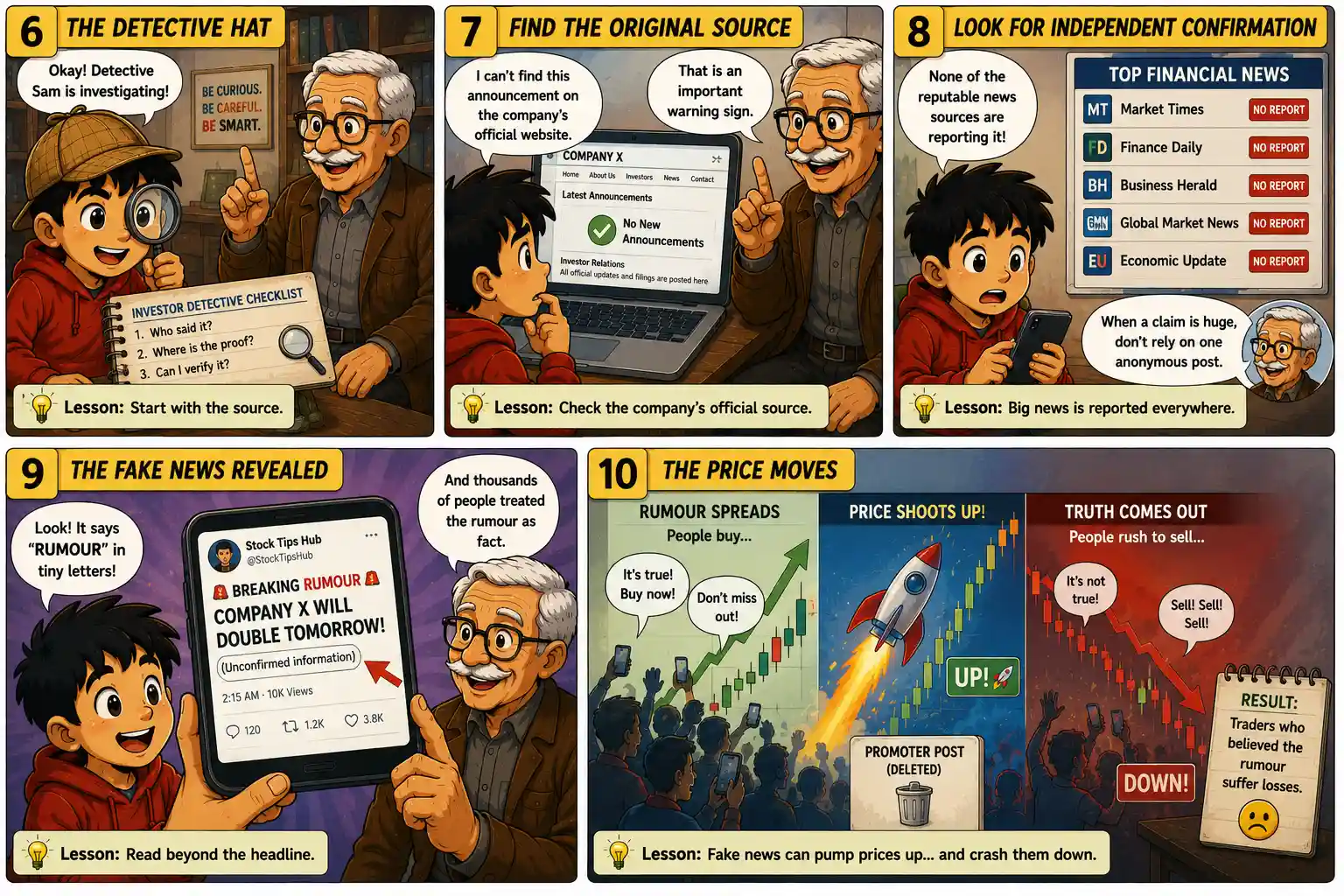
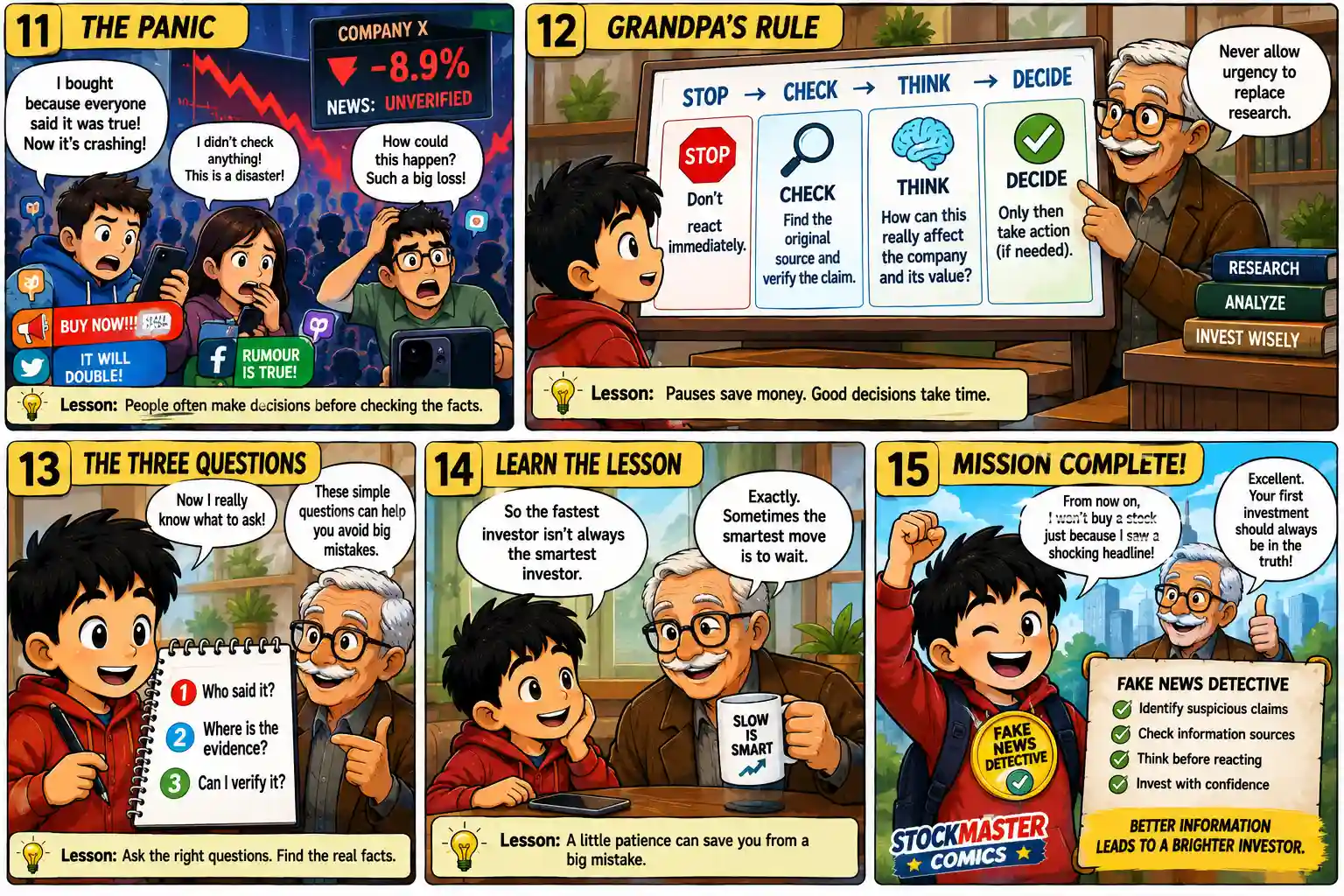
StockMaster Comics panels 1 to 5 showing Sam receiving a shocking stock market message and Grandpa Ben teaching him to check the source. StockMaster Comics panels 6 to 10 showing Sam investigating fake stock news, checking the original source and discovering how rumours can move prices. StockMaster Comics panels 11 to 15 showing Sam learning to stop, check, think and decide before investing and becoming a Fake News Detective.

Lesson Summary

Why Fake News Can Move Stock Prices

Stock prices are influenced by what investors believe about a company's future. News about earnings, products, acquisitions, lawsuits, management changes, government decisions, or other major events can change those expectations. The problem is that not every piece of information circulating online is reliable. A false claim can spread rapidly when people share it without checking the original source. If enough investors believe the story, they may buy or sell a stock based on that information. This can create a sudden price movement even before the truth becomes clear. Social media makes this effect even stronger because information can reach thousands or millions of people within minutes. The important lesson isn't that every online story is false. The lesson is that investors should distinguish information from verified information.

How to Detect a Suspicious Investment Story

Before reacting to a dramatic market claim, become an information detective. Start by asking: Who published it? Is the information from the company itself, a recognised financial publication, a regulator, or an unknown account? Where is the original source? A screenshot of a headline isn't proof. Look for the original announcement or document. Are independent sources reporting it? Important corporate developments are often covered by multiple reputable sources. Does the claim sound too good to be true? Promises such as “guaranteed profits,” “stock will double tomorrow,” or “secret information” should immediately trigger caution. Is someone trying to create urgency? Fake investment stories often use phrases such as “BUY NOW,” “LAST CHANCE,” or “DON'T TELL ANYONE.” These techniques don't guarantee that information is true or false. They simply help investors slow down and investigate before making a decision.

The Smart Investor's Four-Step Rule

Grandpa Ben gives Sam a simple rule: STOP → CHECK → THINK → DECIDE STOP: Don't immediately buy or sell because of a shocking headline. CHECK: Find the original source and verify the claim. THINK: Ask how the information could actually affect the company's business and valuation. DECIDE: Only then decide whether any action makes sense. This approach is useful for investors of every age. The stock market doesn't require you to react to every headline. Sometimes information needs time to be understood. A smart investor doesn't try to be the fastest person in the market. A smart investor tries to be the best-informed person they can be.

Key Takeaways

  • Not everything shared online is reliable.
  • A social-media post is not automatically evidence.
  • Always look for the original source.
  • Check important claims against independent reputable sources.
  • Be especially careful with guaranteed-profit claims.
  • Don’t let urgency control your investment decisions.
  • Verify information before buying or selling.
  • Sometimes doing nothing is better than reacting emotionally.

Vocabulary

Rumour – Information that is being circulated but has not been confirmed.

Misinformation – Incorrect information that is shared, whether intentionally or unintentionally.

Source – The person, organisation, document, or publication from which information originates.

Verification – Checking whether information is accurate and supported by reliable evidence.

Volatility – The degree to which the price of an asset moves up and down over time.

Smart Investor Tip

Never trade at the speed of a rumour.

When a headline makes you excited, frightened, or desperate to act, pause first.

Ask:

“What is the evidence?”

A few minutes of research could save you from making a decision based on a few seconds of emotion.

Next Episode Preview

Episode 47 – Social Media Frenzy

Sam discovers how quickly a stock-market story can explode across social media. One exciting post becomes hundreds of reposts, investors start chasing the crowd, and suddenly everyone wants to buy the same stock. Join Grandpa Ben as he explains social-media hype, herd behaviour, FOMO, and why popularity doesn’t always mean value.

Coming next: Episode 47 – Social Media Frenzy

Scroll to Top