Episode 5 – What Is Interest and Why Does It Matter?

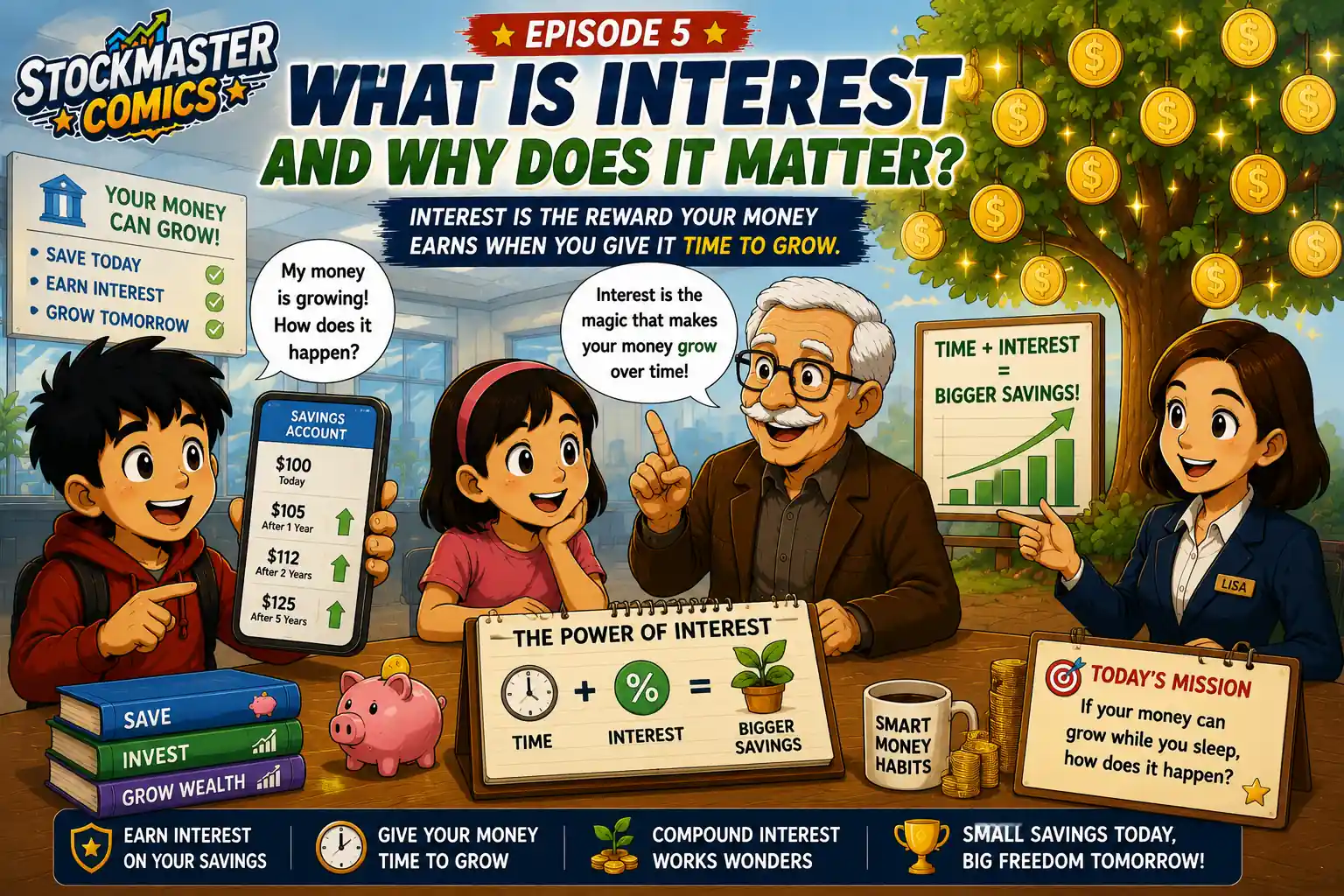
StockMaster Comics Episode 5 hero image showing Sam, Maya, Grandpa Ben, and Bank Manager Lisa explaining how interest helps savings grow over time using charts, a savings account, and a money tree with golden coins.

Introduction

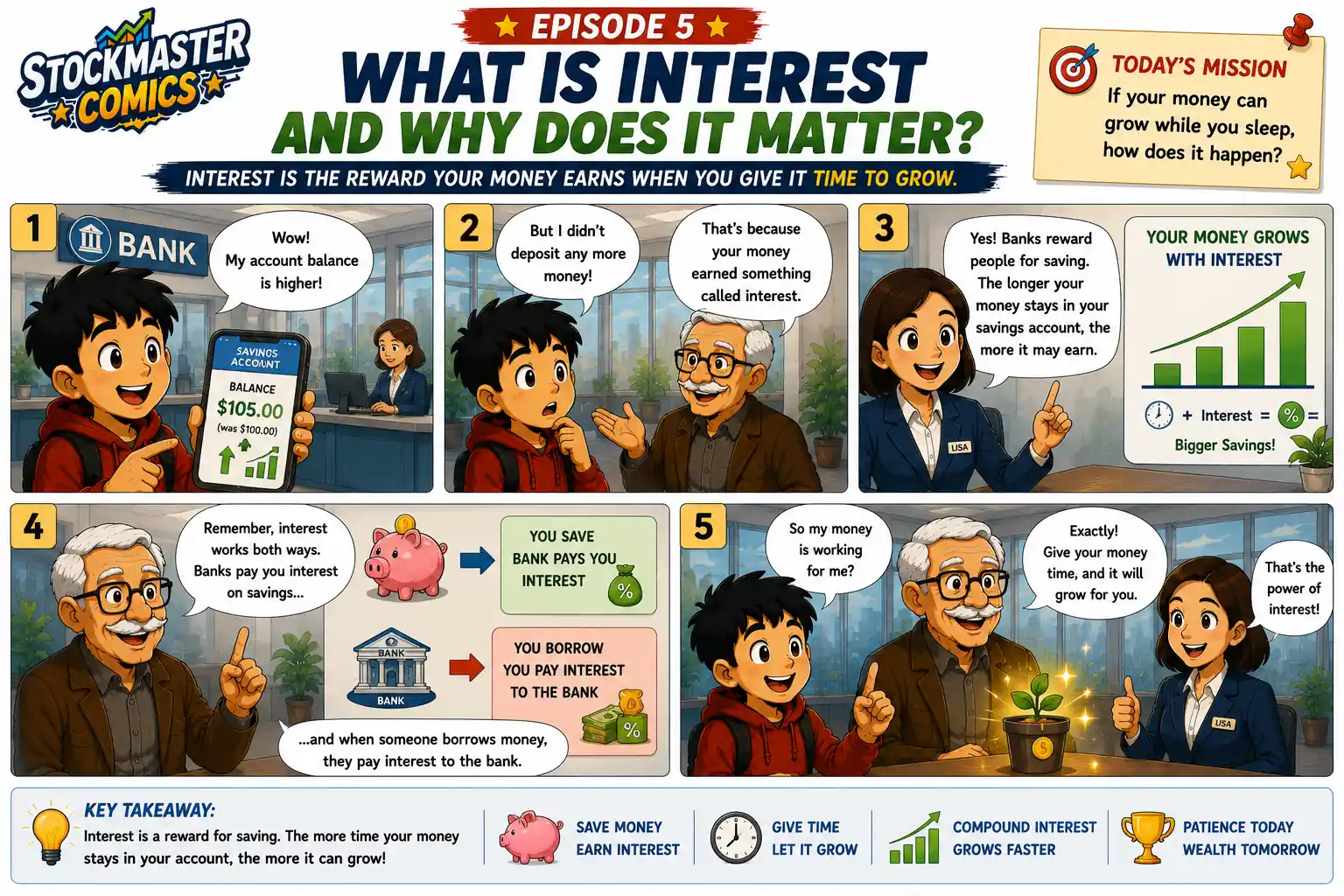
Sam visits the bank to check his savings account and notices something surprising.

“Grandpa Ben, my account balance is higher than before. I didn’t deposit any more money!”

Grandpa Ben smiles.

“That’s because your money earned something called interest.”

Sam is confused.

“So money can make more money?”

Grandpa laughs.

“Yes—but only if you give it enough time.”

Lisa joins the conversation and explains that banks reward people for saving money. The longer money stays in a savings account, the more it may earn. She also explains that interest doesn’t only apply to savings. People who borrow money usually pay interest too.

In today’s adventure, Sam discovers one of the most powerful ideas in personal finance: letting time help your money grow.

By the end of this episode, you’ll understand why investors love patience and why Albert Einstein reportedly called compound interest one of the most powerful forces in finance.

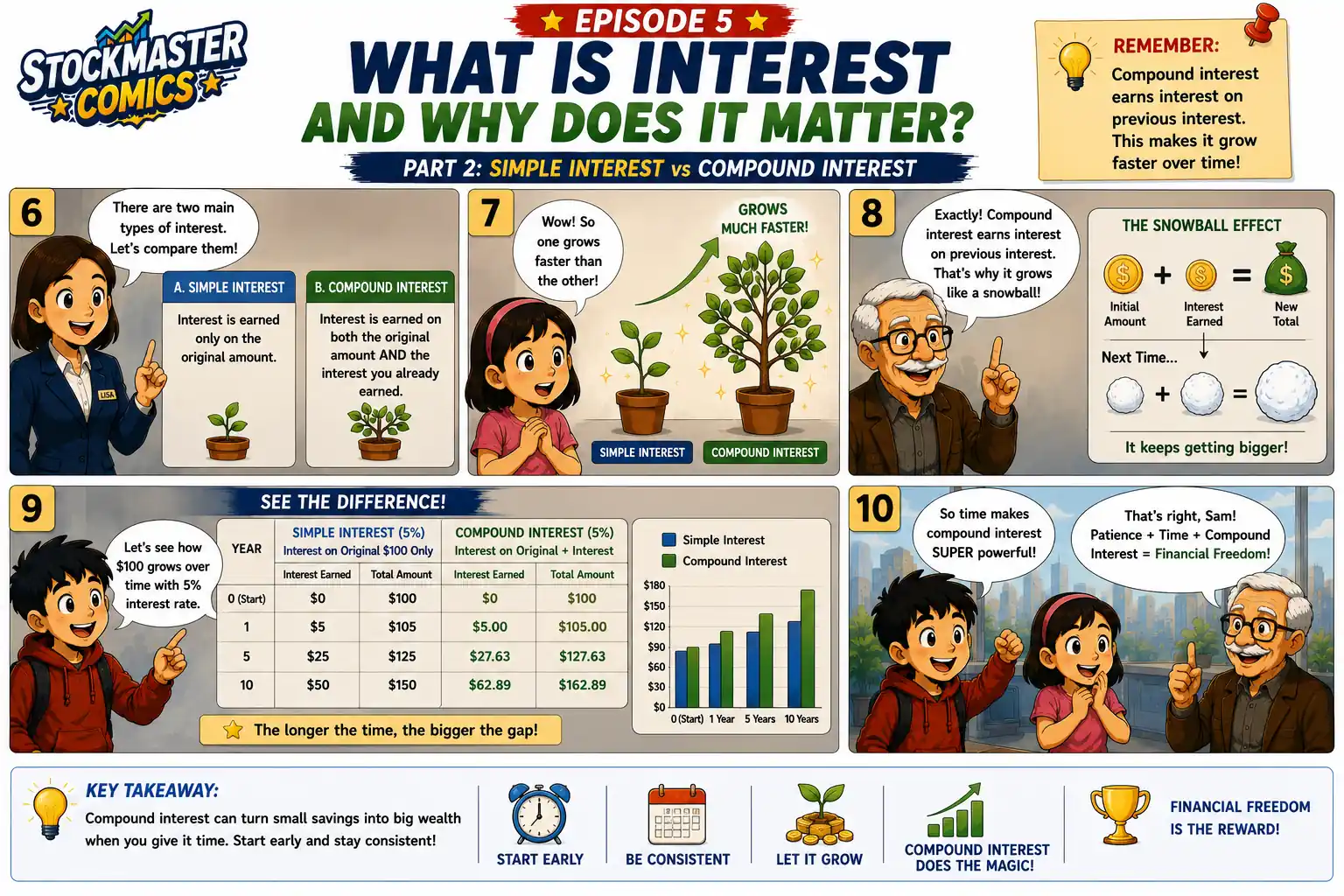
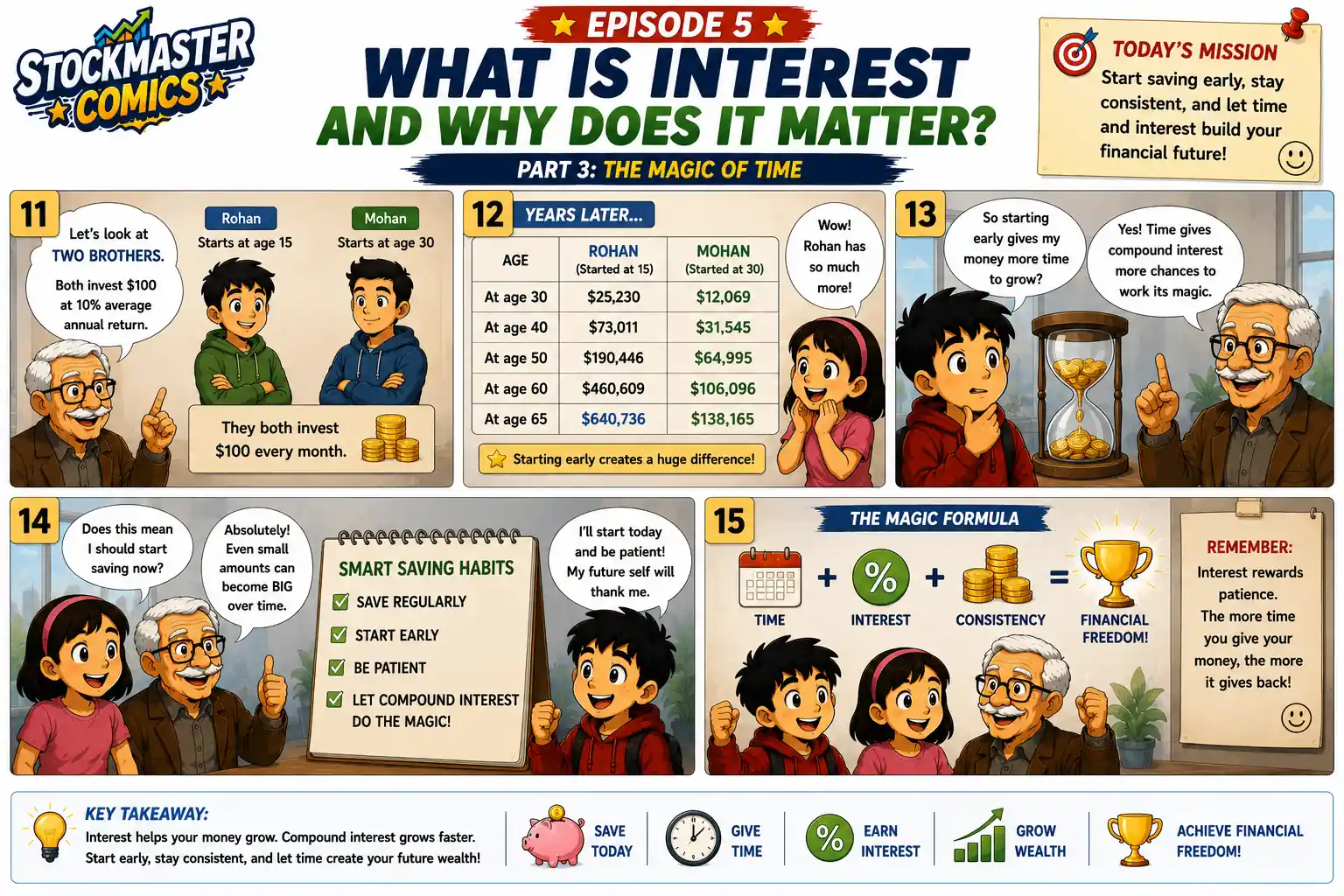
StockMaster Comics Episode 5 comic panels 1–5 showing Sam discovering his bank balance has increased, Grandpa Ben and Lisa explaining that interest is a reward for saving money, and how banks pay interest on savings accounts. StockMaster Comics Episode 5 comic panels 6–10 comparing simple interest and compound interest with easy examples, charts, and illustrations that show how compound interest helps money grow faster over time. StockMaster Comics Episode 5 comic panels 11–15 explaining the power of starting early, showing two investors saving at different ages, and demonstrating how time and compound interest create long-term wealth.

Lesson Summary

What Is Interest

Interest is extra money that is earned or paid when money is saved or borrowed. Think of it as the cost or reward for using money over time. If you keep your money in a savings account, the bank may pay you interest as a reward for allowing it to use your deposit. If you borrow money from a bank, you usually pay interest because you are using the bank's money. Imagine Sam deposits $100 into his savings account. After one year, the bank pays him $5 in interest. Sam now has $105, even though he didn't add any extra money himself. His money grew simply because he gave it time to earn interest.

Simple Interest vs Compound Interest

There are two main ways money can grow through interest: simple interest and compound interest. Simple interest is calculated only on the original amount of money, called the principal. If Sam saves $100 and earns 5% simple interest, he receives $5 every year. After five years, he earns a total of $25, giving him $125. Compound interest works differently. Instead of earning interest only on the original amount, you also earn interest on the interest you've already received. This creates a snowball effect. Every year, your money grows a little faster because the balance keeps getting bigger. For example, if Sam earns compound interest on his $100, the first year he has $105. In the second year, he earns interest on $105, not just the original $100. Over many years, this difference becomes much larger.

Why Starting Early Changes Everything

Imagine two friends who both want to build wealth. Alex begins saving $20 every month at age 15. Ben waits until age 30 to start saving the same amount. Even though Ben saves the same amount each month, Alex's money has fifteen extra years to earn compound interest. Those additional years allow Alex's savings to grow much more because each year's interest earns even more interest in the future. This demonstrates one of the most powerful ideas in personal finance: the earlier you start, the easier it becomes to build wealth.

Key Takeaways

  • Interest helps your money grow.
  • Compound interest grows faster than simple interest.
  • Starting early gives your money more time.
  • Consistent saving builds wealth.
  • Patience is one of the best investing skills.

Vocabulary

Interest — Extra money earned on savings or paid on loans.

Simple Interest — Interest calculated only on the original amount.

Compound Interest — Interest earned on both the original money and previously earned interest.

Principal — The original amount of money invested or saved.

Savings Account — A bank account designed to hold money and potentially earn interest.

Smart Investor Tip

The earlier you begin saving—even with small amounts—the more time compound interest has to work. Time is often more valuable than starting with a large amount.

Next Episode Preview

Episode 6 – Why Do Prices Go Up? (Understanding Inflation)

Sam notices that his favorite chocolate costs more than it did last year. He asks Grandpa Ben, “Why does everything become more expensive?”

Together, they explore inflation, discover why prices change over time, and learn why investing can help money keep up with rising costs.

Coming Next: Why Do Prices Go Up? Understanding Inflation

Scroll to Top