Episode 6 Meet the Stock Market

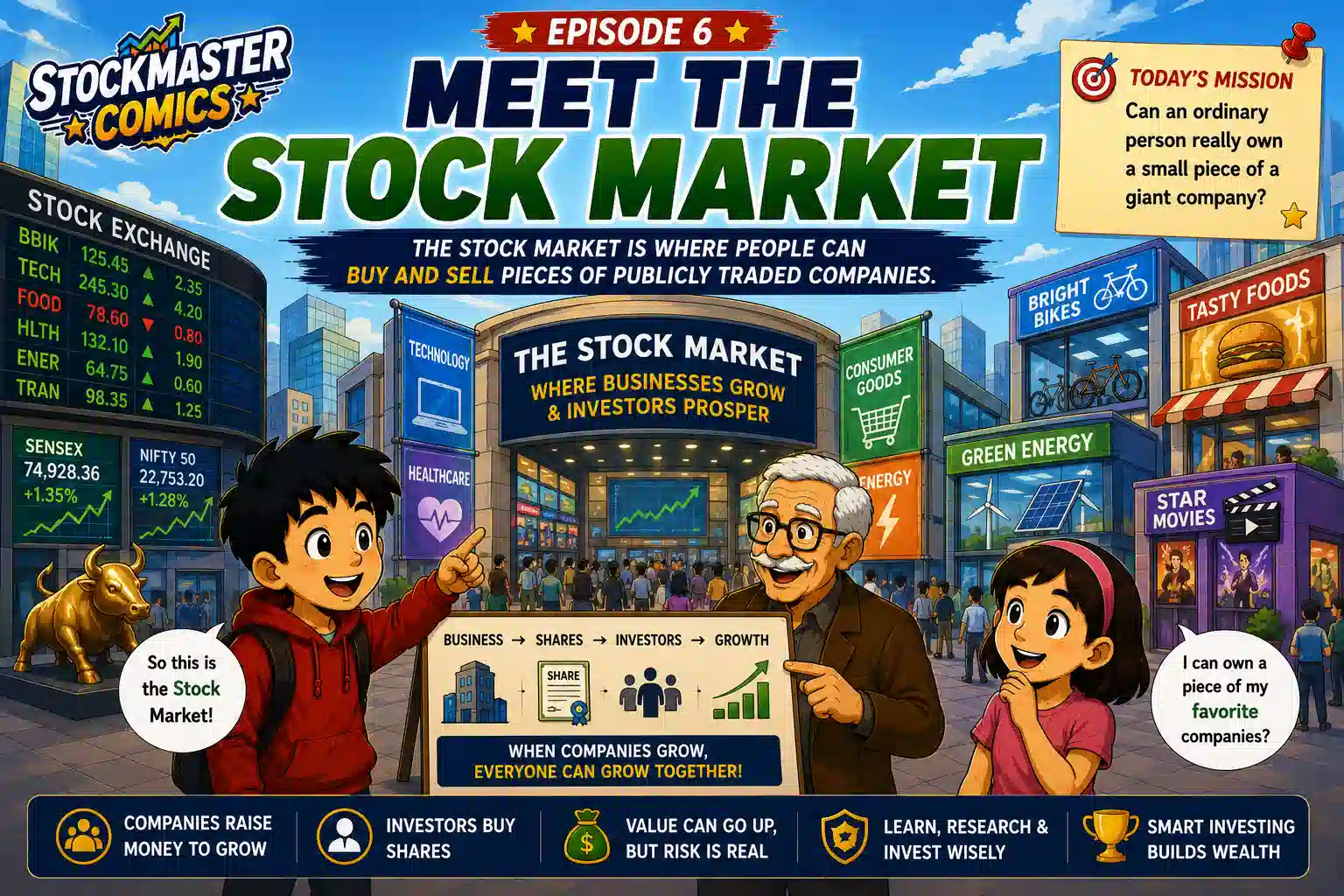
StockMaster Comics Episode 6 Meet the Stock Market hero image showing Sam, Maya and Grandpa Ben learning how companies, shares and investors connect in the stock market.

Introduction

Imagine walking through a giant marketplace. Instead of shops selling fruit, clothes, toys, or electronics, this market offers something very different: tiny pieces of businesses.

Welcome to the stock market.

After learning about money, saving, banks, and interest, Sam is ready to take the next step in his financial journey. One morning, Grandpa Ben tells him something that sounds almost unbelievable.

“You can become a part-owner of a company.”

Sam looks surprised.

“Me? Own part of a huge company?”

Grandpa Ben smiles. “Yes. When certain companies divide their ownership into small units called shares and make those shares available to public investors, people can buy them through the stock market.”

Maya immediately has another question.

“But why would a company want thousands or even millions of people to own small pieces of it?”

That question opens the door to a whole new world.

In this episode, Sam and Maya discover that the stock market is not simply a screen filled with flashing numbers, red and green arrows, and complicated charts. At its core, it is a marketplace that connects companies with investors.

Companies may raise money from investors to help grow their businesses. Investors buy shares because they hope to participate in a company’s future success. Those shares can later be bought and sold in the market.

But Grandpa Ben has an important warning: owning shares also means accepting uncertainty. A company’s share price can rise or fall, and profits are never guaranteed.

By the end of Episode 6, Sam and Maya will understand one of the most important ideas in investing:

When you buy a share, you are not just buying a number on a screen. You are buying a small ownership interest in a real business.

The doors to the stock market are about to open.

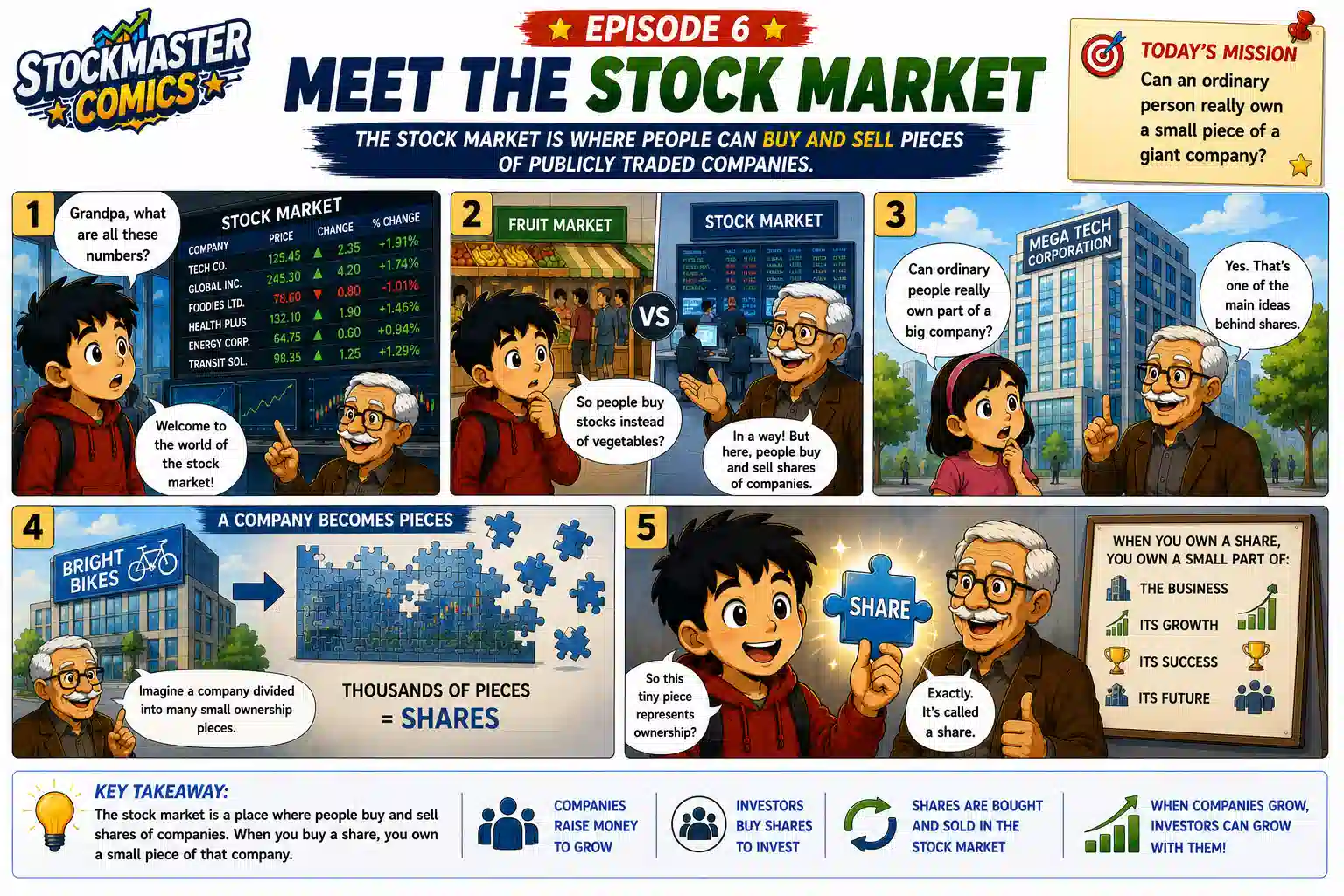
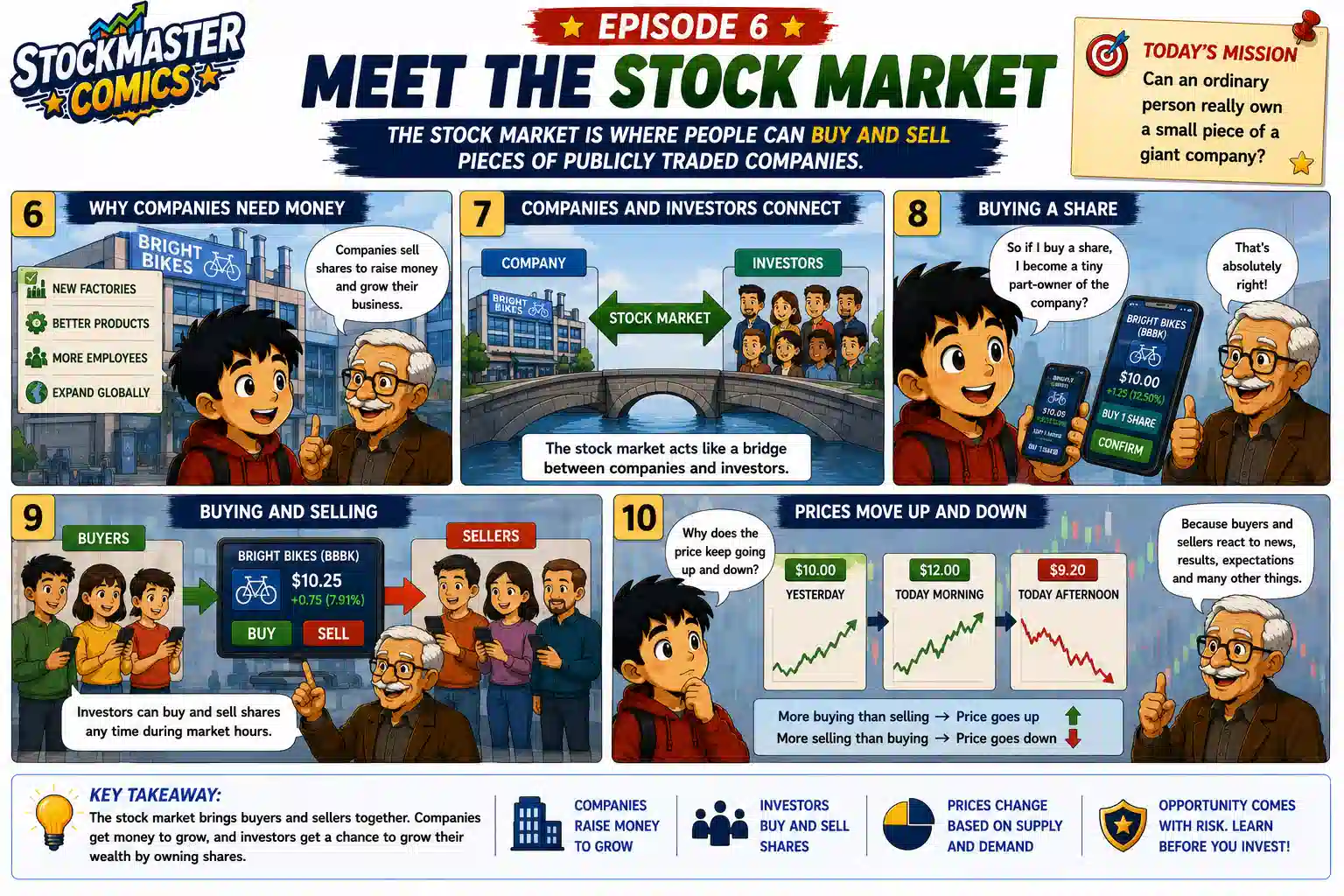
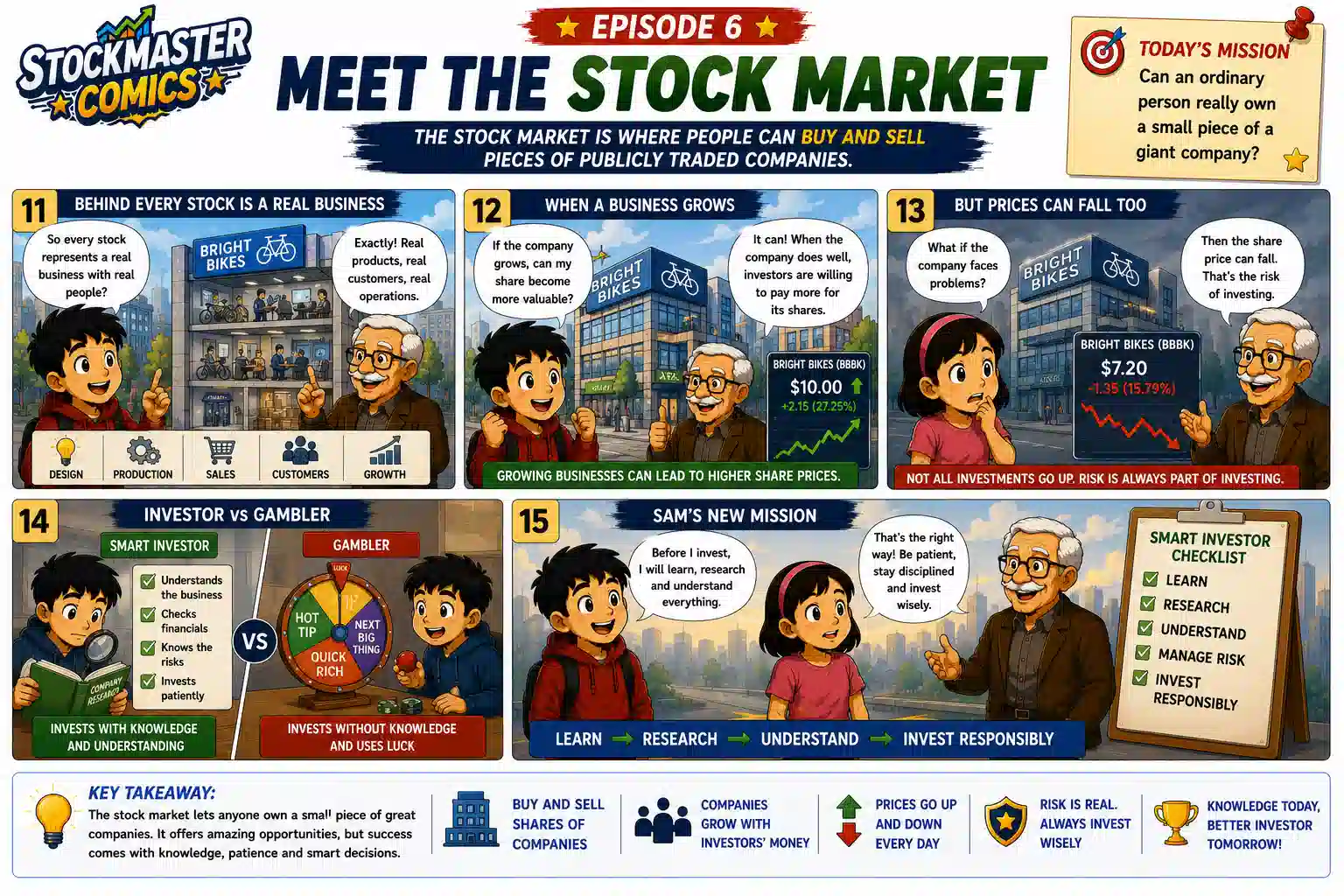
Episode 6 Meet the Stock Market comic panels 1–5 explaining what the stock market is, how companies are divided into shares and how investors can own part of a business. Episode 6 Meet the Stock Market comic panels 6–10 explaining why companies sell shares, how investors buy and sell stocks and why share prices move up and down. Episode 6 Meet the Stock Market comic panels 11–15 explaining that stocks represent real businesses, investment prices can rise or fall, and smart investors research companies and manage risk.

Lesson Summary

What Is the Stock Market?

The stock market is a system where investors can buy and sell shares of publicly traded companies. It is not necessarily one physical building. Modern stock trading largely happens electronically through organised stock exchanges and other regulated market systems. A share represents a unit of ownership in a company. If a company has millions of shares and you own some of them, you own a small economic interest in that business. Think about a pizza divided into many slices. The entire pizza represents the company, while each slice represents a portion of ownership. A real company may be divided into millions or billions of shares, making each investor's ownership relatively small. Major countries and regions have stock exchanges where listed companies' shares are traded. These markets help bring buyers and sellers together under established rules. However, a stock is more than a ticker symbol or a moving price. Behind every stock should be a real business with products or services, customers, employees, competitors, assets, expenses, and goals. Understanding this is one of the most important lessons for a beginner: when you buy a stock, think about the underlying business—not just the price on the screen.

Why Do Companies and Investors Use the Stock Market?

Businesses need money to grow. A company may want to develop new products, expand operations, invest in technology, or enter new markets. Some companies choose to raise capital by offering ownership shares to public investors. After shares become publicly traded, investors can generally buy and sell them in what is known as the secondary market. The price changes as buyers and sellers decide what they believe the shares are worth. Investors buy stocks for different reasons. Some hope the share price will increase over time. Some companies may also distribute part of their profits to shareholders through dividends, although dividends are never guaranteed. Imagine an imaginary bicycle company called Bright Bikes. The company develops popular products, attracts more customers, and increases its profits. Investors may become more optimistic about its future and be willing to pay more for its shares. But the opposite can also happen. If sales decline, competition increases, costs rise, or investors become worried about the company's future, its share price may fall. The stock market therefore creates opportunities, but those opportunities always come with uncertainty.

Why Learning About Risk Matters Before Investing

The stock market can help investors participate in the long-term growth of businesses, but it does not guarantee profits. Share prices can rise and fall—sometimes quickly. A common beginner mistake is buying a stock simply because its price is rising or because someone online says it will become the “next big thing.” A more thoughtful approach begins with understanding the business, its risks, and your own financial goals. Investors should also understand diversification. Instead of depending entirely on one company, diversification spreads investments across multiple holdings. It cannot eliminate market losses, but it can reduce the risk of relying too heavily on a single investment. Time also matters. Short-term stock prices can be unpredictable, while many investors approach stocks with a longer-term perspective. Before investing real money, a beginner should learn basic concepts such as shares, companies, stock exchanges, risk, diversification, and investment goals. The most important lesson from Sam's first visit to the stock market is simple: A stock is not merely a number moving up and down. It represents an ownership interest in a business. Understanding what you own is one of the foundations of responsible investing.

Key Takeaways

  • The stock market allows investors to buy and sell shares of publicly traded companies.
  • A share represents a unit of ownership in a company.
  • Companies can use public markets to raise capital for growth.
  • Stock prices rise and fall as market participants react to information and expectations.
  • Behind every stock is an underlying business.
  • Investing offers potential rewards but also involves risk.
  • Learning and research should come before investing.

Vocabulary

  1. Stock Market A system where shares of publicly traded companies are bought and sold.
  1. Share A unit representing an ownership interest in a company.
  1. Stock Exchange An organised marketplace where securities such as shares are traded.
  1. Investor A person or organisation that puts money into assets with the goal of achieving future financial returns.
  1. Diversification Spreading investments across different holdings to reduce dependence on a single investment.

Smart Investor Tip

Don’t buy a stock simply because its price is moving up. First ask: What does this company do? How does it make money? What risks does it face? Understanding the business is an important first step toward understanding the investment.

Next Episode Preview

Episode 7: Buying Your First Share

Now that Sam understands what the stock market is, he is ready for his next big step—buying his first share!

In Episode 7, discover how investors choose a company, check the share price, place a buy order, and become part-owners of a real business.

Next Mission: If you had $100 to invest, how would you choose your first company?

Scroll to Top