Episode 13 – The World’s Biggest Lemonade Company

StockMaster Comics Episode 13 hero image showing how Sunny Lemonade grows from a small lemonade stand into a global company through customers, reinvestment, capital and investors.

Introduction

Every giant company has a beginning. Some begin in a garage, some in a small shop, and others start with nothing more than a simple idea.

Imagine that Sam and Maya open a small lemonade stand called Sunny Lemonade. At first, they have only a table, a jug of lemonade, and a few customers from their neighbourhood. They use their own money to buy lemons, sugar, cups, and ice. Every glass they sell brings in revenue, but that does not mean all the money is profit. They must first pay their business expenses.

As more people discover their delicious lemonade, demand begins to grow. Sam and Maya realise they have an opportunity. Instead of spending all their profit, they put some of it back into the business. They buy better equipment, produce more lemonade, hire employees, and open new locations.

Soon, Sunny Lemonade needs even more money to expand. The company wants to build a factory, buy delivery trucks, and sell its products across the country. This is where investors can become important.

The company may divide its ownership into shares and sell some of those shares to investors. The company receives money to help fund its growth, while investors become part-owners of the business.

But becoming the world’s biggest lemonade company is never guaranteed. The company must keep customers happy, manage costs, compete with other businesses, and make smart decisions.

In this episode, Sam and Maya discover how a tiny business can grow step by step—and why understanding the business behind a stock is one of the most important lessons for every future investor.


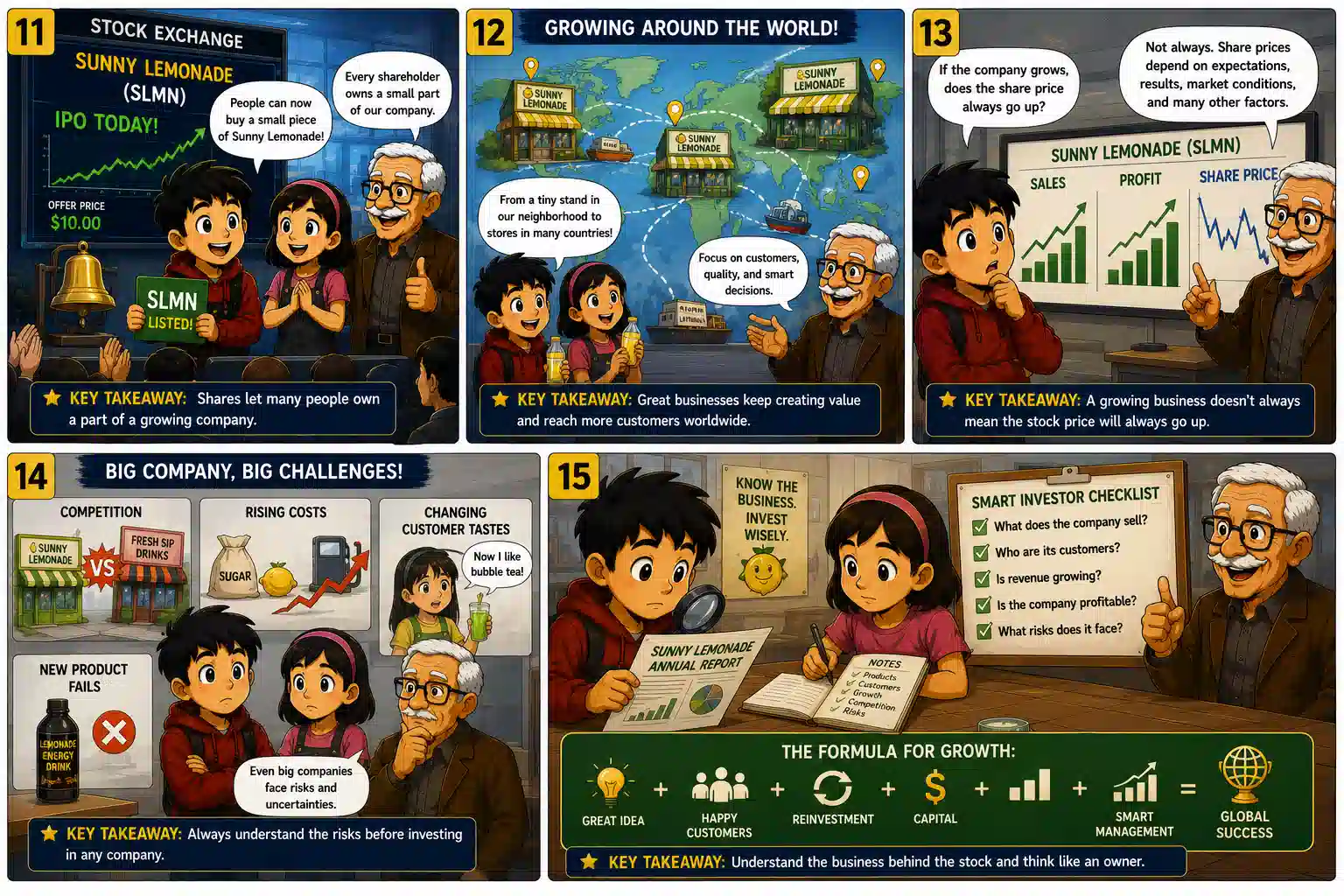
StockMaster Comics Episode 13 panels 1–5 explaining how a simple lemonade business starts with capital, earns revenue, calculates profit and reinvests profits for growth. StockMaster Comics Episode 13 panels 6–10 showing Sunny Lemonade gaining customers, opening shops, expanding the business, raising capital and selling shares to investors. StockMaster Comics Episode 13 panels 11–15 explaining an IPO, global business growth, stock-price risks, business challenges and how investors research a company before investing.

Lesson Summary

How a Small Business Becomes a Big Company

Every large company begins with a product, service, or idea designed to solve a problem or satisfy a customer need. In our story, Sunny Lemonade begins as a tiny neighbourhood stand. Sam and Maya invest money in ingredients and equipment, make a product, and sell it to customers. As customer demand increases, the business has an opportunity to grow. However, growth requires resources. A company may need better equipment, more employees, larger facilities, new stores, technology, marketing, and distribution networks. One common way to support growth is reinvestment. Instead of distributing or spending all its profits, a business can put some of that money back into operations. This might help the company produce more products, improve quality, reach new customers, or develop new ideas. Growth usually happens step by step. A successful local business may become a regional company, then a national business, and eventually an international organisation. But size alone does not guarantee success. A company must continue creating value for its customers.

Why Companies Need Capital to Grow

Capital is money or other financial resources used to start, operate, and expand a business. Small businesses may initially use money from their founders. As a company grows, however, its ambitions may become larger than the money it generates internally. Imagine Sunny Lemonade wants to build a factory. The company may need money for land, machinery, employees, delivery vehicles, packaging, and marketing. Waiting years to save enough money could slow its expansion. Companies can raise capital in different ways. They may borrow money, attract private investors, or, when eligible and appropriate, offer shares to public investors. When investors buy shares, they become part-owners of the company. The company can use the capital it raises to pursue its business plans. Investors, meanwhile, hope that the company will become more successful over time. However, buying a share does not guarantee a profit. A company may grow, struggle, or even fail. This is why investors need to understand both the opportunity and the risk.

Why Investors Should Understand the Business

A stock is more than a price moving on a screen. Behind every genuine publicly traded stock is a real business with employees, customers, products, competitors, expenses, opportunities, and risks. Smart investors therefore look beyond short-term price movements. They try to understand how the company makes money. They may study its products, customers, revenue, profits, debt, competition, management, and long-term opportunities. Sunny Lemonade might look exciting because its stores are expanding quickly. But an investor should ask deeper questions. Is the company making a sustainable profit? Are customers returning? Is expansion becoming too expensive? Are competitors taking market share? Can the company continue growing? Thinking like a business owner changes the way a person approaches investing. Instead of asking only, “Will this stock go up tomorrow?”, a long-term investor may ask, “Is this a strong business that can create value over time?” That is one of the most important ideas in investing: when you buy a share, you are buying a small ownership interest in a real business.

Key Takeaways

  • Every large company starts with an idea, product, or service.
  • Revenue is the money a business receives from sales; profit is what remains after expenses.
  • Businesses can reinvest profits to support future growth.
  • Growing companies often need additional capital.
  • Investors can become part-owners by buying shares.
  • A successful business does not automatically mean its stock price will always rise.
  • Smart investors study the real business behind the stock.
  • Investing involves both opportunity and risk.

Vocabulary

Revenue – The money a company receives from selling its products or services.

Profit – The money remaining after a business pays its expenses.

Capital – Money or financial resources used to start, operate, or grow a business.

Reinvestment – Using some of a company’s earnings to support future business growth.

Shareholder – A person or organisation that owns one or more shares in a company.

Smart Investor Tip

Never think of a stock as just a ticker symbol or a moving price. Before investing, ask: “Would I want to own part of this business?”

Learn how the company makes money, understand its customers and risks, and remember that even the world’s biggest companies must continue earning customer trust.

Next Episode Preview

Episode 14 – Patience Beats Speed

Can getting rich slowly be smarter than trying to get rich quickly?

Sam discovers why successful investing is often about patience, discipline, and staying focused for the long term. Learn how chasing quick profits can increase risk, while giving good investments time to grow can build lasting wealth.

Coming Next: Episode 14 – Patience Beats Speed
 🐢📈🏆

Scroll to Top