Episode 17 – The Piggy Bank vs Investing

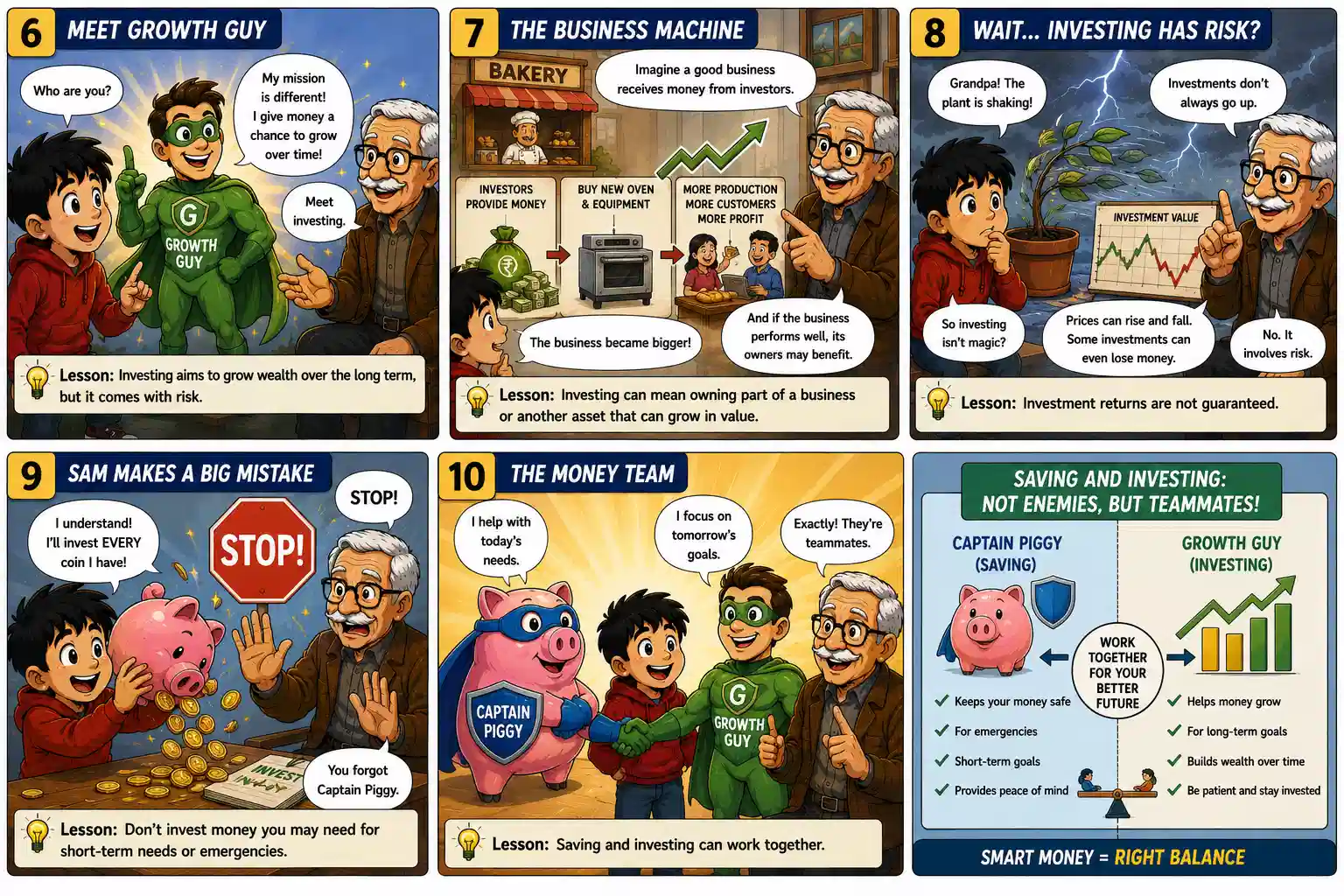
StockMaster Comics Episode 17 The Piggy Bank vs Investing showing Sam and Grandpa Ben explaining the difference between saving and investing for financial goals.

Introduction

Sam’s piggy bank is getting heavy.

For weeks, he has been carefully saving coins instead of spending them on sweets, games, and things he doesn’t really need. Every time Sam drops another coin into his piggy bank, he feels proud. He has finally learned how to save money.

One afternoon, Sam proudly carries his piggy bank to Grandpa Ben.

“Look, Grandpa! I’m becoming rich!” Sam announces with a huge smile.

Grandpa Ben is impressed. Saving is an important financial habit, and Sam has made a great start. But Grandpa asks him a surprising question: “What is your money doing inside that piggy bank?”

Sam looks confused.

“Doing? It’s sitting safely inside!”

That’s when Grandpa Ben introduces Sam to an important financial lesson: saving and investing are not the same thing.

Saving can help protect money and prepare us for short-term needs and emergencies. Investing, on the other hand, gives money an opportunity to grow over a longer period—but it also involves risk.

So, should Sam break his piggy bank and invest every coin?

Not so fast!

In Episode 17: The Piggy Bank vs Investing, Sam discovers why smart money management isn’t a battle between saving and investing. The real lesson is understanding when to save, why to invest, and how both can work together.

Join Sam and Grandpa Ben as they discover two different jobs for money: protecting today and building tomorrow.


Sam and Grandpa Ben explain saving, piggy banks, emergency funds and short-term financial needs in StockMaster Comics Episode 17. StockMaster comic explaining investing, investment risk and how saving and investing can work together for a better financial future. Sam learns about spending, saving, investing, time horizon and choosing the right money strategy for short-term and long-term financial goals.

Lesson Summary

What Is the Difference Between Saving and Investing?

Saving means keeping money available for future use. People commonly save for emergencies, planned purchases, school expenses, travel, repairs, or other short-term needs. The main purpose of saving is usually availability and financial preparedness. Imagine Sam's bicycle suddenly needs a repair. If Sam has money set aside, he can use those savings to pay for the repair. He doesn't have to borrow money or wait for an investment to recover from a market decline. Investing has a different goal. When people invest, they put money into assets such as shares, bonds, funds, property, or other investments with the hope of achieving growth or income over time. However, investing involves risk. The value of an investment can rise or fall, and returns are never automatically guaranteed. This is why Grandpa Ben describes saving and investing as having different jobs. Saving can help protect your financial flexibility. Investing can give money an opportunity for long-term growth. Understanding the difference is more important than simply asking which one is “better”.

Why You May Need Savings Before Investing

Sam initially makes a common beginner mistake. After learning that investing can help money grow, he wants to invest every coin in his piggy bank. Grandpa Ben immediately stops him. Why? Imagine investing money today and suddenly needing it next month. The market may be lower at exactly the time you need to withdraw your money. You could be forced to sell an investment at an unfavourable time. Savings can act as a financial cushion. An unexpected repair, urgent travel expense, or sudden loss of income can create financial pressure. Having accessible savings may make it easier to manage these situations without immediately selling long-term investments. The appropriate amount of savings differs from person to person. Income, expenses, family responsibilities, financial goals, and local circumstances all matter. The important lesson is simple: understand your short-term needs before taking long-term investment risk. Investing should not mean ignoring today's financial responsibilities.

Saving and Investing Can Work Together

The title of this episode is The Piggy Bank vs Investing, but Grandpa Ben reveals an important secret: there doesn't need to be a battle. Saving and investing can be teammates. Think of money as having different jobs. Some money pays for today's needs. Some money can be kept for emergencies and short-term goals. Money that isn't needed soon may, depending on your circumstances and risk tolerance, be considered for longer-term investment. This is why Sam creates three money buckets: Spend, Save, and Invest. The idea is not a universal formula or fixed percentage. Every person's financial situation is different. Instead, the buckets teach Sam to think before using his money. “What job does this money need to do?” That simple question can change the way you make financial decisions. The real lesson is that good money management is about balance. Saving without ever thinking about long-term growth may limit opportunities. Investing money that you urgently need can expose you to unnecessary financial stress. Smart financial decisions begin with your goals, your time horizon, and an understanding of risk.

Key Takeaways

  • Saving and investing are not the same.
  • Savings can help with emergencies and short-term financial needs.
  • Investing aims to create long-term growth or income but involves risk.
  • Investment values can rise and fall.
  • Money needed soon may require a different approach from money intended for long-term goals.
  • Saving and investing can work together.
  • Give your money a clear purpose before deciding what to do with it.

Vocabulary

Saving – Setting aside money for future needs or goals.

Investing – Putting money into an asset with the aim of achieving growth or income over time while accepting risk.

Emergency Fund – Money kept available for unexpected financial needs.

Risk – The possibility that an investment’s result may be different from what you expected, including losing money.

Time Horizon – The length of time before you expect to need your money.

Smart Investor Tip

Don’t ask only, “Should I save or invest?”

First ask:

“When will I need this money, what is my goal, and how much risk can I reasonably accept?”

Money needed for an immediate expense has a very different job from money intended for a goal many years into the future.

Next Episode Preview

Episode 18 – Why Everyone Can't Get Rich Overnight

Sam sees an exciting message online promising “Turn $100 into $10,000 FAST!” Suddenly, becoming rich looks easy—and everyone seems to be chasing the same dream. But Grandpa Ben has an important question: “If getting rich overnight were so easy, wouldn’t everyone already be rich?” Join Sam as he discovers why quick-money promises are so tempting, how greed and impatience can lead to risky decisions, and why real wealth is usually built through knowledge, discipline, and time.

Coming next: Episode 18 – Why Everyone Can’t Get Rich Overnight

Scroll to Top