ROA Ratio Race
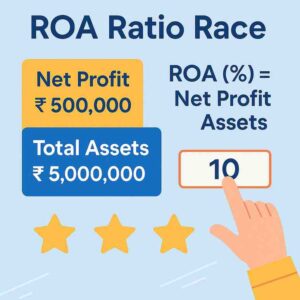
ROA (Return on Assets) shows how efficiently a company uses its assets to generate profit. Enter the correct ROA value and earn stars based on your accuracy!
How to Play: Calculate ROA from Net Profit & Total Assets. Enter your answer and instantly see your score & explanation.
What Is ROA (Return on Assets)?
ROA measures how effectively a company uses its total assets to generate profit. It shows true operational efficiency.
ROA Formula:
ROA (%) = (Net Profit ÷ Total Assets) × 100
Why ROA Matters
- Shows asset productivity
- Reveals management efficiency
- Helps compare companies regardless of size
- Critical for evaluating capital-intensive businesses
This game helps beginners practice ROA calculation with increasing accuracy while earning fun star ratings!
Understanding ROA in Simple Terms
ROA shows:
 👉 How much profit the company earns for every ₹1 invested in assets.
If ROA = 10%, it means the company generates ₹0.10 in profit for every ₹1 of assets.
Higher ROA indicates:
- Efficient operations
- Better asset management
- Strong profitability
Lower ROA suggests inefficiency or overinvestment.
❓ Frequently Asked Questions (FAQ)
- What is considered a good ROA?
Generally:
- Above 10% = Strong
- 5–10% = Average
- Below 5% = Weak
But this varies by industry.
- Is ROA better for analyzing asset-heavy companies?
Yes!
Industries like manufacturing, telecom, and utilities rely heavily on assets — ROA is a key profitability metric for them.
- Can ROA be negative?
Yes.
If net profit is negative, ROA becomes negative — a red flag for investors.
- Is ROA better than ROE?
They measure different things:
- ROE → profit on shareholder money
- ROA → profit on company assets
Together, they give a complete picture of performance.
- What skills will I learn in ROA Ratio Race?
You’ll learn:
- How to compute ROA
- How to analyze asset efficiency
- How to interpret profitability metrics
- How different industries compare in ROA
- Why does this game use star scoring?
Stars create instant motivation, helping beginners practice ROA with excitement and repetition.