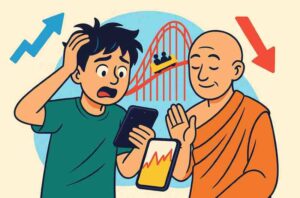
 The morning sun sprinkled gold across the rooftops of Aranyapur as Aryan rushed excitedly to the Market Monk’s home. Today was special — he had finally bought his first stock.
He burst through the door.
“Master! I did it! I bought my first share!”
The Monk smiled warmly.
“That is wonderful, Aryan. And how do you feel?”
Aryan grinned.
“Like a champion! The price went up 2% right after I bought it. I think I’m a natural investor!”
The Monk chuckled.
“Ah, the first emotion: Euphoria.”
⭐ THE RISE OF OVERCONFIDENCE
Over the next two days, Aryan watched his stock rise slowly.
+1%
+2%
+3%
He checked the price every hour, sometimes every few minutes.
Each small uptick filled him with pride.
“Master, investing is easy! Why do people make it sound so difficult?”
“That,” the Monk replied, “is the emotion of overconfidence. It appears when success comes quickly — even if the success is small.”
Aryan didn’t care. He was sure the stock was going to the moon.
⭐ THE FIRST DROP
On the fourth day, Aryan woke up humming happily and opened the stock app on his phone.
The humming froze.
His stock was –4%.
“What!? Why!? What happened!?” Aryan panicked.
He rushed to the Monk.
“Master! My stock is falling! Should I sell? Should I exit now?”
The Monk placed a calming hand on his shoulder.
“Sit, Aryan. This is the next emotion: Fear.”
Aryan gulped.
“But… but I don’t want to lose money!”
“Fear comes when we watch price movements too closely,” the Monk said.
“A rising stock creates confidence. A falling stock creates panic. Neither is permanent.”
⭐ THE RESEARCH THAT NEVER CHANGES
The Monk asked,
“Tell me, Aryan — why did you buy this stock?”
Aryan replied confidently, “Because the company makes solar panels, and the demand for clean energy is rising.”
“And is solar demand still rising?”
“Yes.”
“Has the company suddenly stopped selling panels?”
“No.”
“Has anything changed in the business?”
Aryan shook his head.
“Then why,” the Monk asked gently,
“do you want to change your decisions based on temporary price noise?”
Aryan lowered his eyes.
He had no answer.
⭐ THE SECOND FALL — AND THE EMOTION OF REGRET
Two days later, the stock dropped again.
–7%
Aryan felt a sinking feeling in his chest.
“Master… I think I made a mistake. I should never have invested. I’m losing money. I want to undo everything.”
“That feeling,” the Monk said, “is Regret.”
He added:
“Every investor feels regret at some point. But regret is not a teacher — only observation is.”
Aryan felt frustrated.
“This hurts, Master. Why doesn’t the stock just go up?”
The Monk smiled.
“Because the market is not your servant.”
⭐ THE SUDDEN RECOVERY — AND NEW HOPE
One morning, Aryan woke to unexpected news.
His stock had bounced back:
–7% changed to
–2%
then
+1%
Aryan ran to the Monk again.
“Master! It’s recovering! It’s going up again! What should I do? Buy more? Hold? Sell?”
The Monk laughed.
“Now you are experiencing Hope.”
Aryan blinked.
“Is that a bad thing too?”
“No emotion is good or bad,” the Monk said.
“But emotions become dangerous when they control your decisions.”
⭐ THE MONK’S BIG LESSON: THE EMOTIONAL CHART
The Monk drew a curve on the ground:
Euphoria → Overconfidence → Fear → Regret → Hope → Recovery → Repeat
“Aryan,” he said softly,
“This is the emotional rollercoaster every new investor rides. The danger is not the market — it is the emotion.”
He continued:
“Price goes up → you feel happy
Price goes down → you feel scared
Price recovers → you feel hopeful
This cycle never ends unless you learn to detach.”
Aryan listened intently.
⭐ THE ONE QUESTION THAT MATTERS
The Monk asked Aryan:
“When your emotions fade… will the company still be strong?”
Aryan replied,
“Yes, Master. The business is still growing.”
“Then the stock price will follow the business eventually. Focus on the business, not the noise.”
Aryan smiled gently.
“I understand now. The market is a mirror… but a broken one. It reflects emotions before value.”
⭐ ONE MONTH LATER
Aryan stopped checking the stock daily.
He checked the company news instead.
He learned how solar panel demand was rising.
He read about government incentives.
He studied the company’s expansion plans.
One month later, he opened his app casually.
The stock was up +12%.
He didn’t scream.
He didn’t dance.
He simply smiled.
“Master,” Aryan said, “I finally understand that investing isn’t about daily excitement. It’s about long-term calm.”
The Monk nodded proudly.
“You have begun your journey, Aryan. Not as an emotional investor — but as a wise one.”
⭐ ARYAN’S FINAL LESSON
As they walked home, Aryan summarised:
- Buying creates excitement
- Falling prices create fear
- Losses create regret
- Recovery creates hope
- Emotions create confusion
“But long-term thinking,” Aryan concluded,
“creates peace.”
The Monk smiled.
“And peace creates wealth.”