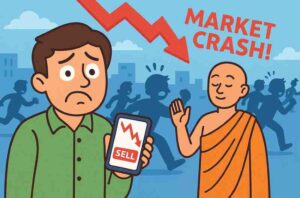
 A cold wind swept through Aranyapur as Aryan and the Market Monk walked toward the local tea stall. The atmosphere felt tense, unusually heavy. Groups of people whispered nervously, all staring at their phones.
“Master,” Aryan asked quietly, “why does everyone look so worried?”
Before the Monk could reply, a panicked voice cut through the air.
“SELL EVERYTHING! The market is crashing!”
It was Mr. Harit, a well-known shopkeeper who had recently begun investing. His hands shook as he refreshed his stock app repeatedly.
“Master Monk! Aryan! The market is down 3% today! Everyone is selling. I must sell too!”
The Monk looked at him calmly.
“And why must you sell, Harit?”
Harit’s voice cracked.
“Because everyone is! Look around!”
Aryan watched in disbelief as Harit pressed the “SELL ALL” button in blind fear.
⭐ THE PANIC HAS BEGUN
Everywhere in the market, the same pattern repeated:
- People shouting
- Phones refreshing
- Hands trembling
- Fear spreading like wildfire
Aryan whispered,
“Master… why is everyone panicking over a small drop?”
The Monk replied softly,
“When fear spreads faster than logic, panic selling begins.”
Suddenly, Harit screamed again.
“My portfolio is down 4%! I knew it! This is the end!”
The Monk shook his head.
“Harit, the market has fallen before… and it will fall again. But it also rises.”
Harit refused to listen.
“No! I cannot see my money fall further!”
And with that, he sold all his shares at a loss.
⭐ THE MONK’S ICE CREAM STORY
To calm Aryan, the Monk took him to an old ice cream cart.
“Aryan,” he asked, “if ice cream prices drop on a cold day, do you sell your freezer?”
Aryan laughed.
“No, Master. Prices fall temporarily. They rise again when it’s hot.”
“Exactly,” the Monk said.
“But people think the stock market is different. They believe every dip is a disaster.”
He paused and added:
“A temporary change in weather does not destroy the summer.
A temporary fall in prices does not destroy a business.”
⭐ THE REAL REASON BEHIND THE MARKET DROP
They sat on a bench where a group of traders discussed the news calmly.
One trader said,
“It’s nothing major. Foreign investors pulled out a small amount today. The fundamentals of good companies haven’t changed.”
Another added,
“Just a normal market correction. It happens every few months.”
Aryan turned to the Monk.
“So the fall wasn’t because companies were failing?”
“No,” the Monk replied.
“But panic selling makes people react as if the world is ending.”
⭐ THE DANGEROUS LOOP OF PANIC SELLING
The Monk drew a circle in the sand.
FEAR → SELLING → MORE FEAR → MORE SELLING → PRICE FALLING → MORE FEAR
“Aryan,” he said,
“This is the panic loop. One person sells out of fear, others copy him, and soon the entire market shakes.”
Aryan nodded slowly.
“So Harit sold because he thought everyone else knew something he didn’t.”
“Correct,” the Monk said.
“But he never asked the most important question:
Has anything changed in the company he invested in?”
⭐ THE NEXT DAY – THE MARKET RISES
The following morning, news broke:
“Markets bounce back sharply after yesterday’s correction.”
Stocks were up again:
+2%
+3%
+4%
Aryan ran to Harit’s shop.
“Sir! The market is up again!”
Harit looked devastated.
“I sold everything yesterday… at the lowest price. If I had held for one more day, I would’ve recovered.”
Aryan whispered,
“This is the cost of panic selling.”
Harit sank into his chair.
“I lost months of savings because of fear… because I copied the crowd.”
⭐ THE MONK’S TEST: THE TREE IN THE STORM
The Monk brought Harit to a banyan tree.
Strong winds blew through the park.
“What do you see, Harit?” the Monk asked.
Harit replied, “The tree is bending… but it doesn’t fall.”
“Exactly,” the Monk said.
“A strong business is like this tree.
Winds — market dips — make it shake.
But it does not fall.”
He continued:
“But you… you reacted like a leaf.
The wind blew once… and you let go.”
Harit closed his eyes, ashamed.
⭐ THE MONK’S FOUR QUESTIONS BEFORE SELLING
The Monk handed Harit a small card.
Before selling any stock, ask:
1️⃣ Has the business fundamentally changed?
2️⃣ Has demand for its product vanished overnight?
3️⃣ Is debt suddenly unmanageable?
4️⃣ Or am I selling only because others are selling?
Harit whispered,
“I sold because others sold… not because the business changed.”
The Monk nodded.
“And that is the definition of panic selling.”
⭐ HARIT’S TRANSFORMATION
Over the next weeks, Harit learned:
- To check company results, not price charts
- To invest for years, not days
- To understand volatility is normal
- To ignore rumours
- To stay calm during dips
One day, Harit proudly announced:
“Master, I bought back my stocks… and this time I won’t sell in fear. I will think before acting.”
The Monk smiled.
“Then you have grown from a panicked seller to a thoughtful investor.”
⭐ ARYAN’S FINAL LESSON
As they walked home, Aryan summarised:
- Panic selling happens when fear beats logic
- People copy each other without thinking
- Short-term dips are normal
- Selling in fear locks in losses
- Patience and understanding create profit
The Monk nodded gently.
“A wise investor does not run when others run.
He stands still and observes.
Because panic is temporary —
but regret lasts long.”