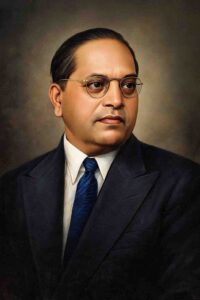
6 December is observed with remembrance and respect. On this day, India usually thinks of Dr. Babasaheb Dr. Babasaheb Ambedkar as the architect of the Constitution, champion of social equality, and leader of justice.
But there is a side of Dr. Babasaheb Ambedkar that very few Indians know:
👉 Dr. Babasaheb Ambedkar was also the most advanced financial economist of modern India.
👉 He was deeply aware of capital markets, exchanges, speculation, inflation, banking, currency and stock pricing.
👉 His ideas were so ahead of time that even today they explain many problems we see in the Indian stock market.
This article reveals the economic and market insights of Dr. Babasaheb Ambedkar that most Indian investors, traders and policymakers have never heard about.
Dr. Babasaheb Ambedkar – The First Indian with a Doctorate in Finance & Monetary Economics
Before India had a Planning Commission, before Stock Exchange became the economic symbol of Mumbai, even before RBI existed — Dr. Babasaheb Ambedkar was studying financial markets in London and New York.
- PhD – Columbia University (1917)
Thesis: “Administration and Finance of the East India Company”
→ Explained company finance, stocks, trading, dividends and speculative behaviour in the East India Company. - DSC (Doctor of Science) – London School of Economics (1923)
Thesis: “The Problem of the Rupee – Its Origin and Its Solution”
→ Focused on currency, inflation, interest rates, and stabilisation of Indian markets.
He was studying free markets and financial behaviour when most Indian leaders were focused only on politics.
He understood that without economic strength, political freedom has no value.
His famous line:
“Political democracy cannot succeed without social and economic democracy.”
Dr. Babasaheb Ambedkar & The Birth of the Reserve Bank of India (RBI)
Most Indians don’t know this:
👉 The RBI was created on the basis of Dr. Babasaheb Ambedkar’s recommendations.
His analysis in “The Problem of the Rupee” was used by the Hilton Young Commission, which recommended the creation of RBI.
Key ideas he gave:
✓ India needs an independent central bank, not controlled by big traders or politicians.
✓ Currency must be protected from speculative trading.
✓ Interest rates must support industry, farmers and savings.
His warning:
“Without control over credit, markets will become a field of monopoly and exploitation.”
This is exactly what we see in stock markets when:
- a few big operators control prices,
- retail investors lose,
- rumours move the market.
Dr. Babasaheb Ambedkar predicted this 100 years ago.
Dr. Babasaheb Ambedkar On Stock Market Speculation – A Hidden Chapter
Dr. Babasaheb Ambedkar reviewed how trading worked in Bombay Stock Exchange during British times.
He observed that:
- few wealthy groups controlled prices,
- manipulated markets,
- and common people had no access to financial knowledge.
His writings mentioned:
“Speculation without knowledge is gambling. And gambling disguised as finance is the ruin of nations.”
He differentiated two behaviours:
| Bad Speculation | Good Investment |
| Rumours | Research |
| Operators | Industry |
| Quick profit | Long-term growth |
| Gambling mindset | Productive capital |
He believed markets should fund industry, not enrich manipulators.
His Fight Against Monopoly Capitalists
Dr. Babasaheb Ambedkar warned that India’s economy will be captured by a few families if financial rules are weak.
He documented how mill owners, traders and brokers dominated Bombay markets.
His solution was state regulation, not to destroy markets but to make them ethical.
He said:
“Competition must be real. Without regulation, it becomes competition among wolves and lambs.”
This is the foundation of modern SEBI thinking.
Dr. Babasaheb Ambedkar & Labour Rights in Financial Markets
Dr. Babasaheb Ambedkar was not against business.
He was against exploitation while doing business.
He introduced:
- 8-hour workday
- Compulsory paid leave
- Minimum wages
- Labour insurance
- Employee Provident Fund
These rules later spread into financial institutions and stock market companies.
Today when you see:
- PF,
- gratuity,
- labour welfare funds,
remember — Dr. Babasaheb Ambedkar drafted them.
He believed wealth must circulate:
“Wealth, if not shared, becomes a fortress of power.”
Dr. Babasaheb Ambedkar Wanted Financial Literacy for Common People
In 1930s itself, Dr. Babasaheb Ambedkar wrote:
“Indian people are denied knowledge of finance. Without financial education, they remain at the mercy of others.”
He wanted:
- schools to teach money, savings, investments
- workers to learn banking
- farmers to understand credit cycle
He believed financial education was as important as political rights.
Imagine if this happened at national scale:
- fewer scams
- fewer emotional trades
- more research-driven investment
Dr. Babasaheb Ambedkar was 100 years ahead in vision.
Dr. Babasaheb Ambedkar’s Concept of Inclusive Capitalism
Dr. Babasaheb Ambedkar did not want capitalism to be crushed.
He wanted capitalism to be inclusive.
His idea:
“Factories must not only make profit; they must make citizens.”
He argued:
- employers must share wealth with workers,
- state must protect competition,
- small investors must be included.
Today when we talk of:
- ESOPs,
- mutual funds giving access to common people,
- SIP investments,
these are reflections of inclusive capitalism Dr. Babasaheb Ambedkar dreamed about.
Land, Agriculture & Commodity Markets
Dr. Babasaheb Ambedkar knew that market volatility affects farmers first.
He studied how price manipulation destroyed:
- cotton farmers,
- mill workers,
- small traders.
He suggested:
- regulated warehouses
- fair commodity pricing
- co-operative markets
He wanted farmers to get market information, so they don’t get cheated.
His idea is modern:
- MSP
- APMC
- regulated commodity exchanges
are all extensions of his economic vision.
Dr. Babasaheb Ambedkar & Gold: Why He Distrusted Gold Fetish
Dr. Babasaheb Ambedkar wrote about how Indians waste savings in gold:
“Gold is dead capital. It does not create industry, does not create jobs.”
He preferred:
- banking,
- insurance,
- productive investment
He recommended:
- gold standard currency must end
- India must move to managed paper currency
- investment should come to industry
Today RBI policy follows this logic.
Dr. Babasaheb Ambedkar & Inflation
He studied inflation deeply.
His finding:
“Inflation is a tax on the poor and a reward to the rich.”
When prices rise:
- workers suffer,
- investors holding assets gain.
He recommended:
✓ stable money supply
✓ central bank control
✓ responsible government spending
This is the foundation of modern monetary policy.
Why Dr. Babasaheb Ambedkar Would Warn Today’s Retail Traders
If Dr. Babasaheb Ambedkar saw today’s stock trading apps, he would warn:
- Emotional trading
- F&O gambling
- Herd mentality
- Blind tips
- Social media hype
He would say:
“Speculation without knowledge is slavery to others’ decisions.”
He would promote:
- research
- fundamentals
- patience
- long-term wealth creation
He would be against:
- operator-driven pump & dump stocks
Dr. Babasaheb Ambedkar always supported reason over emotion.
Why Dr. Babasaheb Ambedkar is Still Relevant to Markets Today
Look at India today:
- retail traders lose money
- operators control small caps
- rumours move markets
- financial literacy is low
Dr. Babasaheb Ambedkar predicted all this.
His solution:
- strong regulation → SEBI
- independent central bank → RBI
- education for masses → financial literacy
- protection for poor → labour laws
His vision is not finished.
India still needs:
- education in financial thinking
- protection of small investors
- ethical industry
6 December: A Day to Remember His Economic Mind
Whenever 6 December arrives, people focus on only one part — his social contribution.
But Dr. Babasaheb Ambedkar was also:
- world-class economist
- banking expert
- stock market analyst
- currency theorist
- labour reformer
- finance minister of his own mind
India honours him mostly for Constitution, but his economic legacy is equally extraordinary.
Conclusion: Dr. Babasaheb Ambedkar’s Message to Today’s Investors
If Dr. Babasaheb Ambedkar could speak to Indian investors today, his message would be:
- Study before you invest.
- Markets must be ethical, not exploitative.
- Long-term wealth is created by productive capital, not gambling.
- Protect the weak, regulate the powerful.
- Economic democracy is as important as political democracy.
His vision was clear:
“Without economic power in the hands of the many, democracy is only a shell.”
The Indian stock market is not just a financial playground.
It is a stage where economic justice is performed every day.
6 December is not only a day of mourning.
It is a day to remember the brilliant economic architect of modern India.