PE Ratio Guess Game
- Exact (within 0.1): +10 points
- Close (within 1.0): +6 points
- Okay (within 2.5): +3 points
- Wrong: 0 points — correct PE shown
Why the PE Ratio Matters
Price-to-Earnings (PE) shows how much investors pay for each rupee of earnings. Lower PE can mean cheap valuation or low growth expectation; higher PE can mean high growth priced in. Use PE alongside other metrics (growth rate, ROE, cash flow) for better decisions.
About PE (Price-to-Earnings)
PE = Price ÷ Earnings Per Share (EPS). It is a quick way to compare how the market values earnings across companies. Use it with growth and cash flow metrics — PE alone does not tell the whole story.
What Is the PE Ratio?
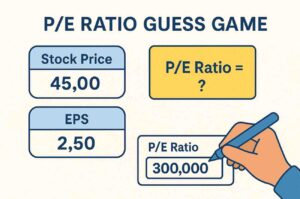 The Price-to-Earnings Ratio (PE Ratio) tells you how much investors are willing to pay for each rupee of earnings a company generates.
It is one of the most widely used valuation tools in stock market analysis.
PE Formula:
👉 PE Ratio = Price ÷ EPS (Earnings Per Share)
A high PE often suggests:
- High growth expectations
- Strong investor confidence
- Premium valuation
A low PE may indicate:
- Undervalued stock
- Slowing earnings
- Market pessimism
But PE is meaningful only when compared with:
- Industry averages
- Historical PE of the same company
- Future growth rates
✔ 1. Why the PE Ratio Matters
PE tells you instantly how expensive or cheap a stock is relative to its earnings.
Investors use it to answer questions like:
- Is this stock overvalued or undervalued?
- Are earnings strong enough to justify the price?
- How does this company compare to competitors?
PE helps investors find value stocks or avoid overpriced ones.
✔ 2. How This Game Helps You Learn
The PE Ratio Guess Game gives you:
- A stock price
- Its EPS
- A chance to input the PE guess
- Instant scoring, explanations, and a learning loop
This helps you:
- Build valuation intuition
- Understand how price and EPS interact
- Train your mind to quickly evaluate stocks
- Recognize when a PE seems too high or too low
The game strengthens the foundation of valuation analysis.
✔ 3. Understanding PE More Deeply
There are multiple types of PE ratios:
- Trailing PE
Based on past 12 months earnings (most commonly used).
- Forward PE
Uses projected future earnings — helpful for growth companies.
- Historical PE
Compares current PE with the company’s long-term average.
- Relative PE
Compares PE with competitors or the industry.
This game helps beginners master the core concept before exploring advanced PE variations.
✔ 4. Perfect For Beginners & Investors
This game is especially useful for:
- Students learning financial basics
- Stock market beginners
- Value investors
- Analysts building quick valuation reflexes
PE is one of the fastest ways to evaluate a stock — this game helps you understand it by doing.
❓ Frequently Asked Questions (FAQ)
- What does a high PE ratio mean?
A high PE generally means the stock is expensive compared to earnings.
Investors expect strong future growth.
- What does a low PE ratio mean?
A low PE may indicate a cheap or undervalued stock, but it can also signal:
- Slowing growth
- Weak business fundamentals
- Market concerns
Always analyse deeper before investing.
- What is a good PE ratio?
There is no universal “good PE.”
It depends entirely on:
- Industry
- Company growth rate
- Economic conditions
Tech companies often have high PE; utility companies have low PE.
- How accurate should the PE guess be in the game?
The game accepts guesses with different scoring levels:
- Within 0.1 = Perfect
- Within 1.0 = Great
- Within 2.5 = Acceptable
This helps you build valuation intuition gradually.
- Why does PE become infinite when EPS is zero?
If EPS = 0, dividing price by EPS is impossible — PE becomes undefined (infinite).
This usually means the company made no profit.
- Can PE be negative?
Technically no.
If EPS is negative, PE is not meaningful because the company is losing money.
Analysts simply say:
“The company has negative earnings,”
not
“PE is negative.”
- Should I use PE alone to evaluate a stock?
No. PE must be combined with:
- Growth rate
- ROE / ROCE
- Cash flow
- Industry comparison
- Debt levels
PE is a starting point, not a complete valuation model.
- What skills will I learn from this game?
You will learn:
- How price influences valuation
- How EPS impacts PE
- How to compare stocks quickly
- How to build valuation intuition
These skills are essential for both beginners and experienced investors.