It was a bright Saturday morning in Aranyapur, and the city market was buzzing with visitors. Shops were decorated, vendors were shouting offers, and children chased each other between stalls.
Aryan and the Market Monk were walking together when they noticed a large crowd gathered around a shop.
Above the shop hung a big, bold sign:
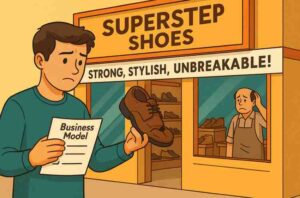 “SuperStep Shoes – Strong, Stylish, Unbreakable!”
Aryan smiled. “I’ve heard of this place! They claim their shoes last forever.”
The Monk raised an eyebrow. “Forever? That is an unusual business promise.”
Just then, a man stormed out of the shop holding a shoe whose sole had completely separated from the body.
“These shoes didn’t last even six weeks!” he shouted angrily.
Another customer added, “Mine tore in two months!”
A third complained, “Cheap quality! Never buying again.”
Aryan sighed. “So their claim is fake.”
“Not just fake,” the Monk said. “It shows a deeper problem. Come, Aryan. Today you will learn why business models decide whether a company succeeds or collapses.”
THE SHOP OWNER’S EXCUSES
Inside the shop, the owner, Mr. Prakash, looked overwhelmed. Several customers demanded refunds, and staff members kept apologizing.
Prakash looked up at the Monk as if recognizing wisdom when he saw it.
“Master, please tell me what went wrong!” he pleaded. “We are losing customers every day.”
The Monk glanced around—shoes stacked everywhere, discount banners, unhappy customers.
“Aryan,” the Monk asked, “what do you think the problem is?”
Aryan thought for a moment.
“The product quality is poor.”
“Correct,” the Monk said. “But the deeper issue is this: the business model is weak.”
Prakash looked confused. “Business model? But we sell shoes. People buy shoes. That is the model, right?”
The Monk shook his head gently.
“No, Prakash. A business model is not what you sell—it is how you create value and earn profit sustainably.”
THE FOUR QUESTIONS EVERY BUSINESS MUST ANSWER
The Monk pulled out a small notebook and drew four large circles.
“These represent the questions every strong business model must answer clearly.”
- Who is the customer?
“Do you know exactly who you are serving?”
Prakash hesitated. “Everyone who wears shoes?”
The Monk smiled. “That answer is too broad. Great businesses know their exact customer—athletes, office workers, school children, hikers, etc. You are trying to serve everyone… so you end up serving no one well.”
- What problem are you solving?
“Good shoes solve problems—comfort, durability, style, safety. What problem do your shoes solve?”
Prakash looked embarrassed. “We mostly focus on making them cheap.”
“And that,” the Monk said, “is why customers leave.”
- How will the business make money sustainably?
“Low prices bring customers, but poor quality drives them away. Your repeat customers are disappearing, which destroys long-term revenue.”
- What makes the business different from competitors?
“Why should someone buy your shoes instead of others?”
Prakash stuttered, “We… we offer discounts.”
The Monk sighed. “Discounts are not a business model. They are a temporary trick.”
THE VISIT TO A SUCCESSFUL SHOE STORE
To explain further, the Monk took Aryan and Prakash across the market to StridePro Footwear, a smaller shop but bustling with happy customers.
The owner, Ms. Sahana, welcomed them warmly.
“Master Monk! Please come in.”
Sahana showed them around:
- A section for jogging shoes
- A section for trekking shoes
- A section for school shoes
- A customization counter
- A repair and service desk
Aryan was amazed. “Your store is smaller, but it feels so organized.”
The Monk nodded. “Because Sahana has a clear business model.”
He pointed to a sign on the wall:
“Right Shoes for the Right Person.”
WHY STRIDEPRO’S MODEL WORKS
Sahana explained her approach:
✔ She identified specific customers
“Runners, students, office workers.”
✔ She focused on solving their real problems
“Comfort, durability, light weight, foot support.”
✔ She priced the products fairly—not cheaply
“Cheap becomes expensive when it breaks in two months.”
✔ She added services
Free cleaning for regular customers, repairs, and loyalty cards.
✔ She ensured quality
“We don’t promise ‘unbreakable shoes.’ We promise well-made shoes that match your needs.”
Prakash looked stunned.
“So customers keep coming back because they trust your model.”
Sahana nodded. “People return not because the shoes are perfect—but because the experience is honest.”
THE MONK’S COMPARISON
Back outside, the Monk made Aryan observe both shops again:
SuperStep Shoes
- Big store
- Big claims
- Low quality
- High returns
- Angry customers
- Declining sales
- Confused strategy
StridePro Footwear
- Smaller store
- Clear focus
- Quality products
- Loyal customers
- Growing sales
- Strong reputation
- Smart business model
Aryan whispered, “The difference is not size… it is strategy.”
“Exactly,” the Monk said.
“A weak business model collapses even if the shop looks beautiful.
A strong business model thrives even if the shop is small.”
THE REBUILDING
Prakash lowered his head.
“Master, what should I do now?”
The Monk smiled warmly.
“Start by redefining your business model.”
He handed Prakash a new notepad.
New Plan for SuperStep Shoes
✔ Identify target customers—office workers & school children
✔ Improve product quality—partner with better suppliers
✔ Stop unrealistic claims
✔ Add repair/return service
✔ Introduce quality testing
✔ Build brand trust with transparency
✔ Gather customer feedback monthly
✔ Train staff to help customers choose correct sizes and types
Prakash nodded eagerly.
“I will rebuild my business from the foundation!”
THREE MONTHS LATER
When Aryan and the Monk returned, SuperStep Shoes had transformed.
- Fewer products, but better quality
- Clear sections for different customer needs
- Honest marketing
- A new service counter
- Happy customers walking out with smiles
Prakash looked brighter than ever.
“Master! Our complaints have decreased. Repeat customers have doubled. Business is finally stable!”
The Monk placed a hand on his shoulder.
“You now understand the importance of the business model.”
⭐ ARYAN’S FINAL LESSON
As they walked home, Aryan summarized the lesson:
“A strong business model means:
- Knowing your customer
- Solving their real problem
- Earning money sustainably
- Offering something better than competitors
- Delivering consistent quality
- Building trust over time”
The Monk nodded proudly.
“And investors look for companies like StridePro—not SuperStep before improvement.”
Aryan smiled.
“Because a broken business model breaks the company.”
The Monk replied:
“And a strong model builds a future.”