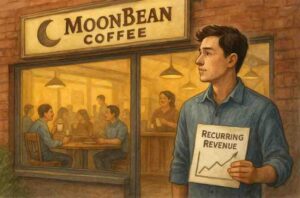
 Aranyapur’s central street came alive every morning as the aroma of fresh coffee drifted through the air. At the heart of this lively area stood a small but charming café called MoonBean Coffee—a place famous for its warm ambience and perfectly brewed drinks.
Aryan and the Market Monk often passed by it during their morning walks. One day, however, the Monk stopped and pointed toward the café.
“Tell me, Aryan,” he asked, “why do you think this small coffee shop always seems full while larger shops sometimes struggle?”
Aryan shrugged.
“Maybe their coffee is tastier?”
“That is one reason,” the Monk said. “But something deeper fuels their success—recurring revenue.”
Aryan blinked. “Recurring… what?”
The Monk smiled.
“Let’s step inside.”
THE CAFE THAT NEVER STOPPED EARNING
Inside MoonBean Coffee, the air buzzed with activity.
Customers lined up at the counter.
Students studied at long wooden tables.
Office workers grabbed their morning brew.
Some stayed for an hour. Others only seconds.
But in every corner, people were drinking coffee.
Aryan observed something interesting.
The same faces kept returning—not just today, but every day.
“Master,” Aryan whispered, “these aren’t one-time customers. They come back daily.”
“Exactly,” the Monk said. “This is the heartbeat of recurring revenue.”
MEETING THE OWNER WHO UNDERSTOOD HABITS
The café owner, a cheerful woman named Kavya, greeted them.
“Master Monk! Aryan! Please sit. I’ll bring your usual drinks.”
Aryan grinned. “She even knows our preferences!”
“That,” the Monk said, “is another reason her business thrives.”
Kavya brought their drinks and joined them.
“You know,” she said, “people think I run a coffee shop. But I actually run a routine factory.”
Aryan tilted his head. “Routine factory?”
Kavya nodded.
“People don’t think of coffee as a luxury. They think of it as a habit. And habits create recurring revenue.”
The Monk smiled proudly.
THE THREE TYPES OF REVENUE
Kavya took out a notebook and drew three circles.
- One-Time Revenue
“Like when someone buys a shoe once every two years.”
Aryan thought of the shoe story and nodded.
- Occasional Revenue
“Like festival sweets. People buy only during special occasions.”
- Recurring Revenue
“Like rent, subscriptions… and coffee.”
Aryan’s eyes widened.
“So recurring revenue means customers keep coming back naturally?”
“Exactly,” said Kavya. “You don’t have to chase them again and again.”
INSIDE THE REVENUE ENGINE
Kavya led them behind the counter where a large board displayed:
✔ Daily Regular Customers: 86
✔ Weekly Regular Customers: 230
✔ Monthly Subscription Members: 120
Aryan was surprised. “Subscription members? For a coffee shop?”
Kavya proudly explained:
“For ₹499 a month, members get a coffee every morning, discounts, and a members-only menu.”
Aryan gasped.
“That means even if no one enters the shop today… you already earned money?”
“Yes!” she laughed. “That’s the beauty of recurring revenue. It brings predictability.”
She continued:
“When I know my monthly income, I can hire better staff, buy better beans, plan expansion, and manage expenses.”
The Monk added:
“This predictable income is one reason investors love recurring-revenue companies.”
THE COMPETITOR WITHOUT A ROUTINE
Across the street stood a larger, fancier café called BrewCastle.
It looked modern and stylish.
But despite its classy design, it was often empty.
Curious, Aryan asked, “Why doesn’t BrewCastle get the same crowd?”
The Monk led him inside.
The place was silent. Only two customers sat inside.
The owner looked tired.
“We rely on occasional customers… tourists, festival shoppers, or people just passing by.”
He sighed.
“Some days we earn great. Some days… almost nothing.”
Aryan realized the difference immediately.
“MoonBean has customers who return every day. But BrewCastle waits for new customers all the time.”
“Correct,” the Monk said.
“A business without recurring revenue is like a tap that drips unpredictably. Some days water flows, some days it stops.”
He continued:
“But a recurring-revenue business flows like a steady river—bringing stability, confidence, and growth.”
WHAT RECURRING REVENUE TEACHES INVESTORS
As they stepped outside, the Monk began his lesson.
“Every strong company has a core engine,” he explained.
“For some, it is subscriptions—like Netflix.”
“For others, it is repeat purchases—like shampoo companies.”
“For some, it is renewal contracts—like software companies.”
He drew a circle on the ground with his stick.
“Recurring revenue creates three superpowers:”
- Predictability
Investors can estimate future earnings easily.
- Stability
Even during tough times, recurring revenue keeps the business alive.
- Customer Loyalty
People who return regularly strengthen the foundation of the company.
Aryan nodded thoughtfully.
“Master… so a coffee shop that earns every day is stronger than a fancy café that earns only sometimes.”
“Yes,” the Monk said.
“And the same principle applies to every business in the world.”
THE NIGHT THAT PROVED THE LESSON
That evening, a sudden rainstorm flooded the streets. Many shops shut down early. BrewCastle closed immediately—no customers meant no income.
But MoonBean Coffee?
Its subscribers still came in the morning, had their drinks, and Kavya earned her monthly subscription income upfront.
Even during a bad day, her business never truly stopped.
Aryan watched it unfold and whispered:
“It’s like MoonBean never sleeps.”
The Monk nodded.
“That is the power of recurring revenue.”
⭐ ARYAN’S FINAL LESSON
As they walked home, Aryan summarized the lesson:
“Recurring revenue means the business earns again and again from the same customers—
not by chance but by habit.”
The Monk smiled.
“And the investors who understand recurring revenue,” he said,
“understand which businesses will grow steadily…
and which ones will struggle unpredictably.”
Aryan took a deep breath of the coffee-scented air.
He finally understood why some businesses survive storms—
because their customers return like sunrise, again and again.