 The evening breeze swept gently across Aranyapur as Aryan and the Market Monk walked through the town square. Rows of shops buzzed with activity—tailors stitching clothes, bakers preparing bread, and merchants closing deals.
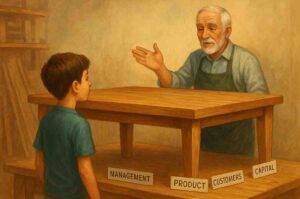
In the center stood a beautiful wooden furniture shop named Stability Furnishings.
Inside, a giant table caught Aryan’s attention. It was tall, polished, strong, and beautifully carved.
Aryan walked closer and touched it.
“Master, this table looks unshakeable.”
The Monk smiled.
“Exactly. And today, you will learn why a business is just like a table.”
Aryan blinked. “A table?”
“Yes,” the Monk said softly. “A strong business stands on four legs—Management, Product, Customers, and Capital. Remove even one, and the entire structure begins to wobble.”
THE CARPENTER WHO UNDERSTOOD BUSINESS
A cheerful old carpenter named Harish entered the shop.
“Welcome, Master Monk! Welcome, Aryan!”
He tapped the giant table proudly.
“This is my strongest creation. It took six months to design.”
Aryan admired it.
“What makes it so strong?”
Harish held up four thick wooden beams.
“These legs,” he said. “If even one leg is weak, the table becomes unstable.”
The Monk nodded.
“Just like a business.”
Harish smiled. “Would you like to see how each leg teaches a business lesson?”
Aryan nodded eagerly.
⭐ LEG 1: MANAGEMENT (THE MIND OF THE TABLE)
Harish pointed to the first leg—smooth, polished, and perfectly shaped.
“This leg,” he said, “represents management—the leadership of the business.”
Aryan listened as he continued:
“A good manager is like a master carpenter:
- They choose the right materials
- They guide workers
- They plan ahead
- They solve problems
- They ensure quality”
The Monk added:
“A business with weak management collapses even if the product is good.
Poor decisions, lack of direction, or dishonesty weaken the entire structure.”
Examples appeared in Aryan’s mind:
- A restaurant with great chefs but terrible management fails
- A company with innovative ideas but greedy leaders struggles
- A team without direction wastes talent
Aryan nodded.
“So the first leg must be strong and wise.”
“Exactly,” Harish said.
⭐ LEG 2: PRODUCT (THE PURPOSE OF THE TABLE)
Harish tapped the second leg.
“This leg represents the product—what the company creates.”
He walked Aryan to a shelf holding different items.
“What makes customers come back?” Harish asked.
Aryan replied, “A good product… something useful.”
“Correct,” Harish said. “If a table breaks easily, no one buys it.
If a shoe tears, nobody returns.
If a phone overheats, customers switch brands.”
The Monk added:
“In investing, you must always ask—
Does this company have a product people truly want?
A bad product breaks the table quickly.”
Aryan realized something important:
“A strong product keeps the business standing—just like this leg keeps the table steady.”
⭐ LEG 3: CUSTOMERS (THE LIFE OF THE TABLE)
Harish pointed to a leg decorated with small carvings of people.
“This leg is customers—the lifeblood of any business.”
He pulled out a small notebook.
“Every day I write down:
- Who bought from me
- What they liked
- What they didn’t
- What they may need next”
Aryan was impressed. “You track everything?”
“Yes,” Harish said. “Because without customers, even the best product and management fail.”
The Monk nodded.
“Investors love companies with:
✔ repeat customers
✔ loyal fans
✔ strong demand
✔ customer trust”
Aryan remembered MoonBean Coffee and BlueSpring Water—both successful because of strong customer loyalty.
“So this leg must never crack,” Aryan said.
“Correct,” Harish smiled.
⭐ LEG 4: CAPITAL (THE ENERGY OF THE TABLE)
Finally, Harish tapped the fourth leg—a thick, heavy beam.
“This leg represents capital—money needed to grow.”
He explained:
“A carpenter needs:
- Wood
- Tools
- Workspace
- Workers
- Time”
“All of that requires capital.”
The Monk added:
“Some businesses fail not because their product is bad, or customers aren’t interested—but simply because they run out of money.”
Aryan nodded seriously.
“So a business needs enough capital to survive tough times.”
“Yes,” the Monk said.
“Capital is the strength that keeps the table balanced during storms.”
⭐ THE TABLE WITH A BROKEN LEG
Harish suddenly pushed a table with one short leg into the center of the room. It wobbled violently.
Aryan laughed. “That table will fall if you put anything on it!”
Harish winked.
“Exactly. Now imagine this wobbly table is a business.”
Aryan pointed at each broken leg:
“Bad management… weak product… no customers… no money…”
“And that,” the Monk said, “is why many businesses collapse.”
Sometimes:
- A great product fails due to bad management
- Customers leave because quality drops
- A business runs out of money even if demand is high
- Strong capital is wasted due to lack of strategy
Aryan understood the message deeply.
⭐ BUILDING A STRONG BUSINESS TABLE
Harish handed Aryan a wooden board with four words:
Management – Product – Customers – Capital
“These four legs must grow together,” he said.
The Monk added:
“When investors evaluate a company, they check these four foundations.
A business with all four strong legs stands firm for decades.”
Aryan repeated softly:
“A table with four strong legs never falls.”
“Exactly,” the Monk smiled.
⭐ ARYAN’S FINAL LESSON
Walking home, Aryan summarized the wisdom:
- Great management guides the business
- Great product satisfies customers
- Loyal customers sustain the business
- Sufficient capital powers growth
“All four must be strong,” Aryan said.
“Yes,” the Monk replied.
“That is how great companies stand tall, even through storms.”
Aryan imagined every company as a table.
Some tall and strong.
Some shaky and weak.
He knew he would never look at businesses the same way again.