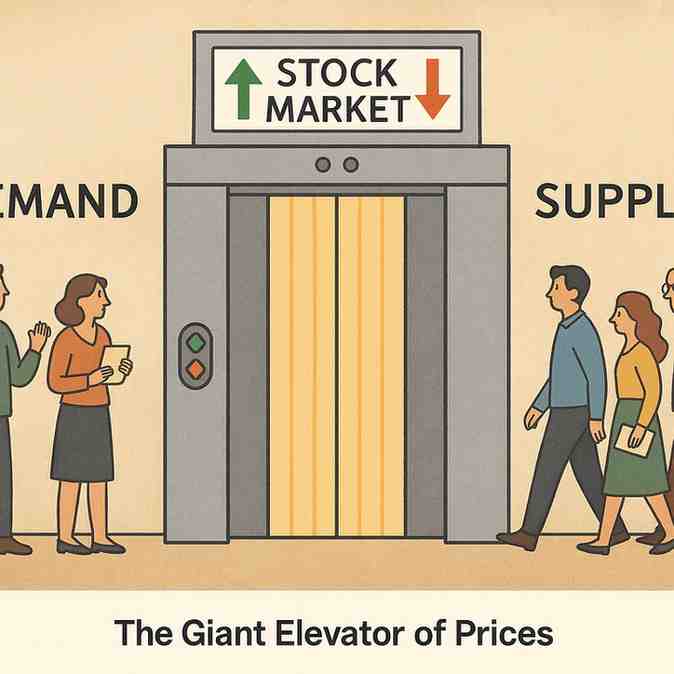
 The city of Aranyapur was known for two things: its golden sunrise and its towering structure in the center—the Giant Elevator of Prices. Every visitor who came to the city heard fascinating tales about this magical elevator, able to go up, down, or stay still depending on the mood of the people.
Aryan, now deep into his journey of understanding the stock market, arrived in Aranyapur with the Market Monk to learn the next major lesson of investing.
As they stood before the elevator, Aryan looked up in amazement. It had no floors, no buttons, and no operator. Yet it constantly moved—sometimes slowly, sometimes in sudden jumps.
“What controls it?” Aryan asked.
The Monk smiled. “This elevator moves based on the desires of the people—how many want to go up and how many want to go down. It is the purest symbol of supply and demand.”
Aryan frowned. “I’ve heard the words ‘supply’ and ‘demand’ many times, but I don’t understand how they affect prices.”
The Monk tapped the elevator gently. “Then let me tell you a story.”
The Golden Mango Cart
Years ago, a woman named Tara ran a mango cart in Aranyapur. She sold rare golden mangoes that were juicier and sweeter than anything people had ever tasted. Every morning she had only 20 mangoes to sell.
People loved them so much that soon 40 people arrived each day to buy them.
Aryan smiled. “So more people wanted them than the mangoes available?”
“Exactly,” said the Monk. “And what happens when many people want something rare?”
“Price goes up.”
The Monk nodded. “Correct. Because people competed. Some said, ‘I will pay extra if you give it to me.’ That is high demand with low supply.”
Tara slowly raised the price—not because she was greedy, but because the market told her that people valued her mangoes more.
When Supply Rises
One year, Tara found a bigger mango farm and started bringing 100 mangoes each morning.
But the number of buyers remained the same—about 40 people.
“So now supply was higher than demand?” Aryan asked.
“Yes,” said the Monk. “And what happens then?”
“The price drops.”
“Correct. Tara had to reduce the price, or she would go home with unsold mangoes.”
Aryan nodded, beginning to understand.
The Elevator Moves
Suddenly the Giant Elevator in the city center jerked upward.
Aryan jumped back. “What happened now?!”
The Monk pointed around the plaza. A crowd of tourists had gathered, each holding silver coins, ready to buy miniature models of the elevator from a street vendor.
“When many people want something,” the Monk said, “the price naturally rises, and the elevator goes up.”
Moments later, another vendor began selling handmade bookmarks. Very few people looked interested. The elevator gently drifted downward.
“The elevator reflects people’s behavior,” explained the Monk. “Just like stock prices reflect buying and selling.”
The Market is a Crowded Bazaar
The Monk led Aryan to the marketplace. Everywhere, vendors shouted prices, buyers bargained, and shopkeepers adjusted rates based on crowd activity.
“This,” the Monk said, “is how the stock market truly works—not through predictions or magic, but through the simple force of supply and demand.”
He continued:
- “When more buyers want a stock, demand is high → price rises.”
- “When more sellers want to get rid of it, supply is high → price falls.”
“Stocks are not controlled by a single person,” he added. “They are controlled by all of us—our hopes, fears, beliefs, and decisions.”
The Tale of the Two Shops
To explain further, the Monk took Aryan to two neighboring shoe shops.
Shop A: Scarcity Increases Value
The first shop had a new collection of handmade shoes—only 10 pairs. People lined up to buy them.
The shopkeeper raised the price slightly. Still, customers eagerly purchased.
“Low supply + high demand,” Aryan said confidently. “So price rises.”
The Monk nodded.
Shop B: Plenty Reduces Urgency
The shop next door had hundreds of pairs. Customers walked casually. No rush. No competition.
To attract buyers, the shopkeeper lowered prices.
“High supply + low demand,” Aryan said. “So price falls.”
The Monk grinned. “You’re learning faster than the elevator moves.”
The Emotional Storm
As they returned to the plaza, dark clouds gathered overhead. People rushed to shelter. Vendors lowered prices to sell quickly before the rain ruined their goods.
Aryan watched in fascination.
“Even fear affects supply and demand,” the Monk said. “When people panic, they sell fast. When people feel hopeful, they buy more.”
“So emotions are part of the market?” Aryan asked.
“They are the fuel,” the Monk replied. “But the law of supply and demand remains the engine.”
The Final Lesson at Sunset
The sun dipped behind the hills, casting long shadows across Aranyapur. The Giant Elevator of Prices glowed faintly in the twilight.
Before leaving, the Monk placed Aryan’s hand on the elevator’s door.
“This elevator is not mysterious,” he said. “It simply responds to the wishes of the crowd.”
He paused.
“In the stock market, the price is nothing but a reflection of how many people want to buy or sell at a moment in time.”
Aryan nodded, feeling clarity spread through his mind.
The Monk concluded:
“Prices rise when more people want to buy than sell.
Prices fall when more people want to sell than buy.
This is the heartbeat of every market in the world.”
As they walked away, Aryan looked back at the ever-moving elevator.
He finally understood:
Stock prices do not move because of magic—they move because people move.
And that was a lesson worth remembering for life.