The rain had washed Aranyapur clean the night before, leaving the morning air crisp and fragrant. Aryan walked alongside the Market Monk through the narrow stone pathways that led toward the city’s old amphitheater. The Monk had been quiet since sunrise—always a sign that a new lesson was coming.
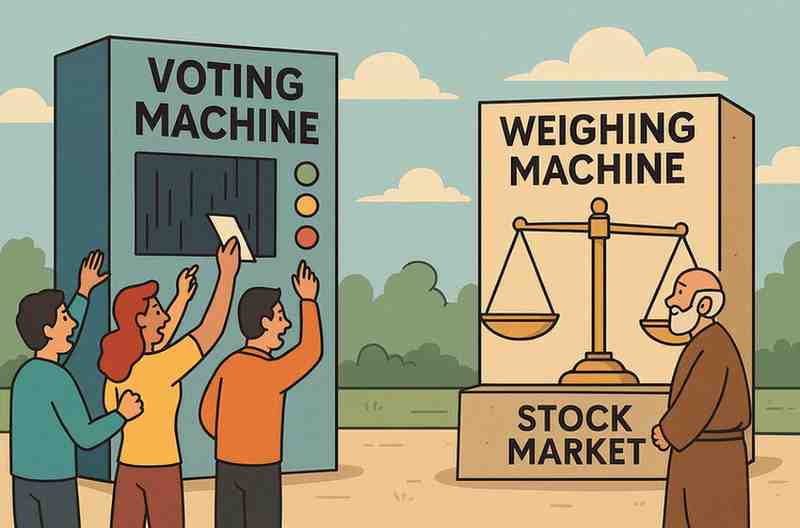
When they reached the amphitheater, Aryan saw two enormous structures facing each other.
One was tall, thin, shiny, full of bells and blinking lights. People lined up in front of it, loudly arguing, cheering, worrying. The machine vibrated like it was alive.
The other was a large stone pedestal, wide and stable. At its center sat a perfectly balanced weighing scale made from bronze. No noise came from this side. No crowds pushed. Only a few calm observers stood silently, watching.
Aryan’s eyes grew wide.
“Master… what are these machines?”
The Monk smiled gently.
“Today you will learn the greatest truth of markets. This,” he said pointing to the loud, glowing machine, “is the Voting Machine.”
“And that,” he added, pointing toward the stone pedestal, “is the Weighing Machine.”
Aryan was puzzled. “Why do we need two?”
The Monk motioned him to follow.
THE VOTING MACHINE – WHERE EMOTIONS RULE
They approached the noisy machine. People threw small tokens into its slot—some laughing confidently, others shaking nervously.
The machine responded instantly. Lights flashed. Numbers jumped. Bells chimed. The crowd reacted louder each time.
Aryan flinched. “It looks chaotic.”
“That is because it is,” said the Monk. “The Voting Machine reacts to opinions, emotions, rumors, news, fear, excitement, and impatience.”
A man pushed through the crowd, shouting,
“I heard a company is launching a new product—buy, buy, buy!”
Immediately the machine lit up bright green.
Moments later, someone else yelled,
“A rumor says profits might fall—sell everything!”
The machine flashed red.
Aryan blinked. “It moves so fast… even when nothing real has happened?”
The Monk nodded.
“Yes. Because this machine does not measure truth—it measures sentiment. Every day in the stock market, millions of investors cast votes based on how they feel. And prices jump because of this emotional voting.”
Aryan looked again.
People weren’t studying businesses. They were reacting to noise.
“This is why prices fluctuate wildly in the short term,” the Monk continued. “The market behaves like a voting machine—capturing popularity, predictions, fear, greed, and panic.”
Aryan sighed. “So the short-term market is basically a mood swing?”
“Exactly,” said the Monk, laughing softly. “It is human emotion made visible.”
THE WEIGHING MACHINE – WHERE TRUTH WINS
The Monk then guided Aryan toward the quiet stone pedestal. The bronze weighing scale rested peacefully, unmoving.
“No crowds?” Aryan asked.
“Only those who understand value come here,” the Monk replied.
He placed a small metal cube onto one plate of the scale.
“It weighs what it is,” he said. “Not more, not less.”
Aryan watched the needle rise gently, settle smoothly, and stop with absolute certainty.
“This scale does not care about rumors,” the Monk explained. “It does not react to excitement or fear. It measures only the true weight—the fundamental worth.”
Aryan understood.
“In the long run, the market behaves like this weighing machine?”
The Monk nodded.
“Yes. Over time, good businesses rise because they deserve to rise. Weak businesses fall because they deserve to fall. Not because of emotion, but because of performance.”
He continued:
- “A business with strong earnings becomes heavier.”
- “A company with growing customers becomes heavier.”
- “A company with innovation becomes heavier.”
“And over years,” the Monk added, “the Weighing Machine recognizes this.”
Aryan stared at the bronze scale with newfound respect.
“So short-term is voting… long-term is weighing.”
“Correct,” the Monk said. “In the short term, people choose based on feelings. In the long term, reality chooses.”
THE STORY OF THE TWO BROTHERS
To make the lesson clearer, the Monk told Aryan a tale.
“Two brothers, Kavi and Ravi, started identical sweet shops in the bazaar.”
Kavi was flashy, loud, and constantly promoting.
“He shouted, ‘My sweets will run out today!’ even when they didn’t. People rushed—sometimes for no reason.”
His shop’s demand changed every day.
“Ravi, on the other hand,” the Monk said, “simply focused on making the best sweets. Every day he improved his recipe, trained his staff, and listened to customers.”
Weeks passed. Crowds swarmed Kavi’s shop on some days and ignored him on others, depending on the hype he created.
“That,” the Monk said, “is the Voting Machine.”
But Ravi’s shop grew steadily. People trusted his quality, returned often, and recommended it to others.
“That,” he continued, “is the Weighing Machine.”
Aryan smiled. “So popularity wins today… but quality wins tomorrow.”
“Exactly,” the Monk said. “A business becomes valuable not because people scream its name but because it quietly proves its worth.”
THE FINAL REALIZATION
As sunset painted the sky orange, Aryan stood between both machines.
The Voting Machine glittered, noisy and restless—just like daily market prices.
The Weighing Machine glowed softly, patient and wise—just like true business value.
“Master,” Aryan said softly, “I finally understand.”
He pointed to the noisy side.
“This is why I should not panic when prices jump or fall.”
He pointed to the weighing scale.
“And this is why long-term investors study businesses, not noise.”
The Monk nodded proudly.
“Remember, Aryan—
In the short run, the market votes.
In the long run, the market weighs.”
Aryan smiled, feeling wiser than ever.
And as the last bell rang from the Voting Machine, he turned away—realizing he would never again fear the daily noise of markets.
He would trust the Weighing Machine.
The machine that always told the truth.