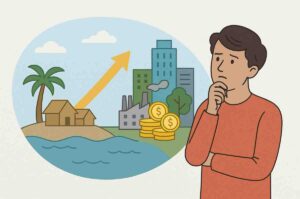
 Far beyond the busy towns of Aranyapur lay a peaceful island called Nivara. The people there were cheerful, hardworking, and skilled in many trades. Fishermen brought home fresh catches each morning, farmers grew colourful fruits, and artisans carved beautiful ornaments from shells and wood. Life was simple, calm, and predictable.
Yet, despite all this happiness, something strange happened on Nivara.
No one ever seemed prepared for the future.
Every day people earned just enough to get by—and every day they spent everything they earned. Fishing nets were patched until they tore completely. Boats were repaired only when they sank. Farms struggled during dry seasons because no one had saved enough to buy water storage tanks or better seeds.
Aryan visited Nivara alongside the Market Monk as part of his financial learning journey.
“Master,” Aryan whispered as they walked through the village market, “everyone looks happy. Why are we here?”
The Monk placed his hand gently on Aryan’s shoulder.
“Because, Aryan, this island hides a silent problem—one that existed everywhere before capital markets were born.”
THE CRISIS OF NO SAVINGS
One afternoon, a storm hit Nivara. It tore fishing nets, destroyed roofs, and flooded fields. The people struggled.
Aryan saw fishermen staring hopelessly at broken boats.
A farmer cried, “I cannot plant seeds this season. I have no money left.”
An artisan sighed, “I cannot buy new tools. I live day to day.”
Aryan looked at the Monk.
“If they have skills and businesses, why can’t they grow?”
The Monk replied softly:
“Because without savings, a dream cannot rise. And without investment, a society cannot grow.”
Aryan nodded, understanding slowly.
“When people do not save,” the Monk continued, “they cannot build. They cannot prepare. They cannot protect themselves from uncertainty.”
THE ISLAND’S MEETING
The island’s leader, Elder Nilo, called a meeting.
“Our island is filled with talent,” he said. “But talent alone cannot build a future. We must learn to save—and we must learn to invest.”
The villagers murmured.
“Invest? What does that mean?” a fisherman asked.
“How can we give money when we barely have enough?” a mother questioned.
Elder Nilo smiled. “You misunderstand. Investment does not mean losing money. It means growing money.”
Aryan looked at the Monk, who nodded gently.
THE BIRTH OF AN IDEA
The Monk stepped forward.
“Imagine,” he began, “a fisherman named Rako who wants to buy a new boat. The boat costs more than he can afford. But what if 20 villagers each contribute a small amount? Rako can buy the boat. He catches more fish. His income grows. And he shares a portion of the profit with all the contributors.”
The villagers exchanged excited looks.
“That sounds fair!” one fisherman shouted.
A farmer raised his hand. “Can this also help me buy storage tanks for my field?”
“Yes,” said the Monk. “If villagers invest in your farm, you grow more crops. They benefit when you benefit.”
Aryan stepped forward.
“So villagers become partners in each other’s growth?”
“Exactly,” the Monk said.
“This is the purpose of capital markets.”
WHY CAPITAL MARKETS EXIST
The Monk picked up a handful of sand and let it slip slowly through his fingers.
“Time slips away,” he said. “But wealth can grow—if people save and invest wisely.”
He explained:
- Capital markets allow people to save money safely.
- Businesses can borrow or raise funds by offering shares or bonds.
- Growth becomes possible because money flows where it is needed.
- People who save can earn returns from businesses they support.
- Society becomes stronger because savings turn into progress.
Aryan listened carefully.
“So, capital markets exist because people need a way to grow their money AND help businesses grow?”
“Correct,” said the Monk.
“Without them, communities stay stuck—just like Nivara.”
THE ISLAND’S FIRST INVESTMENT
A few days later, the villagers gathered again.
A fisherman named Rako stood trembling before the crowd.
“I want to buy a strong new boat,” he said. “It costs 1,000 shells. I only have 200.”
“For years I dreamed of expanding my work,” he continued. “But I never could. Today, with your support, maybe I can.”
One by one, villagers stepped forward:
“I will invest 50 shells.”
“I can spare 20.”
“I’ll add 10.”
“My family can give 30.”
Within an hour, Rako had more than enough.
He looked overwhelmed. “I will not disappoint you.”
Aryan smiled. It was the first public investment in Nivara’s history.
A YEAR LATER
Rako’s new boat glided across the waves like a sea bird. His catch doubled. Sometimes tripled. He built a small storage hut and hired young boys from the village.
At the end of the year, he handed each investor a small leather pouch.
“Your share of the profits,” he said proudly.
The villagers clapped and cried with joy.
Soon:
- The farmers raised money for irrigation
- The artisans bought new carving tools
- The school raised funds for books
- A new medical hut was built
Savings transformed into opportunity.
Opportunity transformed into growth.
Growth transformed into prosperity.
ARYAN’S REALIZATION
As Aryan and the Monk prepared to leave the island, Aryan turned and watched the villagers bustling with new energy.
“Master,” he said softly, “I finally understand.”
He pointed to the lively scene:
“Capital markets exist because people need a bridge—
A bridge that connects today’s savings with tomorrow’s dreams.”
The Monk smiled warmly.
“Yes, Aryan.
Where savings sleep, societies stay the same.
Where savings grow, societies rise.”
Aryan whispered:
“So savings are seeds…
And capital markets are the gardens where they grow.”
The Monk nodded.
And the island of Nivara—once quiet and stuck in time—now stood as a glowing example of what happens when people learn to save, invest, and build a future together.