The sun had barely risen when Aryan stepped out of the airport into the cool morning breeze of a city he had only seen in photographs. He had travelled here to meet someone people whispered about in investing circles—the Market Monk. Some said he could explain the stock market to a child. Others said he had no interest in money at all, only in understanding how people make decisions about money.
Aryan wasn’t here for magic, though. He was here because he was confused. He had read blogs, watched videos, listened to friends, but all he heard was noise—“Buy this stock,” “Sell that one,” “This is going up,” “This is going down.”
He didn’t want shortcuts. He wanted clarity.
The Market Monk lived in a small village a few miles from the city’s edge. Aryan reached a wooden house painted in earthy tones, surrounded by plants and a peaceful silence. A man with calm eyes and a gentle smile opened the door.
“You must be Aryan,” he said. “I’ve been expecting you.”
The Monk led him to a courtyard where two cups of steaming tea waited.
“Before we begin,” the Monk said, “tell me one thing: What do you think the stock market is?”
Aryan replied, “A place to buy and sell stocks. A place where prices go up and down.”
The Monk smiled. “That is the surface. The stock market is not a place of numbers. It is a place of stories.”
“Stories?” Aryan asked, confused.
“Yes,” the Monk said. “Let me show you.”
He picked up a dried leaf that had fallen from a mango tree.
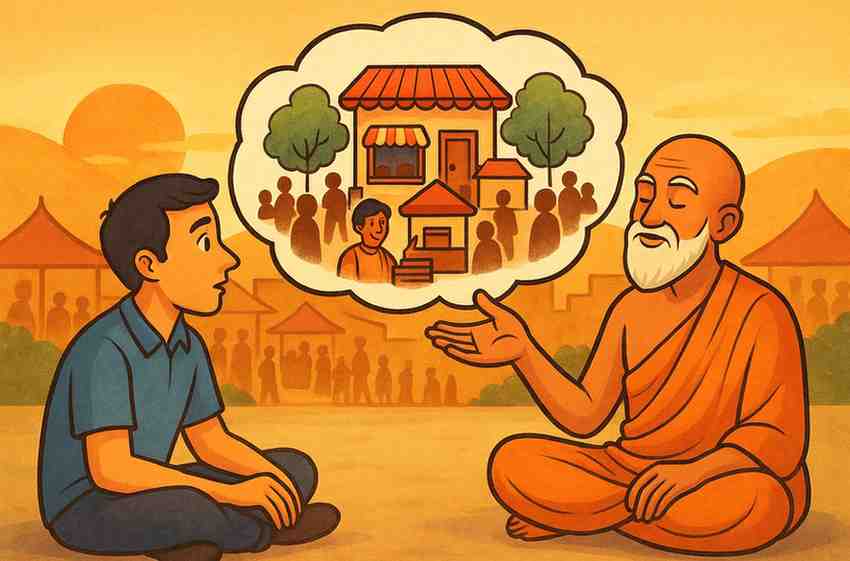
“Imagine a village,” he began. “In this village lives a baker named Rohan. He makes the best bread anyone has ever tasted. People come from faraway towns to buy it.”
Aryan nodded, following the story.
“One day, Rohan thinks, ‘If I could hire more workers and buy another oven, I could serve twice as many customers.’ But he doesn’t have the money. So he asks the villagers to invest in his bakery.
In return, he gives them small pieces of ownership—shares.”
“So that is what a stock is?” Aryan asked. “A piece of a business?”
“Yes,” the Monk said. “A share is not a lottery ticket. It is a tiny part of a real business.”
He continued:
“The villagers like Rohan. They believe the bakery will grow. So they invest. Rohan buys a new oven, hires workers, and the bakery becomes a big success. The villagers who invested early now own a piece of a more valuable business.”
Aryan smiled. This made sense.
“But,” the Monk said, “not everyone understands this. One villager buys shares only because others bought. Another sells because he panics when a rumour spreads. Someone else buys more because the price rises and he fears missing out.
The bakery grows, but the emotions of the villagers make the price move up and down.”
He looked at Aryan.
“This,” he said, “is the stock market. Businesses grow or struggle based on real-world actions. But the prices of their shares move based on how people feel about them.”
Aryan leaned back and exhaled. “So the stock market is actually two things at once—the real business and the people’s emotions.”
“Exactly,” said the Monk. “The business is the tree. The price is the shadow. Always study the tree. The shadow keeps changing with the sun.”
The Monk stood and motioned Aryan to follow him to a small workshop behind the house. It smelled of books, wood, and wisdom.
He pointed to an old wooden board with carved symbols of factories, shops, and tiny boats.
“This is the Marketplace of Dreams,” he said. “Every business is a dream someone is trying to build. When you buy a stock, you are supporting that dream.”
Aryan walked around the room, observing miniature models of industries—a small replica of a software office, a toy plane representing an airline, a small grocery shop carved from bamboo.
“These businesses are real,” the Monk said. “They hire people, make products, solve problems, and serve customers. When they succeed, the people who believed in them early are rewarded—not because they guessed, but because they understood.”
Aryan paused before the model of a shipping boat. “And when they fail?”
The Monk nodded. “Then investors share the burden. That is why you must learn to understand a business before you become a part of it.”
They walked back to the courtyard, and the Monk poured more tea.
“Tell me,” he asked Aryan, “Why do you want to invest?”
Aryan thought for a moment. “To grow my money. To have freedom in life.”
The Monk smiled. “Good reasons. But remember this—money grows slowly when planted in the right place, the way a tree grows from a seed. People lose money when they expect a seed to become a tree in one night.”
Aryan laughed softly. “Yes, I’ve seen people expect quick profits.”
The Monk looked at him kindly.
“Quick gains are not bad. But depending on them is dangerous. Understanding and patience are the two lamps that light the path of smart investors.”
He continued:
“When you step into the stock market, don’t ask, ‘Which stock should I buy today?’
Ask instead:
‘Which business would I proudly own a part of?’”
The question hit Aryan deeply. He realized how different this approach was from what he had seen online—predictions, tips, speculation.
Here, everything was grounded in understanding.
The sky had turned orange as the sun melted into the horizon.
Aryan stood by the gate, ready to leave. “Thank you, Monk. This one day has taught me more than months of research.”
The Monk nodded. “Remember today’s three truths:
One: A stock is ownership of a real business.
Two: Prices move because people feel.
Three: Your job is to study businesses, not emotions.”
He paused, then added:
“If you learn this, the market becomes your teacher, not your enemy.”
Aryan bowed respectfully and began walking down the path.
It felt as if a new world had opened in front of him—clearer, calmer, wiser.
The Marketplace of Dreams wasn’t a place somewhere far away.
It was everywhere people worked hard to build something meaningful.
And now, he finally understood that becoming an investor was not about chasing numbers—
It was about believing in the power of human ideas.