Aranyapur’s railway station was busier than ever. People rushed in and out carrying luggage, waving at taxi drivers, and hurrying to catch trains. Aryan and the Market Monk stood at the entrance watching the chaos unfold.
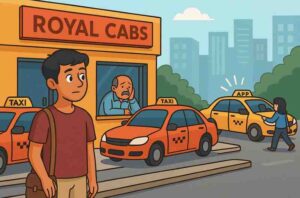 Suddenly, a uniformed taxi driver from Royal Cabs, the city’s oldest taxi service, ran toward them.
“Master Monk, please talk to our owner!” the driver pleaded. “Business is falling every month!”
The Monk nodded knowingly.
“Aryan, today you will witness the power of disruption—when new ideas wipe out old businesses.”
THE OLD GIANT STRUGGING TO SURVIVE
They walked to the Royal Cabs office—a large, aging building with peeling paint and a faded board that once shone proudly above the entrance.
Inside, stacks of paper lay everywhere: fare logs, driver rosters, handwritten receipts.
The owner, Mr. Raghav, sat with his head in his hands.
“Master, customers are disappearing,” he said miserably. “People used to wait in line for our taxis. Now our cars sit idle.”
Aryan asked gently, “Sir, what changed?”
Raghav clenched his jaw.
“Those phone apps! People tap a screen, and a cab arrives at their doorstep. No calls. No bargaining. No waiting.”
He slammed the table.
“We don’t need apps. Our reputation is enough.”
The Monk sighed.
“That is precisely why your business is failing.”
THE MONK’S PARABLE OF THE TWO BRIDGES
The Monk drew two bridges on a dusty table.
Bridge A – The Old Taxi System
- Phone calls
- Paper logs
- Cash payments
- No tracking
- No pricing transparency
Bridge B – The New App-Based System
- Instant booking
- Digital payments
- Real-time tracking
- Transparent pricing
- Safety features
- Reviews & ratings
Aryan stared at the drawing.
“Bridge B is faster… safer… easier.”
“Yes,” the Monk said. “But Royal Cabs is stuck on Bridge A. When customers find a smoother bridge, they switch.”
Raghav sighed.
“But our drivers know every road in the city!”
“Knowledge doesn’t beat convenience,” the Monk said softly.
“A phone app can guide anyone.”
WHERE ROYAL CABS WENT WRONG
The Monk explained Raghav’s biggest mistakes:
- Ignored customer experience
Customers no longer wanted long waits or unpredictable fares.
- Refused technology adoption
While the world moved to mobile apps, Royal Cabs stayed on paper.
- Relied on old reputation
Past success blinded them to current competition.
- Failed to innovate
No digital payments, no tracking, no customer ratings.
- Believed competition wouldn’t matter
A fatal error in business.
Raghav looked devastated.
“I thought disruption wouldn’t affect us.”
The Monk shook his head.
“Disruption does not knock. It breaks the door.”
A GLIMPSE INTO THE FUTURE
To teach Aryan a deeper lesson, the Monk led him outside.
There, an app taxi silently arrived, guided only by GPS.
A woman stepped in confidently, checking the fare on her screen.
“No bargaining, no surprises,” Aryan observed.
A minute later, another app cab arrived.
A teenager entered, paying with a digital wallet.
Aryan whispered, “Master… Royal Cabs cannot compete.”
“Not unless they change,” the Monk said.
MEETING THE NEW WINNER
Across the road stood the office of SwiftRide, the app-based taxi company transforming Aranyapur.
Inside:
- Big screens showed live taxi locations
- A support team monitored safety alerts
- Drivers were trained using tablets
- Feedback was analyzed daily
- Prices adjusted instantly with demand
Aryan couldn’t believe the difference.
The SwiftRide manager explained:
“People choose us not for cheaper rides, but for control and transparency.”
Aryan nodded.
“Royal Cabs offered taxis. SwiftRide offers confidence.”
DISRUPTION IN BUSINESS: SIMPLE EXAMPLES
The Monk listed examples Aryan already knew:
- Smartphones disrupted cameras
- Online streaming disrupted television
- Digital payments disrupted cash
- Online shopping disrupted markets
- Electric vehicles are disrupting petrol cars
“And app taxis,” Aryan added,
“are disrupting traditional taxi companies.”
“Correct,” the Monk smiled.
THE OWNER’S LAST CHANCE
Back at Royal Cabs, Raghav looked defeated.
“Master, is there any hope left for us?”
The Monk smiled gently.
“Yes—if you embrace change.”
He handed Raghav a new blueprint:
✔ Create a simple taxi booking app
✔ Offer online payments
✔ Add GPS tracking
✔ Introduce fixed transparent fares
✔ Build a customer-friendly cancellation policy
✔ Offer driver ratings & training
✔ Run promotions for first-time users
✔ Upgrade your cars gradually
Raghav looked determined now.
“I will not let Royal Cabs die,” he said.
“We will evolve.”
THREE MONTHS LATER
Aryan and the Monk revisited Royal Cabs.
It was unrecognizable.
- A clean, modern office
- A simple booking app named RoyalGo
- Digital payments accepted
- Drivers trained on smartphones
- Transparent pricing boards
- Customer support available 24/7
And most importantly—
Cars were moving again.
Raghav smiled proudly.
“Master, we are not the biggest company… but we are growing again.”
The Monk nodded.
“When a business stops fighting disruption
and starts learning from it—
it becomes stronger.”
ARYAN’S FINAL LESSON
Walking home, Aryan summarized the day’s lesson:
“Disruption destroys those who refuse to adapt.
Companies that evolve—not companies that cling to the past—survive.”
The Monk smiled.
“And investors look for businesses that innovate faster than the world changes.”
Aryan looked up at the sky, imagining the future.
Perhaps one day, he thought, he would build something new—
and never fear disruption.