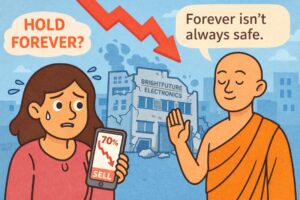
 The morning sun warmed the streets of Aranyapur as Aryan and the Market Monk walked toward the library square. The city was calm, but Aryan noticed someone sitting quietly on a bench with a worried face.
It was Mrs. Kavita, a school teacher known for her discipline and patience.
She held her phone tightly.
Aryan greeted her politely.
“Good morning, ma’am. Is everything alright?”
Kavita sighed.
“I invested in a company five years ago. Everyone said good investors hold forever, so I never sold.”
Aryan smiled.
“That sounds like a good habit.”
But Kavita shook her head slowly.
“The company’s stock has fallen 70%… and the business itself is collapsing.”
The Market Monk looked at Aryan.
“Today you will learn the danger of blind optimism.”
⭐ The Promise That Sounded Perfect
Five years earlier, Kavita had invested in a company called BrightFuture Electronics.
The company made televisions and home appliances. At that time, analysts praised it.
“Buy it and hold forever!” people said.
Kavita followed that advice faithfully.
Every year, she told herself:
“The price will recover.”
“Good companies always bounce back.”
“Patience is the key to investing.”
So she held.
And held.
And held.
⭐ The Slow Collapse
But things were changing.
New competitors entered the market.
Smart TVs became cheaper from foreign brands.
BrightFuture’s technology stopped improving.
Sales started falling.
Profits shrank.
Debt increased.
Employees began leaving.
Yet Kavita ignored every warning.
She kept repeating one sentence:
“Long-term investors never sell.”
⭐ The Monk’s First Question
The Monk sat beside Kavita.
“Tell me,” he asked gently, “do you still believe the company is strong?”
Kavita hesitated.
“I… don’t know.”
“Have you read the company’s financial reports?”
“No.”
“Have you checked its competitors?”
“No.”
“Have you followed industry changes?”
“No.”
The Monk nodded.
“You were not investing… you were hoping.”
⭐ The Broken Bicycle
To explain his point, the Monk walked Aryan and Kavita to a bicycle repair shop.
A man pushed in an old bicycle.
Its chain was rusted.
Its tires were flat.
Its brakes barely worked.
The owner asked the mechanic,
“Should I keep riding this bicycle forever?”
The mechanic laughed.
“If you don’t repair it, you’ll fall.”
The Monk turned to Kavita.
“A business is like a bicycle.
If the parts break, holding onto it blindly won’t make it stronger.”
Aryan nodded.
“Even long-term investing requires observation.”
⭐ The Difference Between Patience and Blindness
The Monk drew two circles on the ground.
Circle 1 – Wise Patience
- You study the business
• You track the company’s performance
• You adapt to new information
• You hold when the business is strong
Circle 2 – Blind Optimism
- You ignore warning signs
• You avoid new information
• You believe recovery is guaranteed
• You refuse to admit mistakes
Kavita looked at the second circle silently.
“I think I lived inside that one.”
⭐ The Dangerous Sentence
The Monk spoke softly.
“There is one sentence that destroys investors.”
Aryan leaned closer.
“What sentence, Master?”
The Monk replied:
“It will definitely recover.”
He continued:
“Markets don’t guarantee recovery.
Companies fail.
Industries change.
Technology evolves.”
Aryan suddenly understood.
“So holding forever is only safe if the business remains strong.”
“Exactly,” the Monk said.
⭐ The Moment of Realization
Kavita opened her phone and read the latest news about BrightFuture Electronics.
The company had just announced:
- Factory closures
• Massive layoffs
• Heavy debt restructuring
Her hands trembled.
“I ignored all this… for years.”
The Monk smiled gently.
“Loss is painful, but awareness is powerful.”
⭐ The Investor’s Responsibility
The Monk gave Kavita a simple rule.
“Long-term investing requires long-term thinking, not long-term blindness.”
He explained:
A good investor asks regularly:
- Is the business still competitive?
• Are profits growing or shrinking?
• Is management improving the company?
• Are new technologies replacing its products?
If the answers become negative, holding forever becomes dangerous.
⭐ Kavita’s Decision
After a long silence, Kavita took a deep breath.
“I finally understand,” she said.
“I confused patience with stubbornness.”
She sold her remaining shares—not in panic, but with clarity.
Then she began studying other businesses more carefully.
⭐ Aryan’s Final Lesson
As they walked home, Aryan summarized the day’s wisdom.
“Fear makes investors sell too quickly…
but blind optimism makes them hold too long.”
The Monk nodded.
“The best investors are neither fearful nor blindly hopeful.”
Aryan smiled.
“They are aware.”