Episode 20 – Fear in the Market

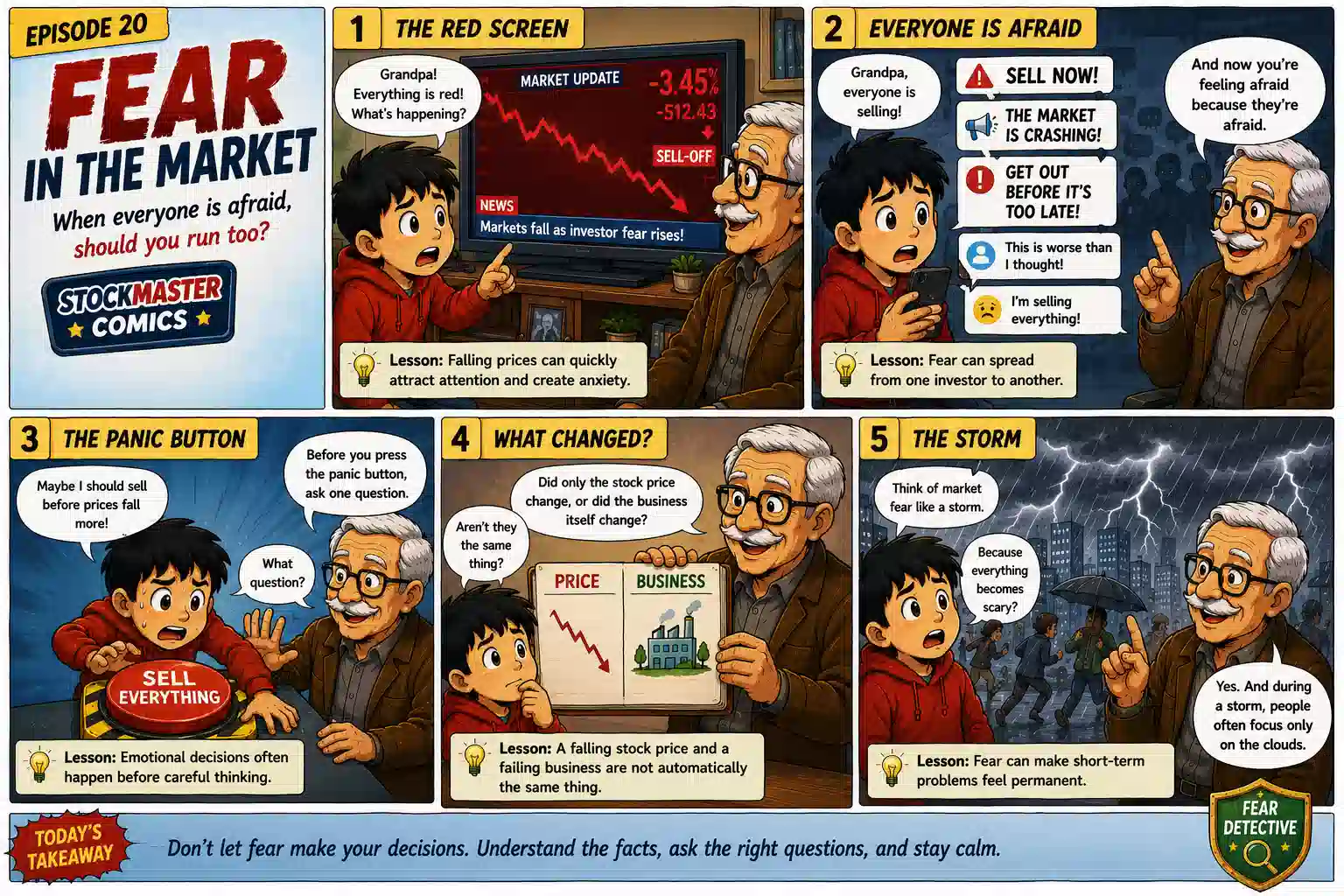
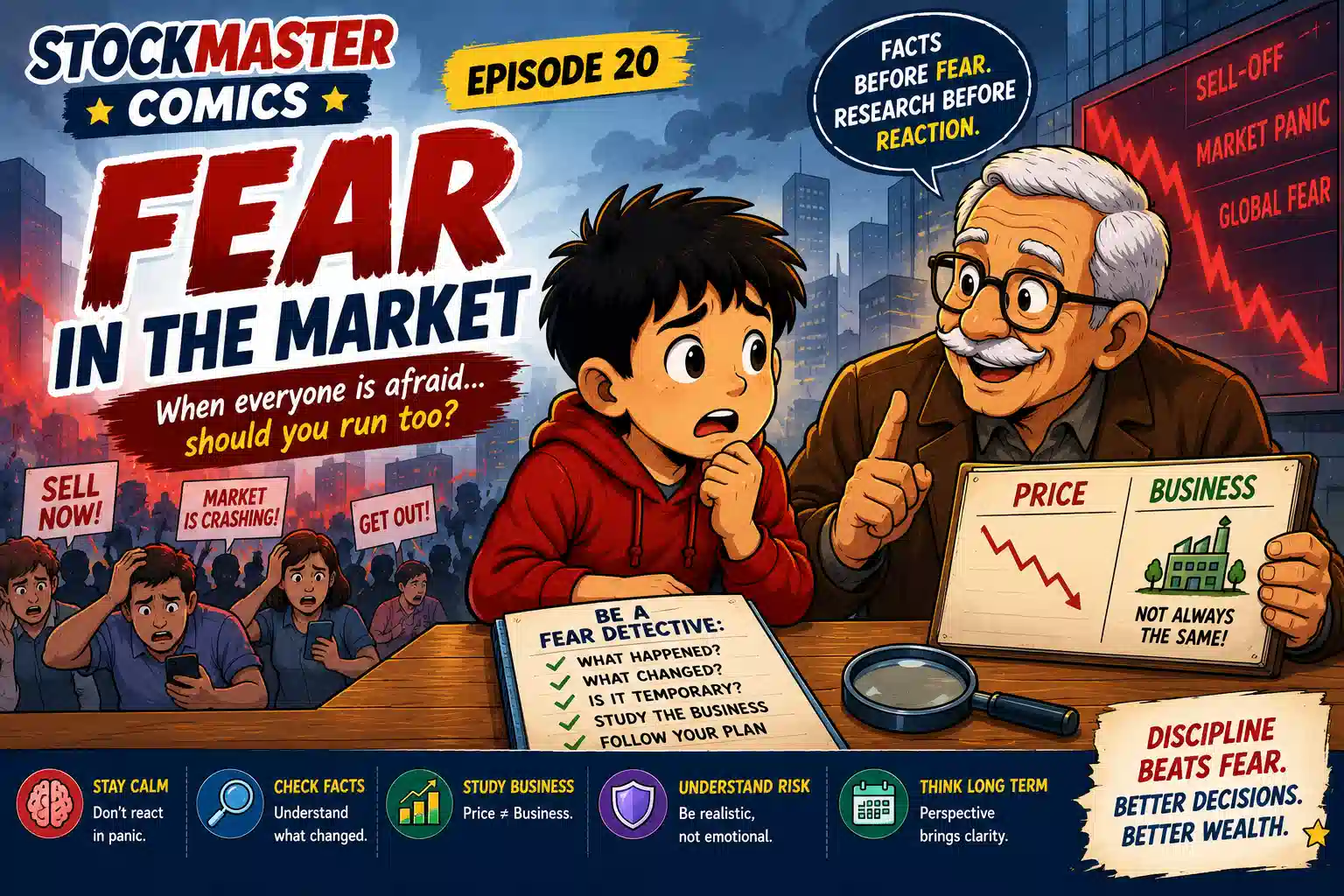
StockMaster Comics Episode 20 Fear in the Market showing Sam and Grandpa Ben learning how fear, panic selling and investor emotions affect stock market decisions.

When everyone is afraid, should you run too?

Introduction

One morning, Sam notices something strange. The television is filled with red stock charts. News presenters are using words like “sell-off,” “panic,” and “market fear.” On social media, people are posting worried messages, and some investors are rushing to sell their shares.

Sam begins to feel nervous.

If everyone else is afraid, shouldn’t he be afraid too?

In Episode 20: Fear in the Market, Sam discovers how fear can spread quickly among investors. Grandpa Ben explains that stock prices are influenced not only by company profits, economic data, and business news but also by human emotions.

When uncertainty rises, investors may imagine the worst possible outcome. Some sell because they are worried about losing more money. Others sell simply because they see everyone else selling. As more investors rush for the exit, prices can fall even faster, creating a cycle of fear.

But does every falling market mean every company has suddenly become a bad business?

Not necessarily.

Through a simple storm analogy, Grandpa Ben teaches Sam why smart investors try to separate price movements from business facts. Sam learns that staying calm doesn’t mean ignoring risk. It means understanding what has changed, reviewing your decisions, and avoiding actions based only on panic.

Welcome to Fear in the Market, where Sam faces one of the most powerful forces in investing—the emotion inside the investor’s own mind.

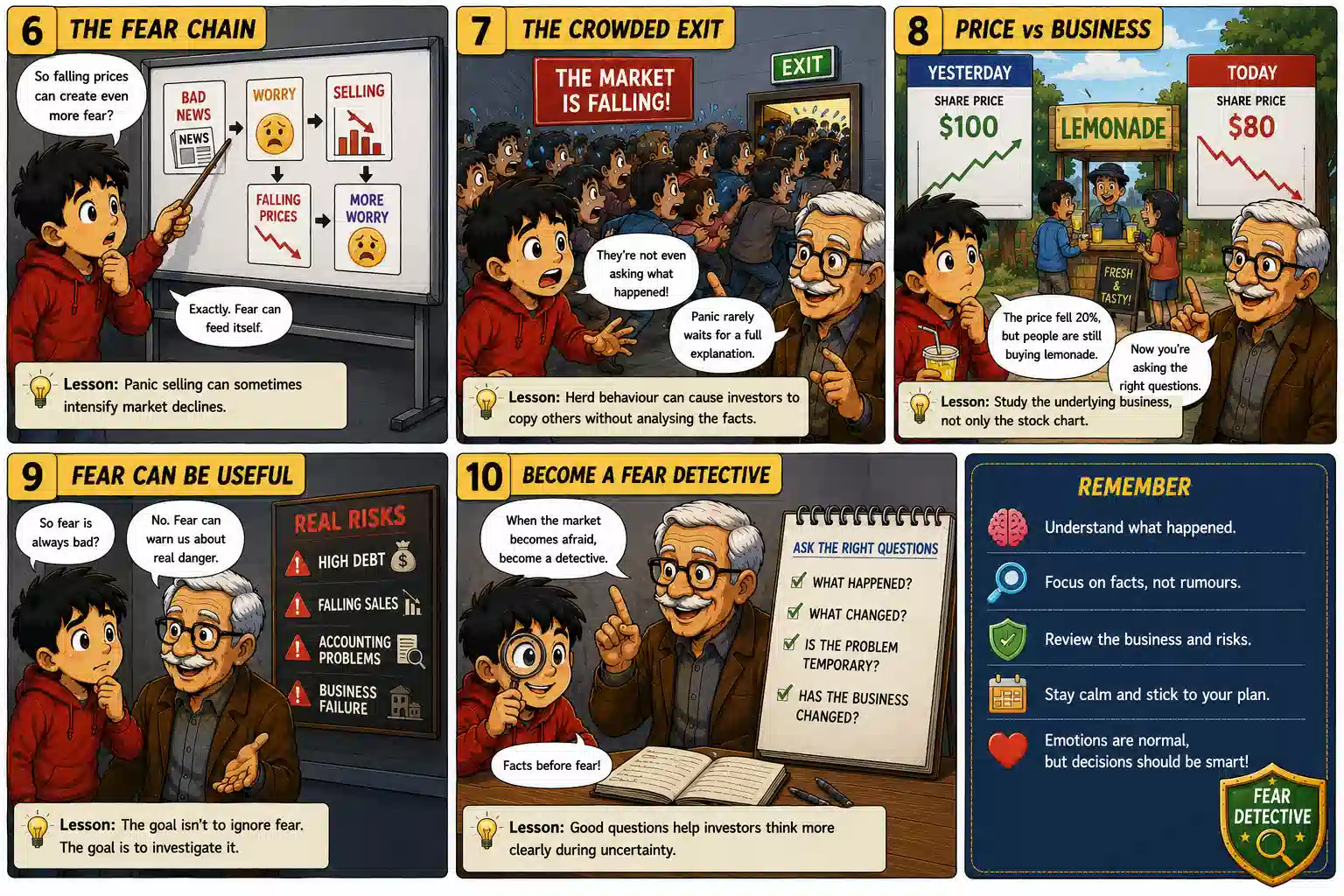
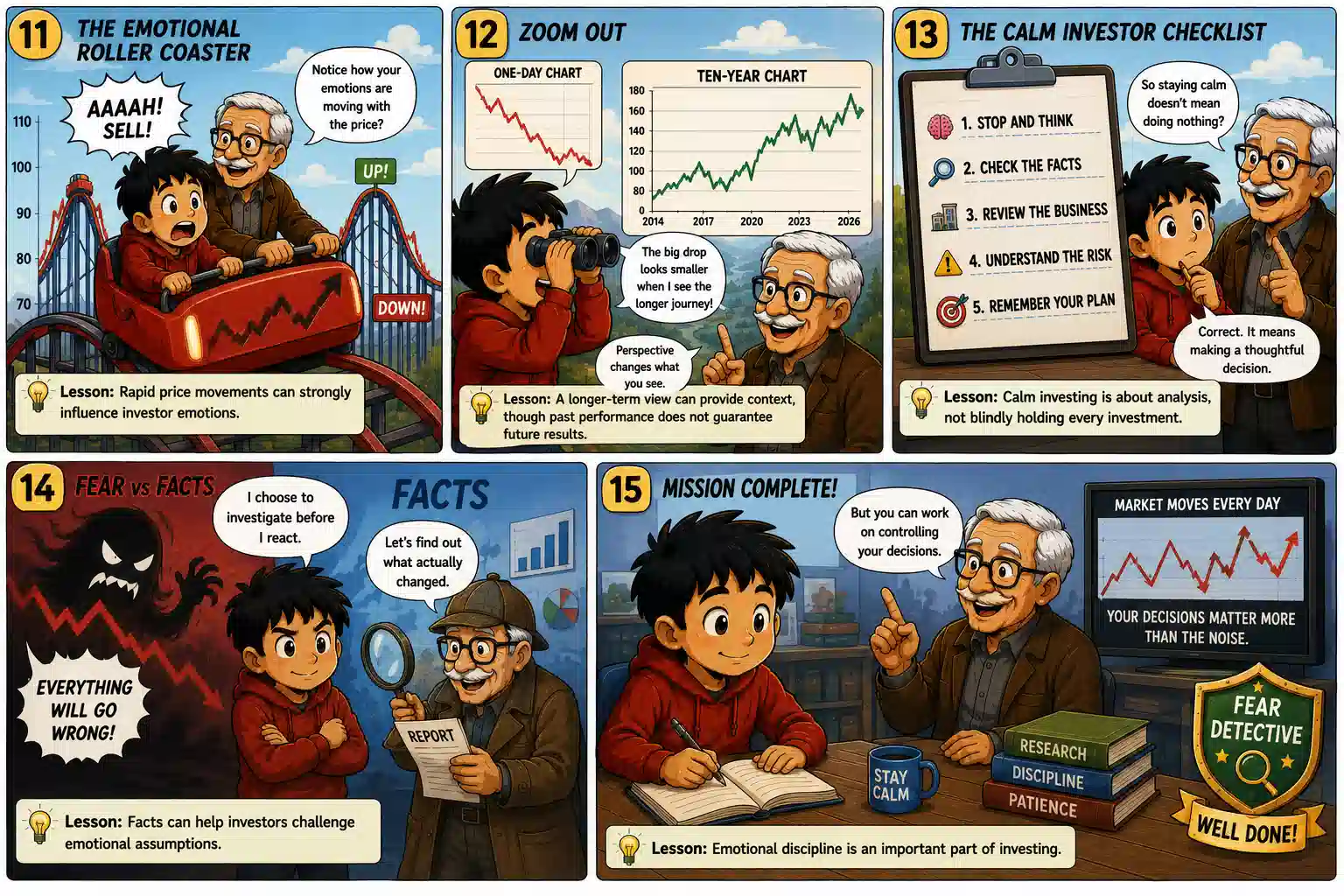
Fear in the Market comic panels showing Sam learning about falling stock prices, investor panic, fear spreading and the difference between stock price and business performance. Stock market fear comic explaining panic selling, herd behaviour, price versus business value, real investment risks and how investors can investigate market fear. StockMaster comic panels explaining emotional investing, long-term market perspective, calm investor checklist, fear versus facts and emotional discipline in investing.

Lesson Summary

Why Does Fear Spread Through the Stock Market?

The stock market is made up of people, institutions, funds, and automated trading systems reacting to information and expectations. Although numbers appear on the screen, human emotions still play an important role in many investment decisions. Fear often begins with uncertainty. Investors may worry about a recession, war, inflation, interest rates, poor company results, political events, or an unexpected crisis. When people are unsure about the future, they may become more focused on protecting their money. One investor sells. Prices fall. Other investors see the decline and become nervous. They may also sell, even if they haven't fully studied the original problem. This can create a fear cycle. However, every market decline is different. Sometimes fear is connected to serious economic or business problems. At other times, investors may react more strongly than expected to uncertainty. The important lesson is not to assume that every fall is an opportunity—or that every fall is a disaster. Investors need to understand why the market is afraid.

A Falling Price Does Not Always Mean a Broken Business

One of Grandpa Ben's most important lessons is the difference between a stock price and the business behind the stock. Stock prices can move for many reasons. Investors may react to economic news, interest-rate expectations, industry problems, geopolitical events, fund withdrawals, or changes in market sentiment. The underlying company, however, has its own story. Are sales growing or falling? Is the company profitable? Does it have too much debt? Are customers still buying its products? Has management made a serious mistake? Has the company's competitive position changed? Imagine a popular restaurant. One day, someone offers to buy the restaurant for a lower price than yesterday. The lower offer does not automatically mean the restaurant has lost all its customers. But if customers are disappearing, debt is increasing, and the kitchen has serious problems, the lower price may reflect genuine business risks. That's why investors should investigate the facts. Price tells you what the market is offering. Business analysis helps you understand what you may be buying.

How Can Investors Think Clearly During Market Fear?

Staying calm during market volatility is difficult. Even experienced investors can feel nervous when prices fall sharply. The goal is not to become emotionless. Fear is a natural human response to uncertainty and potential loss. Instead, investors can build a process that helps prevent fear from controlling every decision. Start by asking what has actually changed. Read reliable information rather than reacting only to dramatic headlines or social media posts. Review the company, investment, and original reason you invested. Consider your own financial situation and risk tolerance. Money needed for essential expenses or short-term goals should not be treated in the same way as money allocated to long-term investments. Most importantly, remember that “don't panic” does not mean “never sell.” Sometimes selling can be a rational decision when the facts, risks, or investment thesis have materially changed. The lesson from Sam's adventure is simple: when fear becomes loud, your thinking process should become clearer. Don't let the crowd make the decision for you. Investigate. Understand. Then decide.

Key Takeaways

  • Fear is a powerful market emotion.
  • Uncertainty can trigger panic selling.
  • Falling prices may cause more investors to become afraid.
  • A falling stock price does not automatically mean the underlying business has failed.
  • Investors should investigate why a stock or market is falling.
  • Fear can sometimes point to genuine risks.
  • Staying calm means analysing facts, not ignoring problems.
  • Long-term perspective can provide useful context.
  • Investors should understand their own risk tolerance.
  • Facts should guide decisions more than social media panic.

Vocabulary

Market Fear – Widespread investor concern about possible losses or uncertain future events.

Panic Selling – Rapid selling driven largely by fear or emotional reactions.

Herd Behaviour – Following the actions of a larger group rather than making an independent decision.

Volatility – The degree to which prices move up and down over a period.

Risk – The possibility that an investment may lose value or produce a different result than expected.

Smart Investor Tip

When the market gets louder, make your research deeper.

Never buy simply because prices have fallen, and never sell only because everyone appears afraid. Ask what changed, study the facts, understand the risks, and make decisions that fit your financial goals and investment plan.

Facts before fear. Research before reaction.

Next Episode Preview

Episode 21 – Greed in the Market

The market is rising, stock prices are jumping, and everyone seems to be making money. Sam watches investors celebrate huge gains and begins to wonder: “What if I invest everything before prices go even higher?”

Join Grandpa Ben as he explains how greed can influence investors, why rising prices can create FOMO, and how the dream of getting rich quickly can lead people to ignore risk.

Coming next: Episode 21 – Greed in the Market

Scroll to Top