Episode 7 – Buying Your First Share

Episode 7 of StockMaster Comics, Buying Your First Share, showing a young investor learning how to research a company, check the share price, place a buy order, and become a shareholder.

Introduction

In the previous episode, Sam discovered that the stock market is a place where people can buy and sell shares of publicly traded companies. He also learned that owning a share means owning a tiny piece of a real business.

Now Sam has a new question: How do you actually buy your first share?

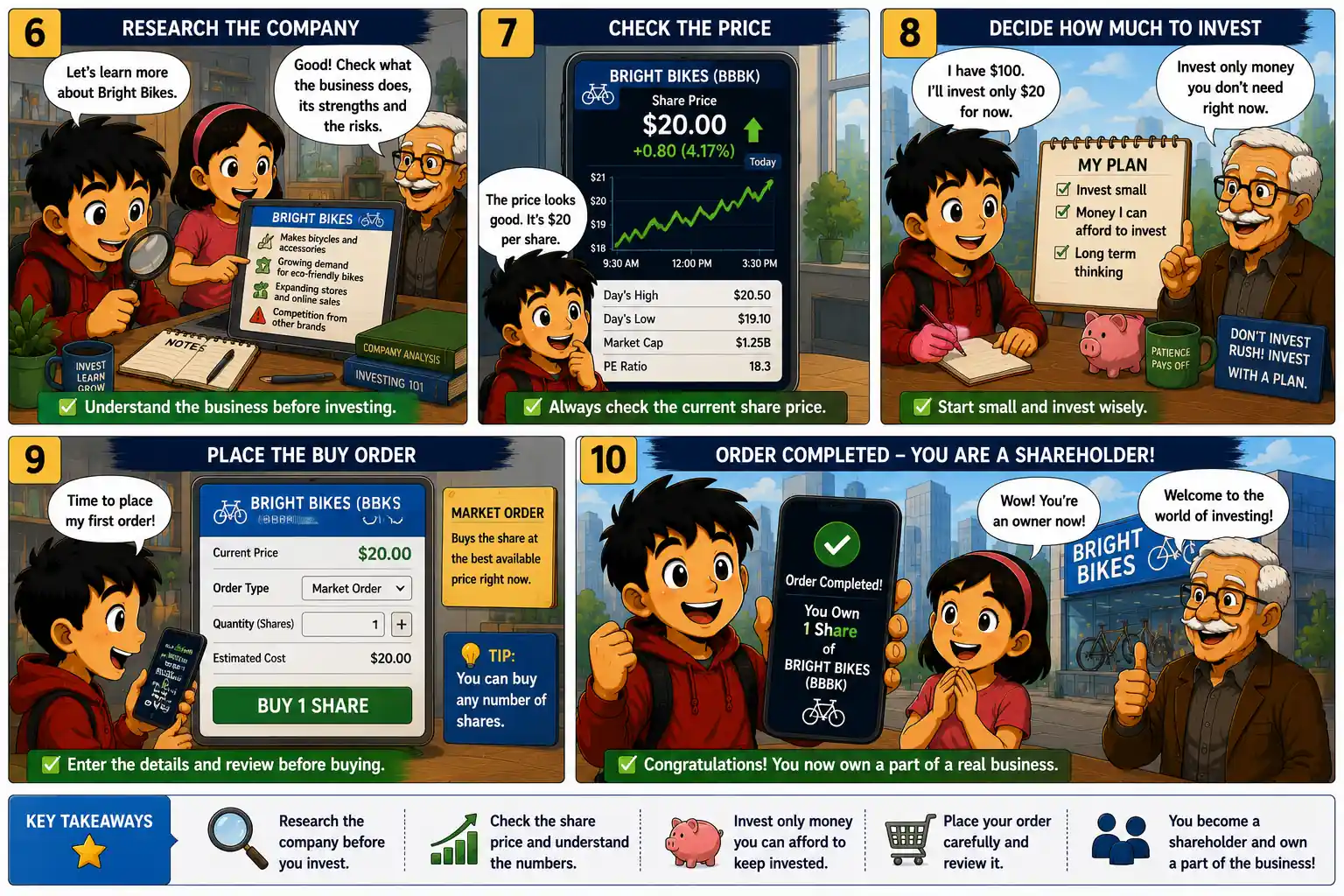
Buying a share today can be surprisingly simple. Investors can use a brokerage account or investing platform to search for a publicly traded company, check its share price and place an order. But just because buying is easy does not mean choosing wisely is easy.

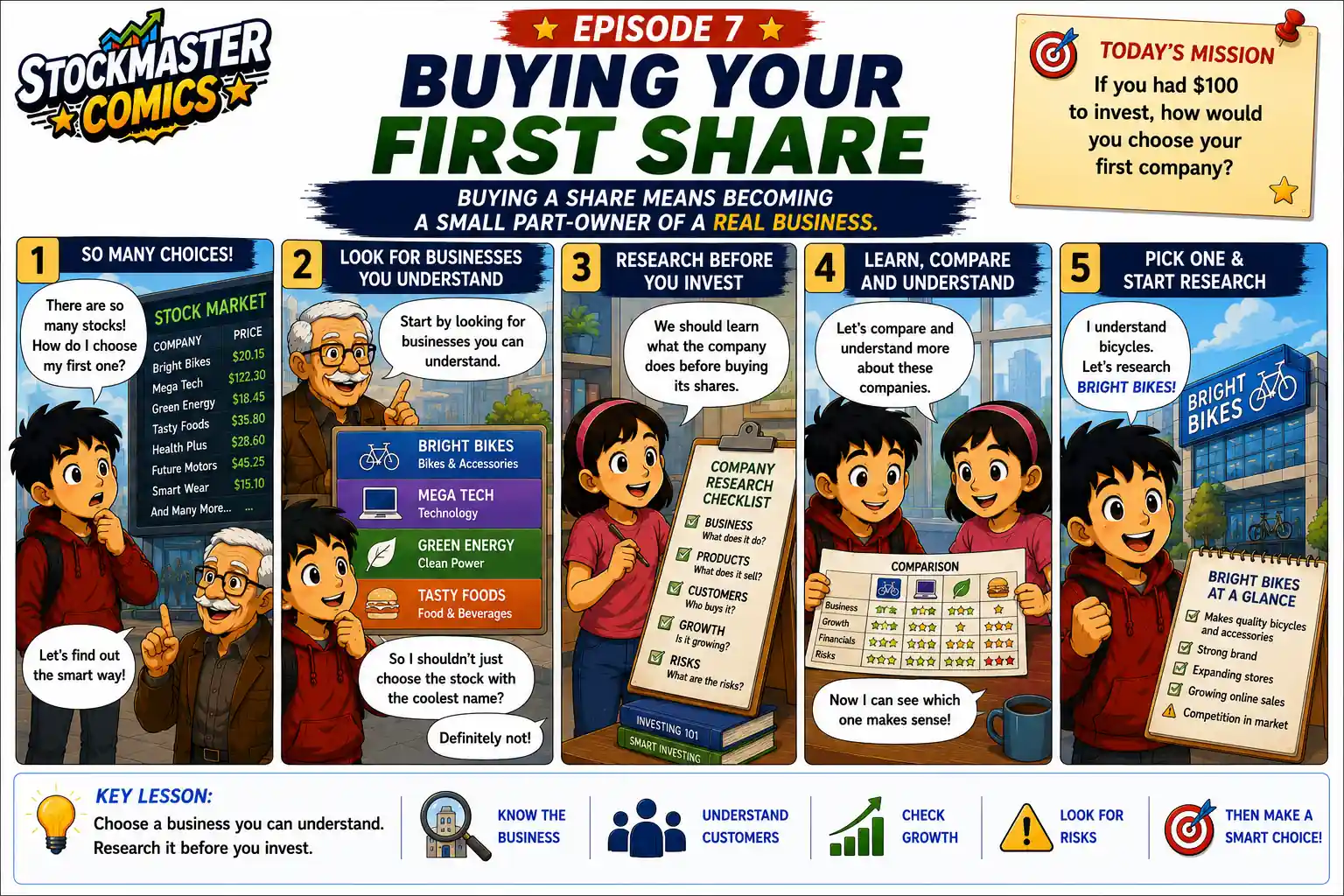
Before investing, a smart investor tries to understand the company behind the stock. What does the business sell? How does it make money? Is the company growing? Does it have strong competitors? What risks could affect its future?

Grandpa Ben explains that buying a share should not be treated like choosing a random number or spinning a wheel. A stock is connected to a real company with employees, customers, products, profits, opportunities and risks.

Sam decides to practise with a fictional company called Bright Bikes. He learns how to research the business, check its share price and decide how much money he can afford to invest. Then comes the exciting moment: placing his first buy order.

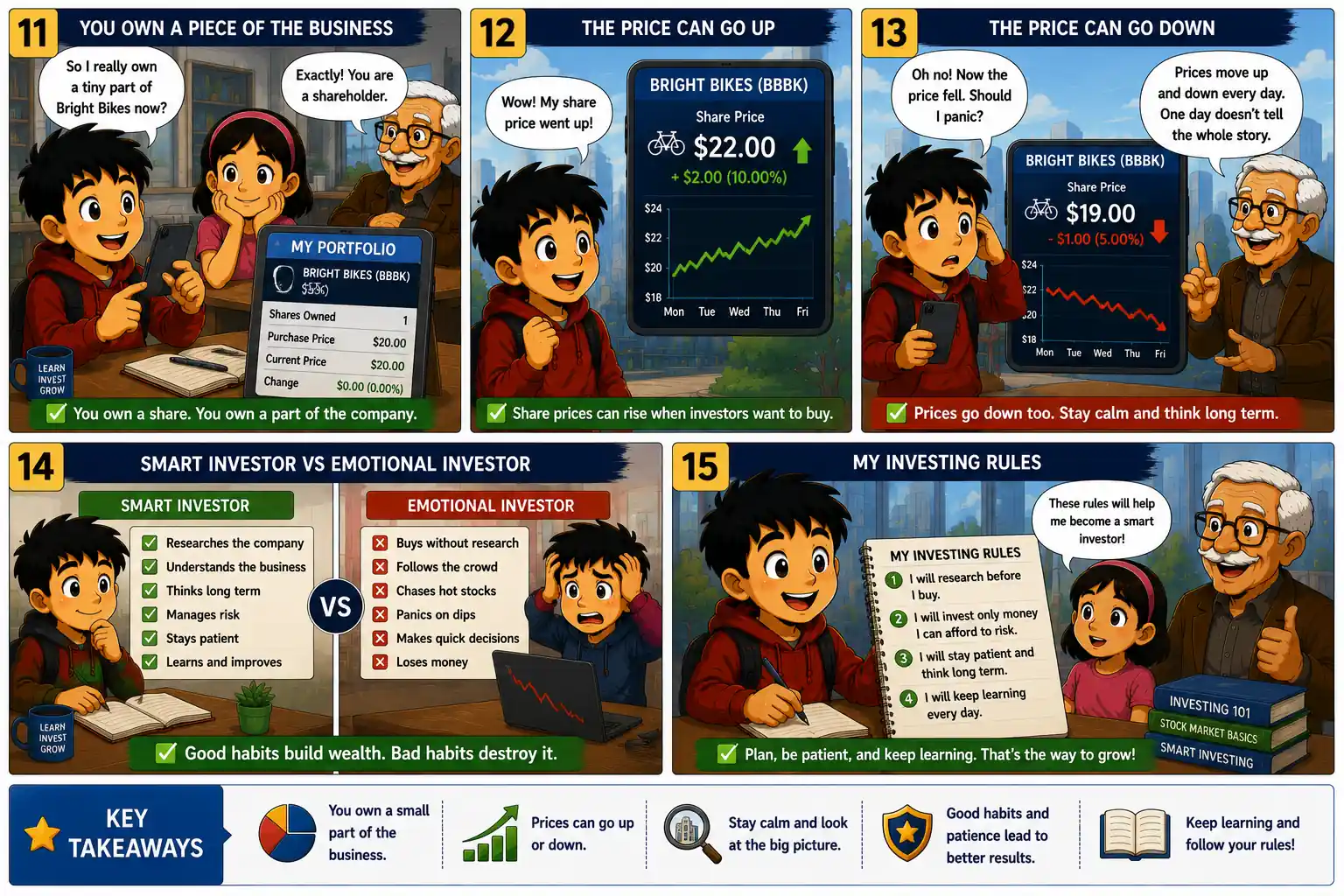
But Grandpa Ben has an important lesson. Buying a share is only the beginning. The price may rise or fall after you invest. Smart investors remain patient, continue learning and avoid making emotional decisions based on every small price movement.

Sam is ready to take his first step from learning about the stock market to understanding how investing actually works.

StockMaster Comics panels 1–5 explaining how to choose a first stock by understanding the business, researching the company, comparing opportunities, growth, and risks. StockMaster Comics panels 6–10 showing the steps to buy a first share, including company research, checking the stock price, deciding how much to invest, placing a buy order, and becoming a shareholder. StockMaster Comics panels 11–15 explaining share ownership, stock price movements, long-term thinking, and the difference between smart and emotional investing.

Lesson Summary

What Happens When You Buy a Share?

When you buy a share, you purchase a small ownership interest in a publicly traded company. You are not simply buying a number that moves on a screen. Behind every legitimate stock is a real business that may have products, employees, customers, assets, competitors and plans for the future. Investors normally buy and sell shares through a brokerage account or investing platform. After choosing a stock, an investor can place an order to buy one or more shares. Depending on the market and the type of order used, the transaction is completed when a matching seller is available. The price you pay becomes your purchase price. After that, the market value of your investment can rise or fall. Becoming a shareholder can give you the opportunity to benefit if the company grows and becomes more valuable. However, ownership also comes with risk. A company may face weaker sales, stronger competition, economic problems or poor business decisions. Its share price can fall, and investors can lose money. That is why buying a share should begin with understanding what you are actually buying.

Why Research Before Buying?

A stock may look exciting because its price is rising, because people are talking about it or because the company has a famous name. None of these reasons alone tells you whether it is a suitable investment. Research helps investors look beyond excitement. Start with simple questions. What does the company do? How does it make money? Who are its customers? Is demand for its products growing? Who are its competitors? What risks could hurt the business? As investors learn more, they may also study financial information such as revenue, profit, debt and cash flow. These numbers can help provide a clearer picture of the company's financial condition. Research does not guarantee that an investment will succeed. Even excellent companies can face unexpected problems, and share prices can be unpredictable. The purpose of research is to make a more informed decision—not to predict the future perfectly. A smart investor also considers personal financial circumstances. Money needed for essential expenses or near-term needs generally should not be exposed to unnecessary stock-market risk.

What Makes a Smart First Investment?

A first investment does not need to be large. Starting small can help a beginner learn how investing works while limiting the amount of money at risk. Diversification is also important. Putting all your investment money into a single company can expose you to greater company-specific risk. As investors build a portfolio, spreading investments across different companies, industries or diversified funds can help reduce reliance on the success of one business. Another important skill is emotional control. Share prices move every trading day. A new investor may feel excited when a stock rises and frightened when it falls. Reacting to every movement can lead to poor decisions. Smart investing is a process: Learn → Research → Understand → Invest Responsibly → Review Your first share is not the finish line. It is the beginning of a longer journey of learning about businesses, risk, diversification and long-term investing.

Key Takeaways

    • A share represents partial ownership in a company.
    • Research the business before buying its stock.
    • Understand both the opportunities and the risks.
    • You do not need to invest a large amount to start learning.
    • Share prices can rise and fall after you buy.
    • Avoid making decisions based only on fear or excitement.
    • Never invest money you cannot afford to put at risk.

Vocabulary

Share: A unit representing partial ownership in a company.

Brokerage Account: An account used to buy and sell investments such as stocks.

Buy Order: An instruction to purchase a particular investment.

Shareholder: A person or organisation that owns shares in a company.

Portfolio: A collection of investments owned by an investor.

Smart Investor Tip

Never buy a stock simply because someone says its price will rise. Understand the business, research the risks and make your own informed decision

Next Episode Preview

Episode 8 – Where Does a Company’s Money Come From?

Companies need money to start, operate, grow, hire employees, develop new products, and expand. But where does all that money actually come from?

In Episode 8, Sam and Maya discover how businesses raise money through sales, profits, loans, investors, and selling shares.

Next Mission: When a company needs money to grow, where can it get that money from?

Scroll to Top