
Chart Mission 4 – Anatomy of a Candlestick

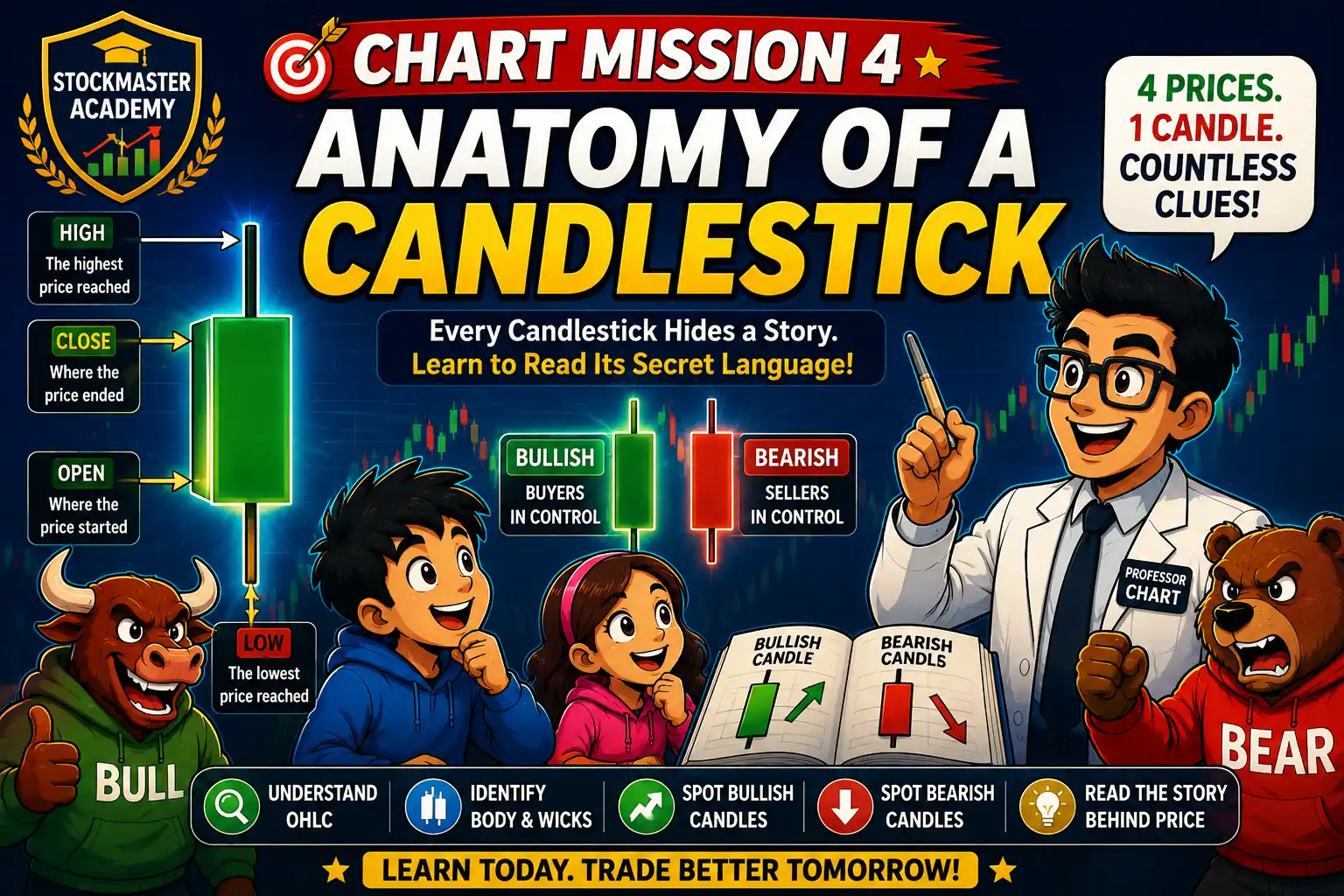
Chart Mission 4 Anatomy of a Candlestick hero image showing OHLC, bullish and bearish candlesticks, Professor Chart, Bull, Bear, and students learning technical analysis.

Introduction

After learning how prices move, Arjun believed he was ready to read charts.

Professor Chart smiled and displayed one enormous candlestick on the academy’s holographic screen.

Arjun laughed.

“That’s just a green rectangle with two lines.”

Professor shook his head.

“No. That single candle tells us where the price started, where it ended, how high buyers pushed it, and how low sellers dragged it.”

Maya looked surprised.

“So one candle tells an entire trading day’s story?”

Professor nodded.

“Exactly. Today’s mission is to understand every part of a candlestick.”

The classroom lights dimmed as the giant candle began to glow.

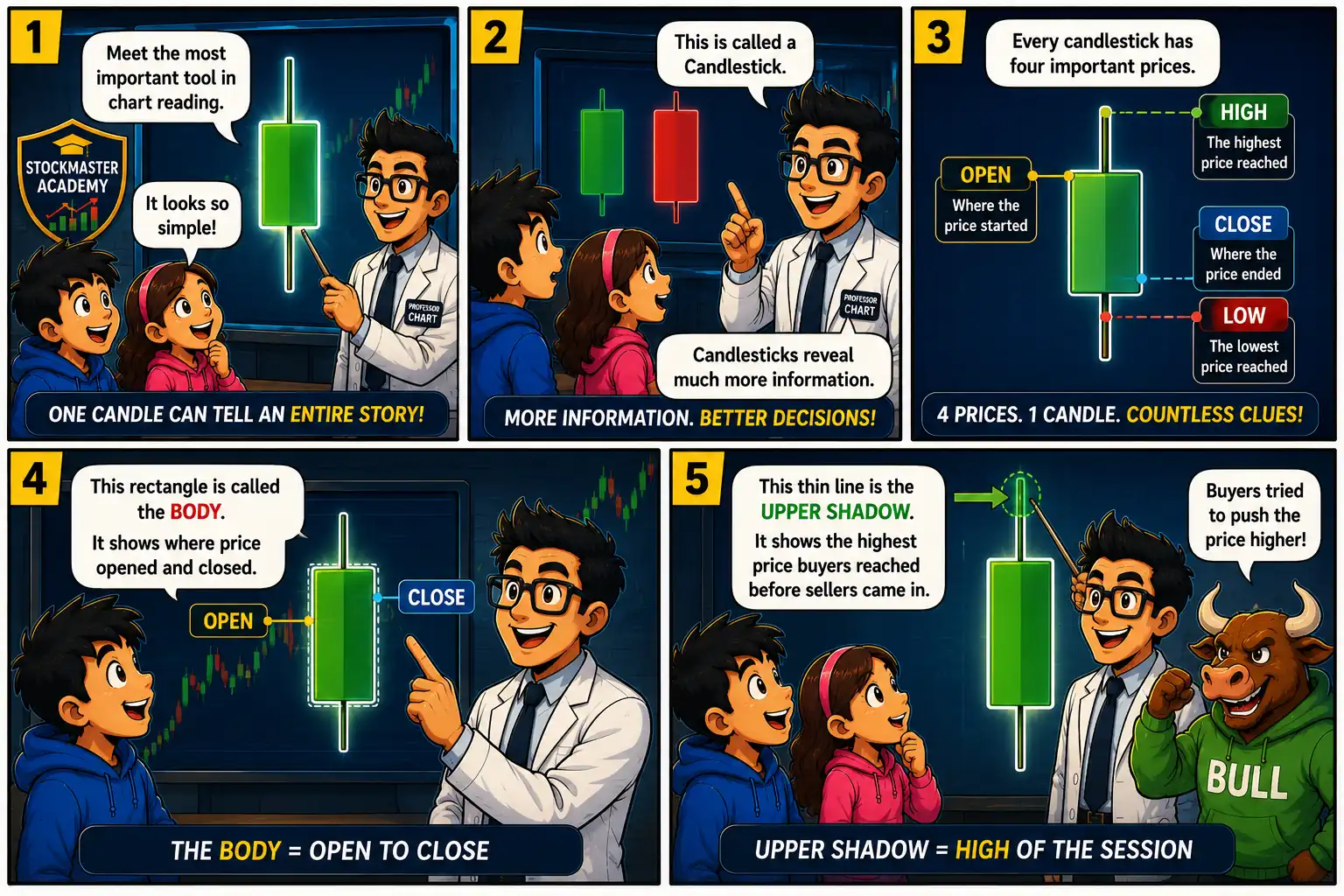
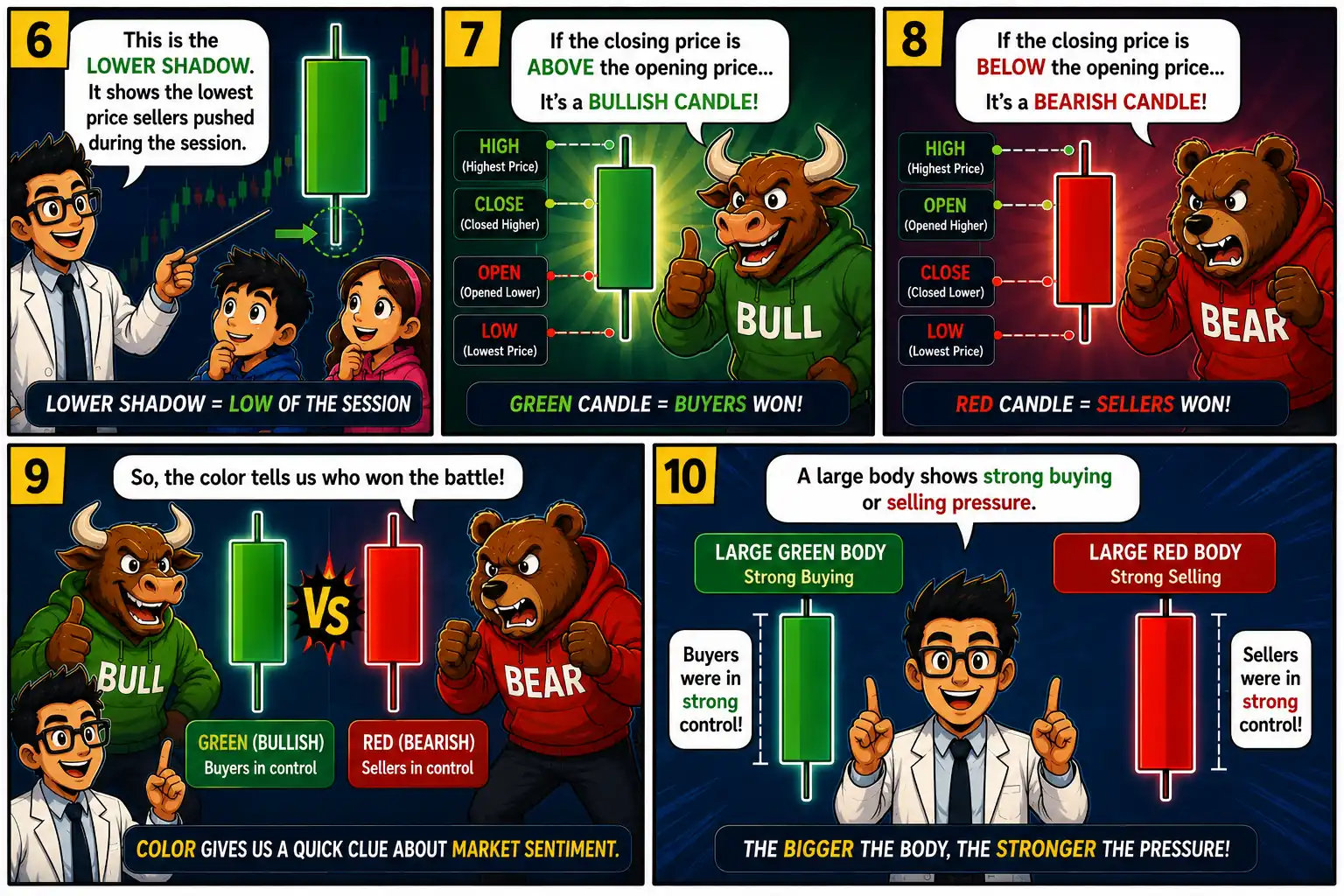
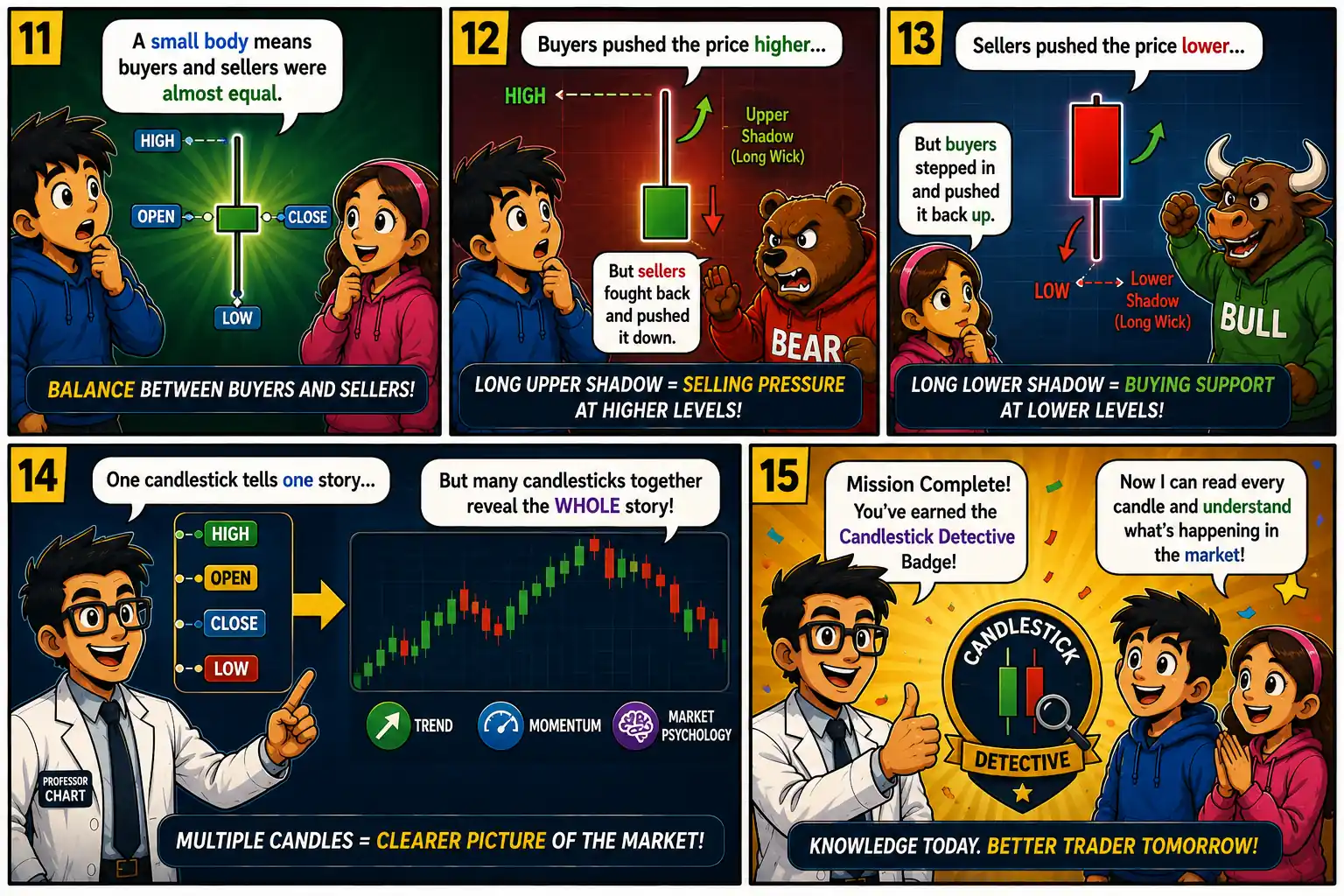
Chart Mission 4 comic panels 1 to 5 introducing candlestick anatomy, OHLC, candle body, upper shadow, and the basics of reading candlestick charts. Chart Mission 4 comic panels 6 to 10 explaining the lower shadow, bullish candles, bearish candles, candle colors, and how large candle bodies indicate buying or selling pressure. Chart Mission 4 comic panels 11 to 15 covering small candle bodies, long upper and lower shadows, reading multiple candlesticks together, and earning the Candlestick Detective badge.

What We Learned

A candlestick is one of the most informative chart types in technical analysis. Each candlestick summarizes four key prices during a selected time period:

  • Open – the first traded price.
  • High – the highest price reached.
  • Low – the lowest price reached.
  • Close – the final traded price.

The body represents the difference between the opening and closing prices. A green (bullish) candle usually means buyers finished stronger than sellers, while a red (bearish) candle indicates sellers gained control by the close.

The thin lines extending above and below the body are called shadows (or wicks). The upper shadow shows how high buyers pushed prices before sellers responded, while the lower shadow shows how far sellers pushed prices before buyers stepped in.

A single candlestick offers insight into one trading period, but the real power of technical analysis comes from studying groups of candlesticks together to understand trends, momentum, and market psychology.

Key Takeaways

  • 🕯 Every candlestick has Open, High, Low, and Close (OHLC).
  • 🟩 Green candles usually indicate buying strength.
  • 🟥 Red candles usually indicate selling strength.
  • 📦 The body shows the difference between opening and closing prices.
  • 📏 Shadows reveal the highest and lowest prices during the session.
  • 📊 Multiple candlesticks together provide a clearer picture of market direction.

Vocabulary

Candlestick – A chart showing Open, High, Low, and Close prices.

Body – The rectangle between the opening and closing prices.

Upper Shadow (Wick) – The highest price reached during the period.

Lower Shadow (Wick) – The lowest price reached during the period.

Bullish Candle – A candle where the closing price is above the opening price.

Bearish Candle – A candle where the closing price is below the opening price.

Smart Investor Tip 

Never judge a stock using just one candlestick. Always study several candles together to understand the market’s true direction.

Next Chart Mission Preview

Chart Mission 5 – Bulls vs Bears Inside Every Candle

Now that you’ve learned the anatomy of a candlestick, it’s time to discover the battle happening inside every single candle. In Chart Mission 5 – Bulls vs Bears Inside Every Candle, Professor Chart reveals how buyers (Bulls) and sellers (Bears) compete throughout every trading session, creating the candlestick patterns you see on charts. You’ll learn why some candles are strongly bullish, why others turn bearish, and how the winner of this invisible tug-of-war can provide valuable clues about market momentum and potential future price direction. Get ready to see every candlestick as an exciting story of competition, psychology, and decision-making!

Scroll to Top