Episode 11 – Why Prices Go Up and Down

Episode 11 StockMaster Comics hero image explaining why stock prices go up and down through buyers, sellers, company news, investor expectations, market conditions, emotions, supply and demand.

Introduction

One morning, Sam opens his investing app and sees something surprising. A stock he was watching has risen by 8%. The company still owns the same factories, sells the same products, and employs the same people—so why has its stock suddenly become more expensive?

The next day, the same stock falls by 5%.

Sam is confused.

“Yesterday everyone wanted it. What changed overnight?”

This question introduces one of the most important ideas in the stock market: stock prices are constantly changing because buyers and sellers are constantly making new decisions.

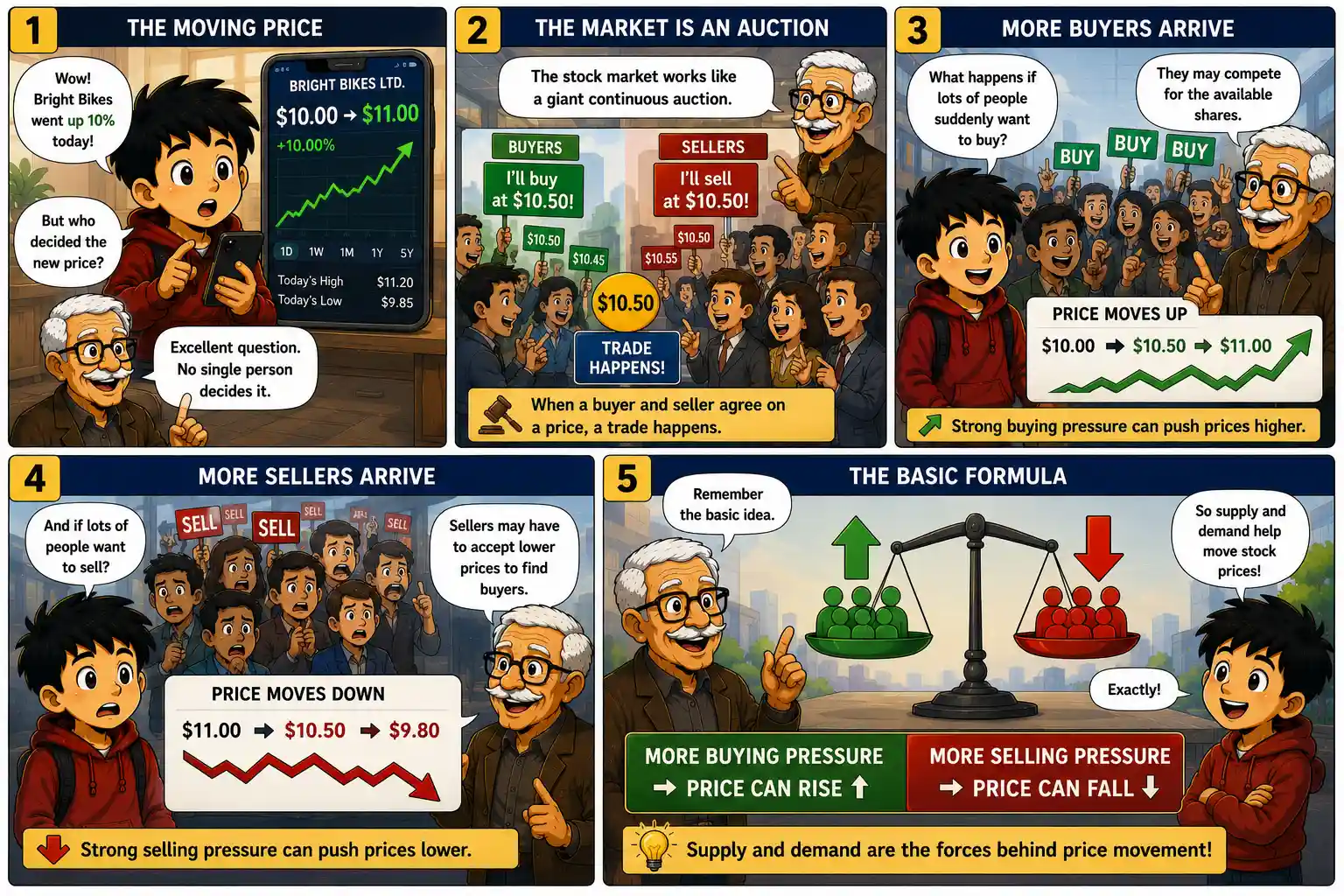
A stock market is an auction. Thousands or even millions of investors may be deciding whether they want to buy, sell, or hold a particular stock. When buyers are willing to pay higher prices, the stock price can rise. When sellers are willing to accept lower prices, the price can fall.

But what makes investors change their minds?

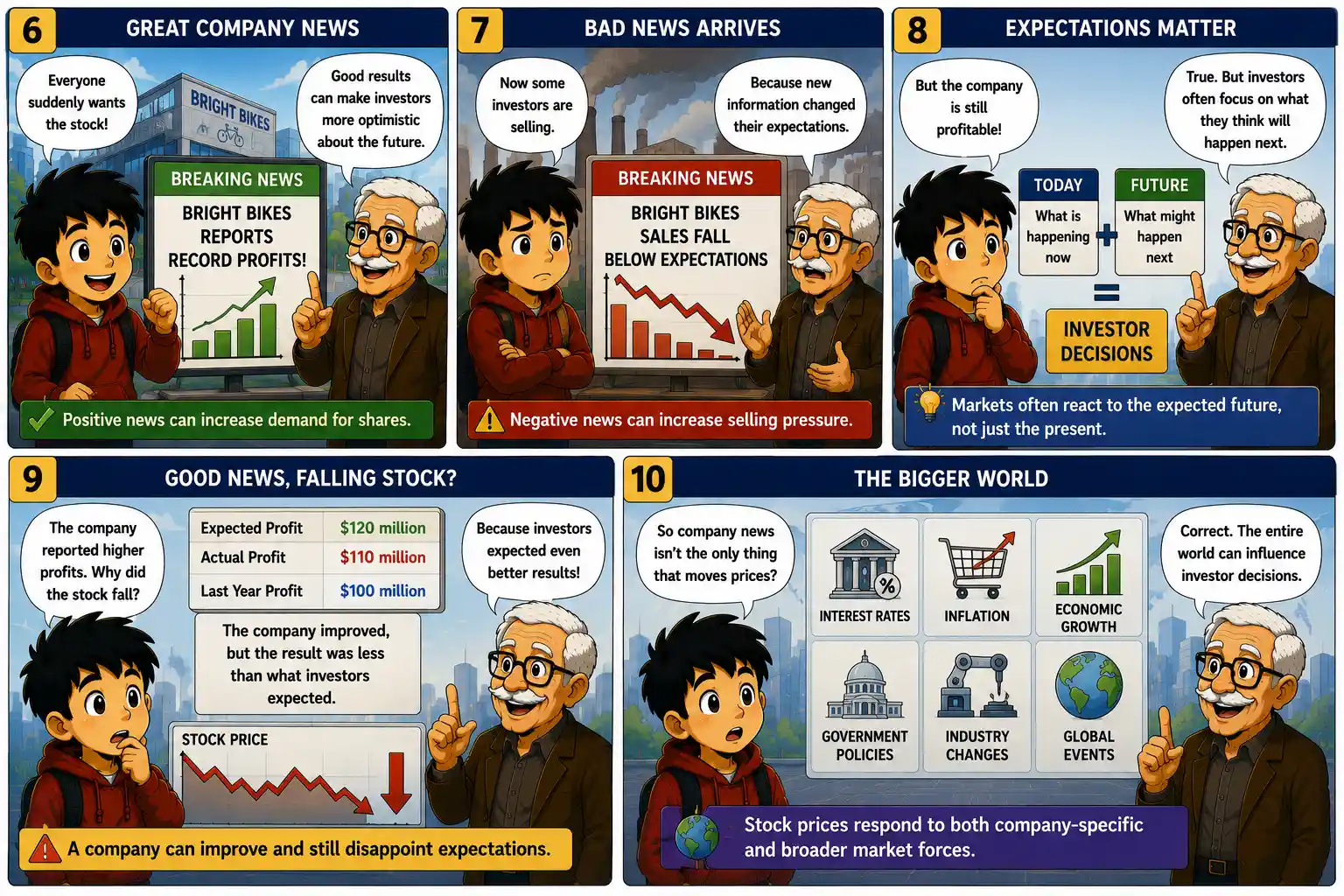
Many things can influence them. A company may announce strong profits, launch a successful product, win a major contract, or reveal plans for future expansion. Positive developments may make investors more optimistic about the company’s future.

Bad news can have the opposite effect. Falling profits, increasing debt, stronger competition, economic problems, or disappointing forecasts may make investors less confident.

Sometimes, prices even move before something actually happens because the stock market is heavily influenced by expectations.

That means a stock price is not simply a number showing what a company is worth today. It also reflects what investors collectively believe—or expect—about the company’s future.

In Episode 11, Sam discovers the forces behind the constantly moving numbers on a stock-market screen. He learns about supply and demand, company news, investor expectations, emotions, and the difference between a changing stock price and the underlying business.

Welcome to the fascinating world of price discovery.

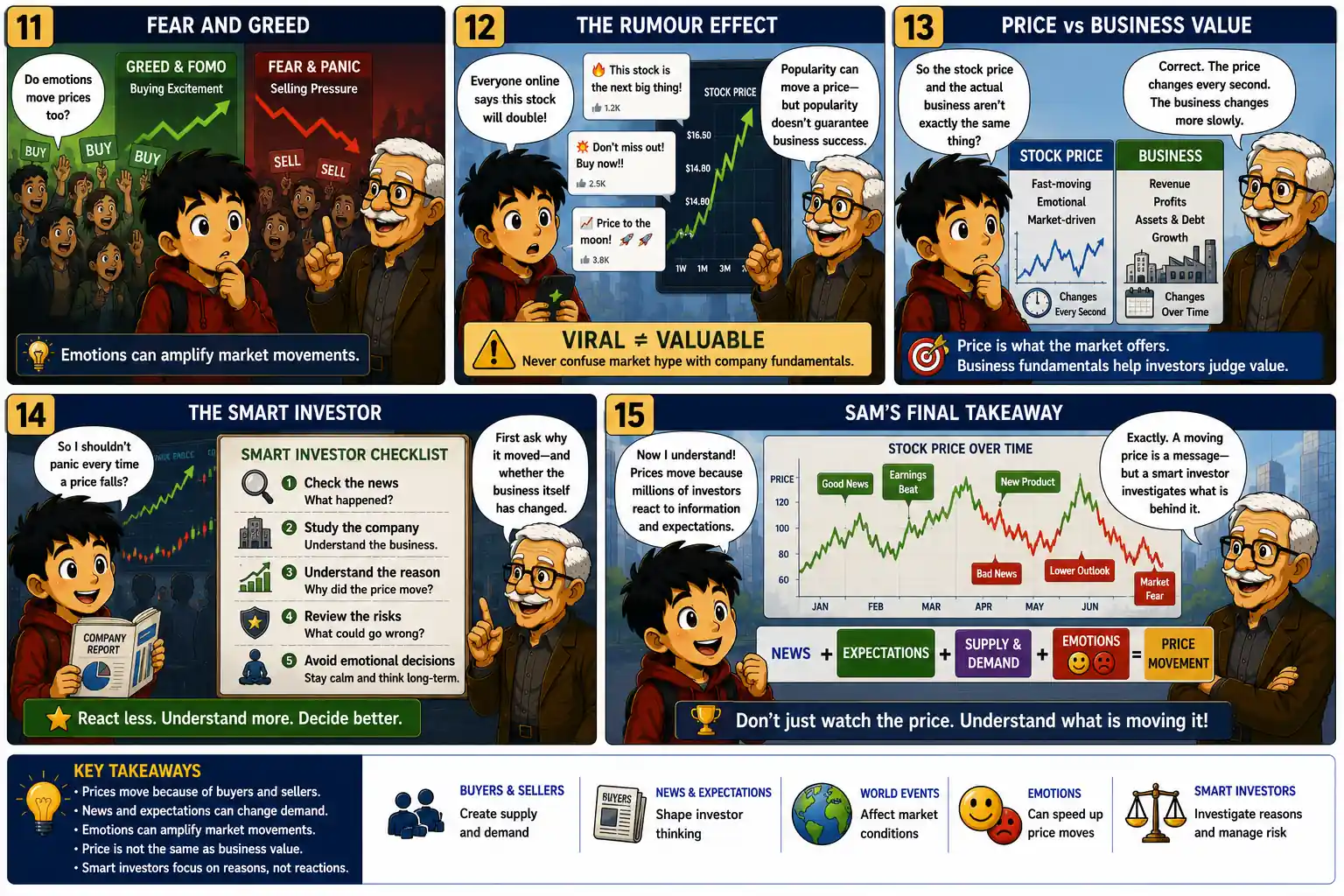
StockMaster Comics panels 1–5 explaining how the stock market works like an auction and how buying and selling pressure, supply and demand, cause stock prices to rise or fall. StockMaster Comics panels 6–10 explaining how company news, investor expectations, interest rates, inflation, economic growth, government policies and global events influence stock prices. StockMaster Comics panels 11–15 explaining how fear, greed, rumours and market hype affect stock prices, the difference between price and business value, and how smart investors investigate market movements.

Lesson Summary

Supply and Demand Move Stock Prices

At its simplest level, a stock price is created through interaction between buyers and sellers. The stock market functions as a continuous auction where investors place orders to buy and sell shares. When buyers become more eager to own a stock, they may be willing to offer higher prices. This creates upward buying pressure. If demand continues to increase relative to the shares available for sale, the market price can rise. The opposite can happen when many investors want to sell. If there are not enough buyers at the current price, sellers may accept progressively lower prices. This selling pressure can push the stock downward. However, saying that prices move because of supply and demand leads to another important question: What causes supply and demand to change? The answer is information. Investors constantly receive new information about companies, industries, economies, and financial markets. Every investor interprets that information differently. One person may believe a stock is attractive at $50, while another may think it is too expensive and decide to sell. These different opinions create a functioning market. A stock price is therefore not permanently fixed. It is continuously being discovered through millions of decisions made by buyers and sellers. This process is known as price discovery.

News and Expectations Can Change Prices

Company performance is one of the biggest influences on stock prices. Investors often study revenue, profits, debt, cash flow, products, competition, and future growth opportunities. Positive developments may increase confidence. A company might report strong profits, launch a successful product, win an important contract, or expand into a promising new market. If investors believe these developments could improve future performance, demand for the stock may increase. Negative developments can create the opposite reaction. But markets do not respond only to what has already happened. They also respond to expectations. Suppose a company earned $100 million last year. Analysts expect it to earn $120 million this year, but it reports $110 million. The company has still grown, yet the stock might fall because the result was weaker than investors expected. This is why stock-market reactions can sometimes appear confusing. Broader events can also affect prices. Interest-rate changes, inflation, economic growth, government policies, technological disruption, geopolitical events, and industry trends can all influence how investors view future opportunities and risks. The market is constantly trying to answer one difficult question: What might this company be worth in the future?

Why Investing Matters

Saving protects your money. Investing gives your money the opportunity to grow over time. When you invest, your money can help businesses expand, develop new products, hire employees, and create value. In return, investors may benefit if those businesses perform well over the long term. Investing always involves some level of risk, and prices can rise or fall. That's why successful investing is not about trying to get rich quickly. It is about making informed decisions, diversifying, staying patient, and thinking years ahead rather than days ahead. The most important lesson is that time can be one of an investor's greatest advantages. Starting early allows small investments to grow gradually through consistent contributions and long-term growth.

Key Takeaways

  • Stock prices are determined through interactions between buyers and sellers.
  • Strong buying pressure can push prices higher.
  • Strong selling pressure can push prices lower.
  • Company news and financial results can change investor expectations.
  • Stock prices often react to the future investors expect.
  • Interest rates, inflation, economic conditions, and global events can influence markets.
  • Fear, greed, hype, and FOMO can amplify price movements.
  • A changing stock price does not always mean the underlying business has changed.
  • Smart investors study the reason behind a price movement before making decisions.

Vocabulary

Supply: The number of shares investors are willing to sell at different prices.

Demand: The willingness of investors to buy a stock at different prices.

Price Discovery: The process through which buyers and sellers determine a stock’s market price.

Market Sentiment: The overall mood or attitude of investors toward a stock or the broader market.

Volatility: The degree to which a stock’s price moves up and down over time.

Smart Investor Tip

Never buy a stock simply because its price is rising, and never sell automatically just because its price is falling. First investigate what caused the movement.

A changing price is information—but understanding the business, news, expectations, valuation, and risks helps you make a more informed decision.

Think beyond the chart. Understand the story behind the price.

Next Episode Preview

Episode 12 – Bulls vs Bears — Who Moves the Market?

Meet the two most famous animals in the stock market! Discover what bullish and bearish markets mean, why prices rise and fall, and how smart investors behave in both.

Preview line:
When optimism pushes prices up and fear pulls them down, who wins—the Bulls or the Bears?

Scroll to Top