Episode 9 – What Does Ownership Mean?

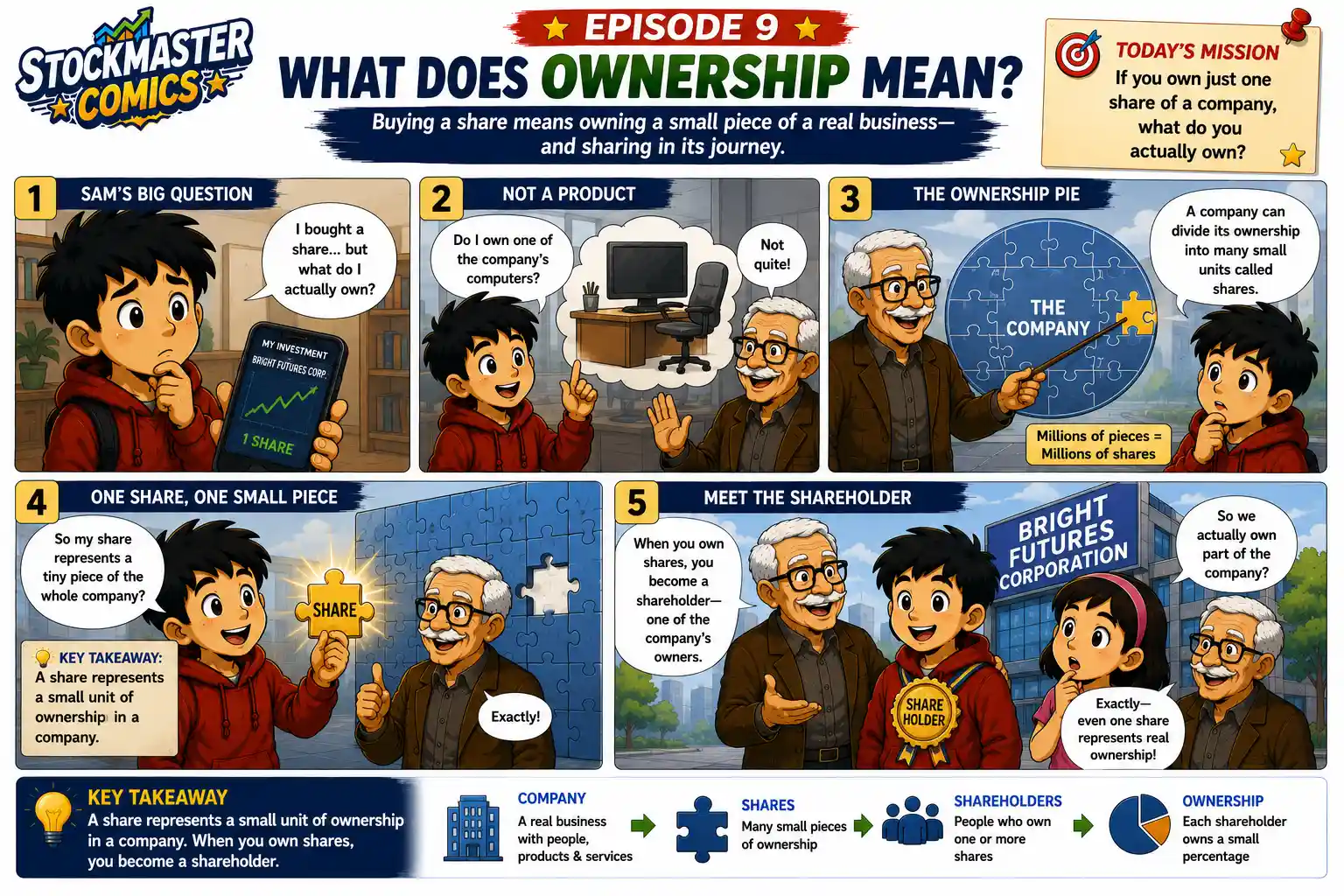
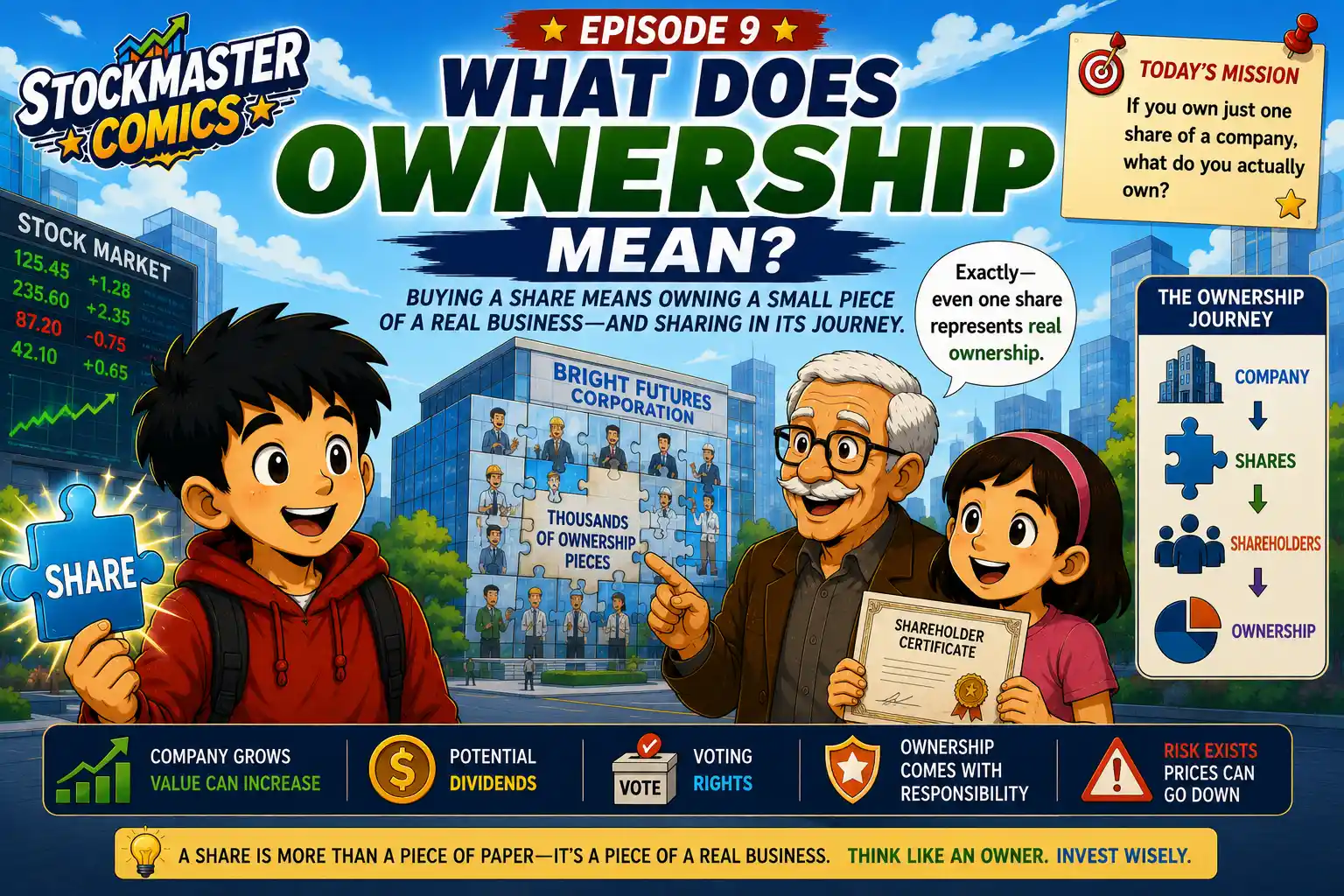
StockMaster Comics Episode 9 What Does Ownership Mean, explaining how buying a share gives an investor partial ownership in a real company.

Introduction

In the previous episodes, Sam discovered the stock market and learned how people can buy shares of publicly traded companies. But buying a share raises an important question: What does ownership really mean?

Imagine a huge company with thousands of employees, factories, offices, products, customers, and valuable ideas. You probably cannot buy the entire company. However, a publicly traded company can divide its ownership into millions—or even billions—of smaller units called shares.

When you buy one of those shares, you become a shareholder. That means you own a very small percentage of the company.

But owning shares does not mean you can walk into the company’s office and take home a computer, chair, or delivery truck. Your ownership is financial. Your investment represents a claim on a portion of the company and its future economic success.

If the business grows, becomes more profitable, and investors believe its future is bright, the value of its shares may rise. Some companies may also share part of their profits with shareholders through dividends. However, ownership also involves risk. If the business struggles, the share price may fall.

Shareholders may also receive certain rights. Depending on the type of shares they own, they may be able to vote on important company matters, such as electing members of the board of directors.

In this episode, Sam and Maya will discover that buying a share is more than watching a number move on a screen. Behind every stock is a real business, and behind every share is a small piece of ownership.

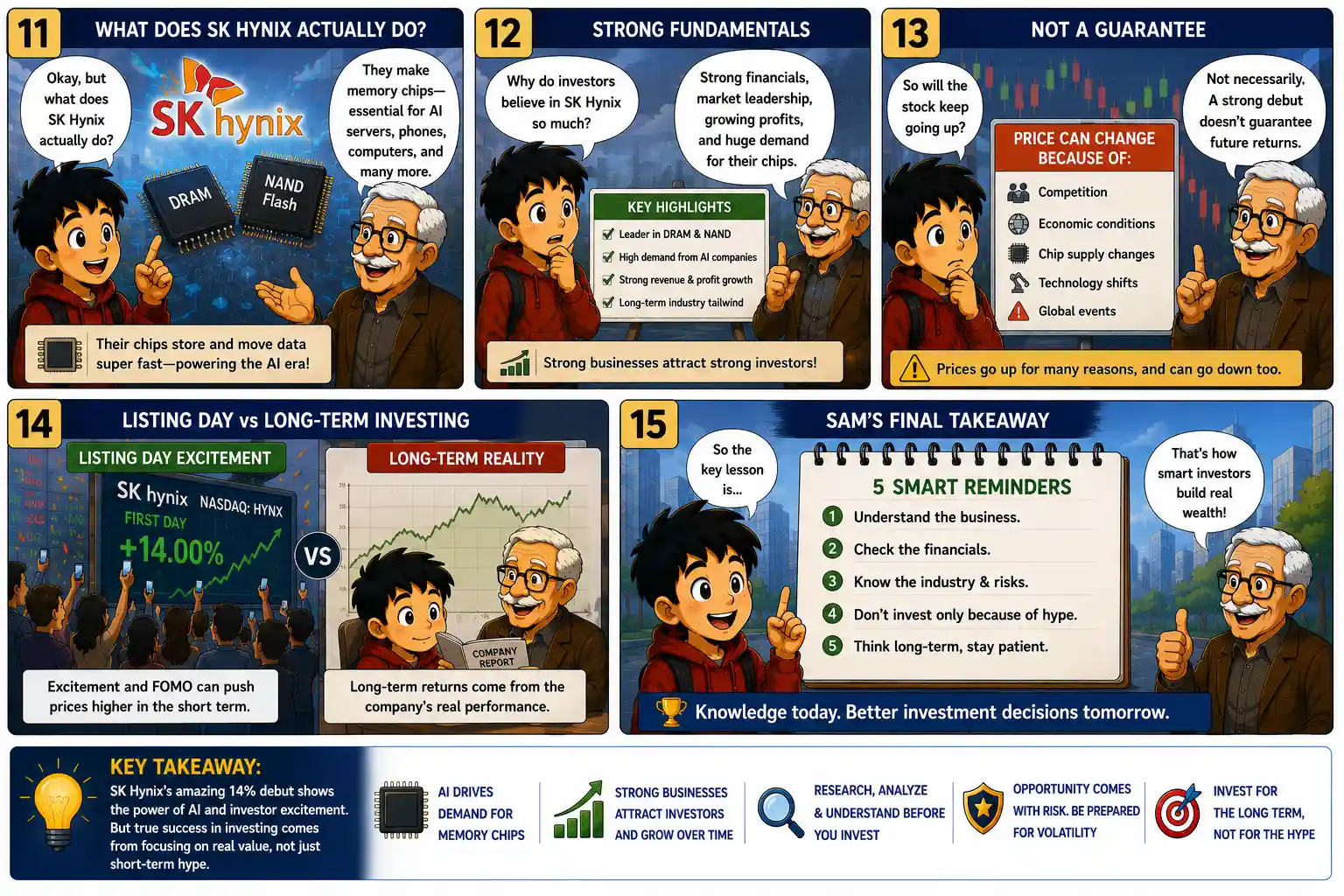
StockMaster Comics Episode 9 panels 1 to 5 explaining shares, company ownership, and how owning stock makes an investor a shareholder. StockMaster Comics panels 6 to 10 explaining investor excitement around SK Hynix, AI memory chip demand, IPO hype, investment risks, and smart stock research. StockMaster Comics panels 11 to 15 explaining SK Hynix memory chips, company fundamentals, stock price risks, long-term investing, and five smart investor reminders.

Lesson Summary

What Does It Mean to Own a Share?

A share is a small unit of ownership in a company. When a publicly traded company divides its ownership into shares, investors can buy and sell those shares through the stock market. If you buy shares, you become a shareholder. The percentage of the company you own depends on how many shares you hold compared with the total number of shares outstanding. For example, imagine a small company divided into 1,000 equal shares. If you own 10 shares, you own 1% of the company. Large public companies may have millions or billions of shares, so an individual investor may own only a tiny percentage. This ownership is financial. A shareholder does not personally own a specific company building, computer, machine, or product. Instead, the shares represent an ownership interest in the company as a whole. This is why smart investors look beyond stock prices. A stock is not simply a number moving up and down on a screen. Behind that number is a real business with employees, customers, products, assets, competitors, opportunities, and risks.

What Can Shareholders Gain From Ownership?

Shareholders invest because they hope the company will become more valuable over time. If a business grows its sales, profits, products, and market position, investors may become willing to pay more for its shares. This can increase the value of an investor’s holdings. However, share prices are never guaranteed to rise. Some companies also pay dividends. A dividend is a distribution that a company may make to shareholders, often from its profits. Not every company pays dividends, and dividends can be reduced or stopped. Depending on the type of shares, shareholders may also receive voting rights. These can allow investors to vote on certain corporate matters, such as electing directors. The exact rights attached to shares can vary. This is why investors should understand what they are buying. Ownership can provide opportunities, but it also brings risk. If the company performs poorly, faces serious competition, loses customers, or experiences financial problems, its share price may fall. In extreme cases, investors can lose most or all of the money they invested.

Why Smart Investors Think Like Business Owners

One of the most powerful investing habits is learning to think like an owner. A gambler may buy a stock simply because its price is rising or because someone online says it will become the “next big thing.” A thoughtful investor asks deeper questions. What does the company actually do? How does it make money? Are customers buying its products? Does it have strong competitors? Is the business financially healthy? What risks could affect its future? Thinking like an owner changes the way you view the stock market. Instead of seeing stocks as flashing prices, you begin seeing businesses. This does not mean every good company will automatically be a good investment at any price. Investors must also consider valuation, risk, diversification, and their own financial goals. The central lesson is simple: when you buy a share, you are buying an ownership interest in a real business. Understanding that idea can help you become more patient, thoughtful, and responsible when making investment decisions.

Key Takeaways

  • A share represents a small unit of ownership in a company.
  • A person who owns shares is called a shareholder.
  • Shareholders may benefit if a company grows and becomes more valuable.
  • Some companies may pay dividends to shareholders.
  • Some shares provide voting rights.
  • Ownership also involves risk, and share prices can fall.
  • Smart investors research the business and think like long-term owners.

Vocabulary

Share: A unit representing partial ownership in a company.

Shareholder: A person or organisation that owns one or more shares of a company.

Ownership: Having an economic interest in a business through shares.

Dividend: A payment or distribution that a company may make to its shareholders.

Voting Rights: The ability of eligible shareholders to vote on certain company decisions.

Smart Investor Tip

Never buy a stock only because its price is moving up. Ask yourself: “Would I be comfortable owning a small piece of this business?” Learn about the company, understand the risks, and invest responsibly.

Next Episode Preview

Episode 10 – The Factory That Became a Fortune

How can a small factory grow into a valuable business—and create wealth for its owners and shareholders? Follow the journey from machines and products to profits, expansion, and long-term value creation.

Coming Next: Discover how a real business can turn hard work, growth, and reinvestment into a fortune.

Scroll to Top